Key takeaways
- Shopping for a toy kitchen set sounds simple until the boxes arrive. Some are molded plastic units that arrive nearly assembled and fit into a corner.
Shopping for a toy kitchen set sounds simple until the boxes arrive. Some are molded plastic units that arrive nearly assembled and fit into a corner of a playroom. Others are wooden cabinets with a working-looking oven door, a sink basin, and enough counter space to shape an entire imaginary restaurant. The real question is which format suits the child, the room, and the person who will be putting it together on a Friday night. A kitchen for a three-year-old who mainly stirs and pours has different needs than one for a six-year-old who runs a pretend bakery.
This guide is written for parents, grandparents, and gift buyers who want to compare the main styles of kids’ kitchens in 2026 without wading through marketing copy. Every pick below is judged only on what the product titles state: the material, the lights and sounds, the accessory counts, the size notes, and the layout features such as a sink, oven, or coffee maker. Use it to decide on a format first, then narrow down by space, storage, and how much pretend-play gear comes in the box.
Quick Picks
Our top picks


As an Amazon Associate we earn from qualifying purchases at no extra cost to you.
| Product | Best for | Key spec taken from the product title |
|---|---|---|
| Step2 Fun with Friends | Families who want built-in storage | Lights and sounds, 25-piece accessory set, ample storage |
| DRAMATION 27.1 in Play Kitchen | Mixed-age siblings | 27.1 inches, sound and light, stove and sink |
| TOUCH US Wooden Play Kitchen | Wood-look playrooms | Wooden build, light, sink, oven and microwave |
| Step2 Best Chefs | Smaller rooms | Compact design, lights and sounds, 25 accessories |
| Wooden Play Kitchen with Coffee Maker | Detailed role play | Stove, sink, oven, coffee maker, ice maker, cabinets, 15 accessories |
| Tiny Land Wooden Chef Kitchen | Growing kids | Adjustable height, lights and sounds, 18 pieces of food and cookware |
How to Choose
Measure the space and think about height
Before comparing features, tape out the footprint on the floor. A kitchen listed at 27.1 inches wide, like the DRAMATION unit, is easier to fit along a wall than a wide wooden cabinet with a coffee station. Height matters just as much. Fixed counters work for a narrow age window, while an adjustable-height unit such as the Tiny Land kitchen can follow a child from toddler years into the early school years. As a rough guide, a child’s elbow should land near the counter edge so pouring and stirring feel natural.
Choose between plastic and wood
Plastic kitchens, including both Step2 models, tend to be lighter, easier to wipe, and quicker to assemble. Wooden kitchens, such as the TOUCH US and the model with the coffee maker, usually look more like furniture and can feel more solid when a child leans on a counter. Wood often means more assembly steps and a heavier box, so confirm that you have help and tools. If the kitchen will live in a living room, finish and styling can matter as much as durability. Either way, look at the weight of the shipping box in the product details if you have stairs to climb.
Count the accessories and the extras
Accessory counts vary widely: 25 pieces with the Step2 sets, 18 pieces of food and cookware with Tiny Land, and 15 accessories with the wooden coffee-maker kitchen. A higher count does not automatically mean better play, because many pieces are small food items. Look for pots, pans, utensils, and a mix of food types, and ignore piece counts padded with tiny props. Also watch for batteries: titles mentioning lights and sounds almost always rely on them.
Where budget models cut corners
Budget kits often trade away storage, sturdy hinges, and tip resistance. Look for a wide base, soft-closing or simple doors without pinch points, and rounded edges. Be cautious with listings that bundle many tiny accessories but offer a thin frame. A mid-range unit with fewer extras but a stable build tends to survive more years of play than a flashy kit with dozens of props and a wobbly stove. Also pay attention to how the oven door and knobs are attached, since those parts take the most repeated handling.
The 6 Best Options
Step2 Fun with Friends Kitchen
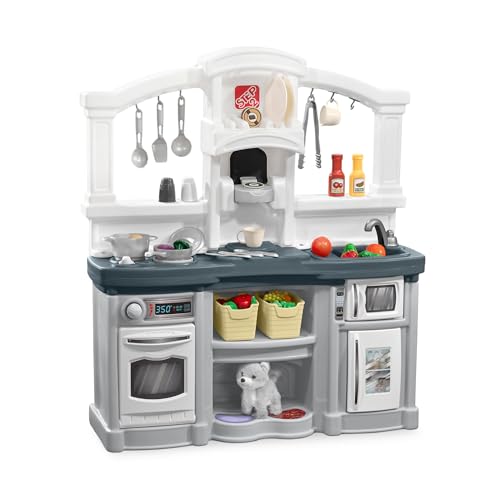
This gray plastic kitchen is aimed at families who want a full-featured unit that also keeps toys tidy. The title highlights interactive lights, cooking sounds, a 25-piece accessory set, and ample storage, which together suggest a role-play station that cleans up well. For a household where toys tend to migrate across every room, a kitchen that doubles as a storage point can be the difference between a tidy corner and a daily scavenger hunt.
- Strength: The 25-piece accessory set gives a child something to cook with immediately.
- Strength: Ample storage means pots and food can be put away after play.
- Trade-off: Lights and sounds typically use batteries, so spare ones are worth having.
Skip it if you want a wood-look piece for a styled living room.
DRAMATION 27.1 In Play Kitchen
The listed 27.1 inches makes this a manageable size for most playrooms, and the title promises sound, light, a cooking stove, and a sink. The age wording spans 3-5 and 6-8, so it is marketed to a wide range of kids. That broad framing makes it a reasonable shared gift for siblings, though the exact fit depends on how tall each child is.
- Strength: A defined size makes it simple to check against your available wall space.
- Strength: Stove and sink cover the core steps of pretend cooking.
- Trade-off: The size is modest, so older kids may outgrow the counter height sooner.
Skip it if you need a larger counter or adjustable height for a child still growing quickly.
TOUCH US Wooden Play Kitchen
A wooden build with light, a sink, an oven, and a microwave makes this the most appliance-heavy of the simpler wood options. It targets children aged 3 and up who enjoy stations to move between. A child can bake at the oven, reheat at the microwave, and wash up at the sink in one continuous game, which keeps longer pretend sessions going.
- Strength: The wood construction offers a more furniture-like look.
- Strength: Oven and microwave expand the range of cooking games.
- Trade-off: Wooden kits generally require more assembly time than plastic ones.
Skip it if you prefer a lightweight kitchen that is easy to wipe down and move.
Step2 Best Chefs Kitchen
The compact design in the title is the main selling point here. It still lists lights and sounds along with 25 accessories, which makes it a smaller cousin to the Fun with Friends model for tighter rooms. It is the sensible choice when you like the Step2 feature list but want it in a smaller package that can slide next to a bookcase.
- Strength: The compact footprint suits apartments and shared bedrooms.
- Strength: The same 25-accessory count offers plenty of starter play pieces.
- Trade-off: A smaller body usually means less counter and storage space.
Skip it if you want a big multi-station layout with room for several kids.
Wooden Play Kitchen with Coffee Maker and Ice Maker
This wooden unit packs a stove, sink, oven, coffee maker, ice maker, and cabinets, plus 15 accessories. It is built for imaginative kids who like to act out a full morning routine or a café. Children who love to serve visitors drinks and snacks tend to get the most variety from a layout like this one.
- Strength: The coffee and ice stations bring more variety to role play.
- Strength: Cabinets add some storage for the 15 included pieces.
- Trade-off: More features usually mean a larger footprint and a longer assembly session.
Skip it if floor space is tight or you want the simplest setup possible.
Tiny Land Wooden Chef Kitchen
Tiny Land stands out for its adjustable height, which lets the counter match a child’s growth. It also lists real lights and sounds plus 18 pieces of toy food and cookware, so it plays well from the first day. Parents who dislike replacing outgrown toys every year will appreciate a design that is meant to change height as the child changes.
- Strength: Adjustable height extends the useful life of the kitchen.
- Strength: The wooden chef design with lights and sounds adds realistic feedback.
- Trade-off: Height adjustment adds a step to setup and may need occasional rechecking.
Skip it if you want a small, fixed-height kitchen for a toddler only.
Which One Fits Your Situation
A small apartment or shared bedroom
The Step2 Best Chefs fits best here. Its compact design and 25 accessories give you the play value without taking over the room, and the plastic build is easy to wipe when snack time overlaps with play.
A toddler who will keep using it for years
Tiny Land makes sense because the adjustable height helps it grow with a child, and the wooden build handles the longer horizon. It is also easier to justify for a gift that is expected to stay in the family room for several years.
A family that needs toy storage built in
Go with Step2 Fun with Friends. The title’s ample storage and 25-piece accessory set mean pots, pans, and food have a home after cleanup.
A child who loves detailed role play
The wooden kitchen with the coffee maker and ice maker gives the most scenario variety, from morning coffee to a pretend café counter. The DRAMATION kitchen is a fair alternative if the child is a little older and you want a mid-range unit, because it offers a stove, sink, and sound and light in a size that is easy to place.
Common Mistakes
- Buying on accessory count alone and ending up with piles of tiny pieces and a wobbly frame.
- Skipping a floor-space check, then discovering a wide wooden unit blocks a doorway.
- Ignoring height, so the counter is too low or too high for the child within a year, which turns pretend cooking into a stretch or a stoop.
- Forgetting batteries for lights and sounds, which leaves the kitchen silent on the first day.
- Underestimating assembly time for wooden kits, which often take longer than plastic ones.
Assembly and Care Tips
A toy kitchen is a large piece of furniture from a child’s point of view, so the first hour matters as much as the purchase. Most units ship flat, with panels, hinges, a bag of fasteners, and a sheet of stickers or printed instructions. Clear a floor area before opening the box, sort the hardware into a bowl, and keep the manual open to the exploded diagram rather than relying on memory.
- Tighten twice. Snug every screw during assembly, then go around again a week later. Wooden frames settle, and a loose side panel is the usual reason a kitchen wobbles when a child leans on the counter.
- Keep it against a wall. Tall units with a hood or shelf on top can tip if a child climbs the oven door. Many wooden sets include a wall strap or anchor; use it when one is supplied.
- Wipe, do not soak. Molded plastic handles a damp cloth with mild soap. Wood prefers a barely damp cloth followed by a dry one, since standing moisture can lift paint and swell joints.
- Reattach stickers carefully. Burner and knob decals tend to peel at the edges. Press them flat with a clean, dry cloth and avoid scrubbing over them.
- Rotate the accessories. A small bin of pots, plastic food, and utensils kept beside the kitchen, rather than inside every cabinet, cuts down on lost pieces.
Safety Checks Before You Order
- Look for a statement that the toy meets the US toy safety standard, ASTM F963, on the listing or the box.
- Check the recommended age range and whether small parts, such as play food or knobs, are meant for a child who still mouths objects.
- Confirm which parts are real wood and which are engineered board, and look for a finish described as water-based or non-toxic.
- Read the battery notes. Sets with lights and sounds use batteries, and the compartment should close with a screw.
- Measure the doorway and stairs if the box is large, because the packaged carton can be bulkier than the finished kitchen.
Who Should Skip a Toy Kitchen Set
A full kitchen is not the right gift for every child. If floor space is truly scarce and storage is tight, a tabletop cooking set or a few pots and a play food basket can deliver most of the same pretend play without a permanent footprint. Families whose child is still under the age printed on the carton should wait, since the smaller accessories are designed for older hands. Anyone who dislikes assembly may also hesitate: a large wooden unit can mean a long build with many identical-looking screws. Finally, if the real aim is cooking with an adult, a sturdy step stool at the real counter may suit better than any toy.
Related guides
- Cordless Vacuum For Hardwood Floors In Apartments
- Black Friday Cyber Monday Health Equipment Deals
- Stain Remover For Set In Stains On Clothes
Frequently Asked Questions
What age is a toy kitchen good for?
Most listings start around age 3, and several mention ranges up to 8. Younger children enjoy simple pouring and stirring, while older ones move into more elaborate scenarios. Check the age wording in each title and the size of small parts.
Is wood better than plastic?
Neither is automatically better. Wood tends to look better and feel sturdier, while plastic is lighter, easier to wipe, and faster to assemble. Choose by room style and how much effort you want to spend on setup. Families with very young children who spill often may lean toward the wipe-clean plastic ones.
Do lights and sounds need batteries?
Titles that mention lights and sounds usually rely on batteries, though the specific type is not stated in the listings here. Keep spares on hand so the feature works on day one.
How many accessories do I really need?
A starter set of 15 to 25 pieces is plenty if it includes pots, pans, utensils, and food. Extra tiny props add clutter more than play value, so focus on variety over quantity.