Key takeaways
- Clamp the work. Use the saw’s clamp or a hold-down so material cannot shift. Follow the manual for cutting small pieces safely.
- Let the blade reach full speed. Start the cut after the blade is up to speed and release the trigger, letting the blade stop before lifting.
- Use the right blade. Blades with a higher tooth count give smoother finish cuts. Use a blade suited to the material.
- Wear protection. Safety glasses, hearing protection, and a dust mask or respirator.
- Support long boards. Use stands or extensions so the board does not tip.
- Keep hands clear. Follow the manual’s keep-out zone around the blade.
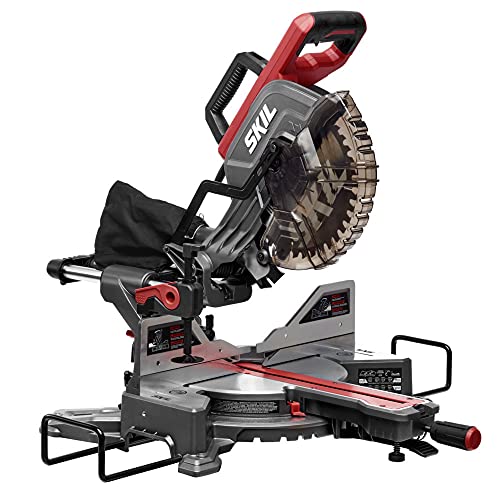
For most workshops and job sites, a 12-inch dual-bevel sliding compound miter saw such as the DeWalt DWS780, Bosch GCM12SD Glide, or Milwaukee 6955-20 is the best all-around buy; a 10-inch sliding model like the Makita LS1019L fits smaller shops and lighter trim work; and a cordless 18V or FlexVolt model suits finish carpenters who value portability. The right saw depends on how wide your boards are, how big your shop is, and whether you want to run a cord.
Our top picks


As an Amazon Associate we earn from qualifying purchases at no extra cost to you.
Sliding Miter Saws at a Glance
| Model | Blade | Best for | Maker-stated highlights | Limits |
|---|---|---|---|---|
| DeWalt DWS780 | 12-inch | General carpentry, framing, trim, crown on a stand | The maker lists a dual-bevel sliding design, an XPS LED cutline system, and a large cross-cut capacity | Heavy, needs room behind for rail travel unless the rails are adjusted |
| Bosch GCM12SD Axial-Glide | 12-inch | Shops with limited wall space | The maker lists an axial-glide arm that replaces sliding rails to save depth | Heavy and premium-tier |
| Milwaukee 6955-20 | 12-inch | Job sites with dust-collection needs | The maker lists a dual-bevel sliding saw with a large cross-cut and a dust management design | Large and heavy for transport |
| Makita LS1019L | 10-inch | Smaller shops, trim, and mobile carpentry | The maker lists a dual-bevel sliding design with laser guide and compact footprint | Lower cut capacity than 12-inch saws |
| Cordless sliding saws (Milwaukee M18 FUEL, DeWalt FlexVolt, Makita 18V X2) | 10- or 12-inch | Remote sites, finish work, no cord management | Makers list battery power with capacities close to corded in some models | Battery cost and weight; runtime depends on pack |
What to Look For
Blade size and cut capacity
Twelve-inch saws cut wider boards: many models list a crosscut capacity in the neighborhood of twelve inches on dimensional lumber, and wider on flat stock. Ten-inch saws are lighter and cost less, but their cut width is smaller. Check the maker’s stated crosscut width, the maximum height at fence, and the miter and bevel ranges. Capacity for nested crown molding is a separate spec, so read it if you install trim.
Sliding mechanism: rails or glide arm
Traditional sliding saws use rails that extend behind the saw. They are durable and well known but need space behind. Bosch’s axial-glide design uses a hinged arm to cut the depth needed. Reviewers often praise the smooth action of the glide arm and its compact footprint, though a rail system is simpler to service. Whichever you pick, any slop in the sliding action will show up as inaccuracy over time.
Dual bevel vs single bevel
Dual-bevel saws tilt both left and right, so you can cut compound angles without flipping the workpiece. That makes crown and large trim work faster. Single-bevel models are usually cheaper but need you to flip pieces. Most buyers who do trim work find dual-bevel worth the step up.
Accuracy and adjustability
Miter detents, a fence that stays square, and reliable bevel stops are all central to accuracy. Reviewers commonly comment on how well each saw holds its settings out of the box and how easy fine adjustments are. Plan on checking the fence for squareness and setting the blade to square after transport, following the manual.
Dust collection
Miter saws are famously messy. Many saws ship with a dust bag that captures only a portion of the debris. Connecting a shop vacuum or dust extractor to the dust port improves capture, and some saws list compatibility with specific systems. Dust collection is particularly relevant if you cut MDF, treated lumber, or composites; wear a suitable respirator as the manual advises.
Lights and lasers
LED shadow lines, such as the XPS system on DeWalt, and laser guides help align the blade to the cut mark. They are convenient but should be calibrated and are not a substitute for careful marking.
Weight and stand
Twelve-inch sliding saws are heavy, often weighing on the order of fifty pounds or more, so a stand or mobile base makes sense. Smaller 10-inch saws and cordless models are easier to move around.
Top Picks by Need
DeWalt DWS780: best all-around for contractors
The DWS780 is a long-running 12-inch dual-bevel sliding saw. DeWalt lists features including the XPS cutline light and a large crosscut capacity. Reviewers commonly choose it as a benchmark for job-site and shop use because of its balance of capacity and accuracy. It is premium to mid-range priced, and, like other rail saws, it needs space behind.
Bosch GCM12SD Axial-Glide: best for tight shops
Bosch’s glide arm moves the pivot instead of using rails, so the saw can sit close to a wall. The maker markets it as compact and accurate, and many reviewers describe the smooth action. It tends to be one of the pricier options and is heavy, so it suits a shop with a fixed or mobile stand.
Milwaukee 6955-20: best for dust management and job-site use
Milwaukee positions this 12-inch dual-bevel sliding saw for professionals who want good dust handling and strong cut capacity. Reviewers note its size and weight, which are the tradeoff for the capacity. It makes sense for those already buying into Milwaukee tools.
Makita LS1019L: best 10-inch option
Makita’s 10-inch dual-bevel sliding model is smaller than the 12-inch saws, which makes it easier to handle and store. It suits trim carpenters and DIYers who rarely cut wide boards. The tradeoff is cut width.
Cordless sliding saws: best for portability
Milwaukee’s M18 FUEL, DeWalt’s FlexVolt, and Makita’s 18V X2 sliding saws let you cut without dragging a cord. They are popular for finish work on remote sites. Expect to buy larger or multiple batteries for heavy use; check battery compatibility with the rest of your tools before choosing.
Pick X If… Decision Table
| Pick this | If you |
|---|---|
| 12-inch dual-bevel (DWS780, Milwaukee 6955-20) | Cut wide boards, crown, and framing, and want one saw to cover most tasks |
| Axial-glide (Bosch GCM12SD) | Have limited bench depth and want a smooth action |
| 10-inch sliding (Makita LS1019L) | Do mostly trim and small stock, and want lighter weight |
| Cordless sliding saw | Work away from outlets or want less cord clutter |
| Budget-tier sliding saw | Make occasional cuts for DIY projects and accept less precision |
Setup and Safety Notes
- Clamp the work. Use the saw’s clamp or a hold-down so material cannot shift. Follow the manual for cutting small pieces safely.
- Let the blade reach full speed. Start the cut after the blade is up to speed and release the trigger, letting the blade stop before lifting.
- Use the right blade. Blades with a higher tooth count give smoother finish cuts. Use a blade suited to the material.
- Wear protection. Safety glasses, hearing protection, and a dust mask or respirator.
- Support long boards. Use stands or extensions so the board does not tip.
- Keep hands clear. Follow the manual’s keep-out zone around the blade.
Budget Tiers
Budget: 10-inch sliding saws from lower-cost lines, fine for occasional DIY work but with less accuracy over time. Mid-range: 12-inch sliding saws from brands such as Metabo HPT and Craftsman-branded lines, as well as some dual-bevel DeWalt and Makita models. Premium: the Bosch Glide, top-tier DeWalt and Milwaukee saws, and cordless sliding saws with large batteries.
Alternatives
- Non-sliding compound miter saw. Cheaper and lighter, suitable if you cut narrow trim and framing.
- Track saw plus miter box. Useful for sheet goods; not a replacement for repeated crosscuts.
- Circular saw with a speed square. Works for rough cuts on job sites when a miter saw is overkill.
Buying Checklist
Measure the widest board you cut and compare it with the maker’s stated crosscut capacity at 90 degrees and at 45 degrees, since capacity shrinks at angles. If you install crown molding, look for the maker’s stated crown capacity both nested and laid flat. Consider where the saw will live: a rail saw needs clearance behind it, a glide-arm saw needs less, and a cordless saw frees you from outlets but needs batteries. Think about a stand or mobile base with material supports, because long boards that hang off the saw cause both inaccurate cuts and safety problems.
Also consider the blade. Stock blades are often adequate for framing but rarely ideal for finish work, and a higher-tooth-count blade usually leaves smoother edges on trim. Reviewers often say upgrading the blade is one of the cheapest ways to improve cut quality. Finally, look at the warranty and service network the maker lists, and plan to calibrate the fence and bevel stops as soon as the saw is set up, following the manual.
Frequently Asked Questions
Is a 12-inch sliding miter saw better than a 10-inch?
A 12-inch saw typically cuts wider boards and taller stock, so it is more flexible. A 10-inch is lighter, usually cheaper, and fine for narrower material. Choose based on the widest board you cut.
Do I need a dual-bevel saw?
If you install crown or cut many compound angles, dual bevel saves time because you do not flip the board. For simple square cuts, a single-bevel model is adequate.
What is the difference between rail and glide-arm saws?
Rail saws slide on tubes that extend behind. Glide-arm saws, such as Bosch’s, use a hinged arm to save depth. Either can be accurate when well made and kept clean.
How do I keep a miter saw accurate?
Check that the fence is square, the blade is set at 0 and 90 degrees, and the sliding action has no play, following the manual. Transport and heavy use can knock settings off, so check periodically.
Can I cut metal or plastics with a miter saw?
Only with a blade and saw rated for it by the maker. Most standard wood-cutting saws are not designed for metal. Follow the manual’s guidance on materials.
Do cordless sliding miter saws have enough power?
Many reviewers find modern cordless models adequate for trim and general carpentry. Heavy production cutting may favor corded saws or larger battery packs. Read the maker’s stated capacity and runtime information.