Key takeaways
- Breaking down sheet goods: a pair with a wide top rail supports plywood without sagging. Place a sacrificial board on top so the blade never touches the horse.
- Holding a workbench top or a machine: choose the highest rating, rigid leg locks and non-skid feet. Spread the weight across both horses.
- Roofing, framing or outdoor work: folding steel is easier to carry and tolerates weather better than wood-and-plastic combinations.
- Finish carpentry and clamping: a clamping design saves reaching for extra clamps, even if capacity is lower.
- Occasional home projects: a budget folding pair or a bracket kit is usually enough.
For most buyers who want a pair of sawhorses that will not flinch under a stack of plywood or a cast-iron machine, an all-steel folding pair from BORA or ToughBuilt is the safest starting point, while a Fulton StableMate-style rigid unit suits a fixed shop and an inexpensive 2×4-bracket set suits occasional DIY. The rest of this guide explains how to read capacity ratings, which design suits which job, and where each type falls short.
Our top picks



As an Amazon Associate we earn from qualifying purchases at no extra cost to you.
Sawhorses at a Glance
| Model or type | Best for | Key stated specs | Limits |
|---|---|---|---|
| BORA Workhorse / Speedhorse (all steel, folding) | Contractors and serious home shops | Roundups report roughly 1,350 lb per unit for the Workhorse and a higher figure for the Speedhorse PM-4500T; the maker publishes the exact ratings | Fixed or limited height on some versions; check whether the rating is per unit or per pair |
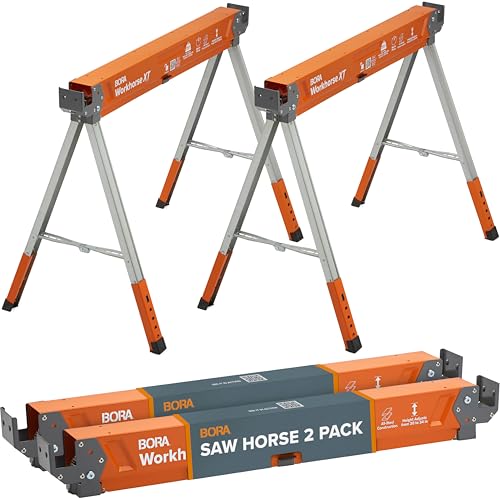
| BORA Workhorse XT (adjustable height) | Mixed jobs where height changes | Named best overall or best adjustable in several 2026 roundups | More moving parts than a fixed-height horse |
| ToughBuilt heavy-duty folding sawhorses (TB-C700 family) | Job-site use, daily folding and carrying | Powder-coated steel; Bob Vila names it best overall; the maker offers a lifetime warranty according to one roundup | Steel is heavier to carry than plastic |
| Fulton StableMate | Fixed shop use, heavy loads | Concord Carpenter lists 3,000 lb capacity, about 39 lb weight, rubber feet and leg locks | Bulkier; less convenient to transport |
| WORKESS-style steel pair | Maximum rated capacity on a tighter budget | One roundup cites 2,600 lb per pair | Rating is per pair, not per horse |
| DeWalt adjustable metal-leg sawhorse | Brand-loyal DeWalt users | Bob Vila lists it as a heavy-duty pick | Check the maker’s rating for your load |
| 2×4 bracket kits (Goplus and similar) | Budget buyers who can cut lumber | Strength depends largely on the lumber you add | Not rated for extreme loads; homemade legs can loosen |
| Clamping sawhorses (WORX) | Finish carpentry, holding a board for planing | Built-in clamping surfaces | Lower capacity than heavy steel horses |
What “Heavy Duty” Actually Means
Capacity ratings are the headline number, and they are also the most misunderstood. Some makers state the rating per sawhorse, others per pair, and a few state a combined number for a set of four. A pair rated at 2,600 lb in total is a very different tool from a single horse rated at 1,350 lb, because the second pair holds 2,700 lb in total but each leg set carries more. Always read the fine print on the maker’s own page before comparing two listings.
It is also worth remembering that a stated capacity is a static, evenly distributed load on a flat floor. A stack of drywall sheets, a doorway slab, or a fixed machine all behave more kindly than a point load or a board that gets pushed sideways with a circular saw. Reviewers consistently suggest treating the rating as a ceiling you stay well under, not a target.
Design Types and Their Trade-offs
All-steel folding horses
This is the category most 2026 roundups put on top. BORA, ToughBuilt and similar brands use steel tube legs that fold flat against a top rail, which means a pair stores behind a door or in a truck. Steel resists the denting and splitting that wood suffers, and powder coating slows rust. The trade-off is weight and, on some models, noise when a board slides on a bare metal rail. Many buyers add a strip of wood or rubber over the rail to protect work and to give a saw something to cut into.
Rigid shop horses
Units such as the Fulton StableMate are built for a fixed spot. According to Concord Carpenter, the model offers leg locks, non-skid feet and a very high rating. If your sawhorses live in one garage corner and rarely travel, the extra bulk is not a big problem and the stability is welcome.
Adjustable-height horses
Adjustable legs let one pair serve as sawhorses, a low outfeed support, or a temporary workbench at a comfortable height. The adjustment mechanism is the part to examine: look for positive locking pins or levers rather than friction-only clamps, and read the maker’s note on whether the rated capacity applies at every height. Reviewers generally find the tallest settings the least stable.
Bracket kits
A 2×4 bracket kit gives you metal connectors; you supply the lumber. It is the budget route and a good one for light-duty cutting, painting and general chores. Strength depends on lumber quality and the screws or bolts used, so follow the maker’s instructions and inspect joints regularly.
Plastic and resin horses
Molded sawhorses are light and stack well. They are usually rated far below steel, so they are better for painting or trim than for lifting a heavy workbench top.
Matching a Sawhorse to the Job
- Breaking down sheet goods: a pair with a wide top rail supports plywood without sagging. Place a sacrificial board on top so the blade never touches the horse.
- Holding a workbench top or a machine: choose the highest rating, rigid leg locks and non-skid feet. Spread the weight across both horses.
- Roofing, framing or outdoor work: folding steel is easier to carry and tolerates weather better than wood-and-plastic combinations.
- Finish carpentry and clamping: a clamping design saves reaching for extra clamps, even if capacity is lower.
- Occasional home projects: a budget folding pair or a bracket kit is usually enough.
Safety and Care Notes
- Set horses on firm, level ground, and fully engage every lock before loading.
- Never stand on a sawhorse unless the maker explicitly states it is rated for that use, and even then follow its instructions on load and placement.
- Support long boards at both ends and avoid cantilevering heavy material.
- Wipe steel dry after rain and touch up chipped coating to slow rust. Keep folding hinges free of grit.
- Retire any horse with bent legs, cracked welds or loose rivets; do not straighten and reuse.
Budget Tiers
At the budget tier, bracket kits and light folding pairs handle cutting and painting, and they cost the least. Mid-range buyers get the best balance of steel construction, a respectable rating and a folding design, with names such as ToughBuilt and the simpler BORA models appearing here. Premium buys add adjustable height, very high ratings, better locks and longer warranties, as with the BORA Workhorse XT and the Fulton StableMate. Spending more only makes sense if you will actually load the horses near their limit or move them daily.
Pick X If… Decision Table
| Pick this | If you… |
|---|---|
| BORA Workhorse or Speedhorse | want fast setup, a compact fold and a high stated capacity |
| BORA Workhorse XT | need one pair to serve several heights |
| ToughBuilt folding pair | carry horses to job sites and value a lifetime warranty |
| Fulton StableMate | keep horses in one shop and prioritize rigidity and capacity |
| WORKESS-style pair | want a high pair rating without paying for the top brands |
| 2×4 bracket kit | do occasional DIY and are comfortable cutting lumber |
| WORX clamping horse | do detailed carpentry that benefits from built-in clamping |
Alternatives to Consider
- Folding work supports with roller or ball-top attachments: better when you feed long stock through a table saw or miter saw.
- Portable workbenches: a folding bench with a vise may replace a pair of horses if you mostly cut small pieces.
- Adjustable material stands: a single-leg stand suits supporting one side of a long board.
Frequently Asked Questions
Are capacity ratings per sawhorse or per pair?
It varies by maker, which is why comparison shopping is tricky. Read the product page carefully, because a figure listed for a pair is roughly half what each horse carries on its own. If a listing is unclear, look at the maker’s manual before buying.
Are steel sawhorses better than wood?
Steel folds flat, resists splitting and holds its shape, which is why roundups favor it for heavy-duty use. Wood and bracket systems are cheaper and easier to modify, but their strength depends on your lumber and joinery. Both can be reliable if you stay within limits.
Can I use sawhorses as a workbench?
Yes, many people lay a sheet of plywood or a solid-core door across two horses. Fasten or clamp the top so it cannot slide, and keep the combined load within the maker’s rating. Adjustable-height models are particularly handy for this.
How do I stop a saw from damaging the top rail?
Lay a sacrificial board, a strip of scrap lumber or a foam insulation panel across the rail before cutting. This protects both the blade and the sawhorse. Many users keep a dedicated cutting strip clamped in place.
How should I store folding sawhorses?
Store them dry and folded, preferably off a damp concrete floor. Wipe off sawdust and moisture and lightly lubricate hinges if the maker’s manual suggests it. Dry storage slows rust on coated steel.
Is an adjustable sawhorse less stable?
It can be at full extension, since longer legs have more leverage to rock or twist. Use positive locks, keep the load centered and use a lower setting when you can. Check the maker’s guidance on capacity at each height.