Key takeaways
- Find the best ladder levelers for uneven ground: bolt-on legs and pitch-hopper platforms compared by fit, adjustment range and safe use on slopes.
The best ladder leveler for uneven ground is the Levelok KeyLok quick-connect kit if you climb often and want legs that adjust in small steps, with the Xtenda-Leg rubber-foot pair as the proven bolt-on choice for firm ground. A ladder leveler is a device that makes one side of a ladder longer or shorter, or props one rail on a step-shaped platform, so both rails sit level when the ground slopes or you are working on stairs. Occasional users on steps or a sloped yard can get by with a pitch-hopper style platform instead.
Quick List
- VEVOR Pitch Hopper Leveler – best for stairs and quick, tool-free setup
- Xtenda-Leg Ladder Leveler Pair – best for firm, uneven ground with an extension ladder
- Roof Leveler Platform Tool – best for a light platform that doubles as a rest on slopes
- Levelok KeyLok Quick-Connect Kit – best overall for frequent users who want fine adjustment
- Pitch Hopper Leveler With Storage – best for stairs and extension ladders with a built-in compartment
- KARRYTON Adjustable Ladder Levelers – best for a threaded, anti-slip bolt-on pair
Which One Is Right for You?
| If you… | Choose |
|---|---|
| climb several times a month and want quick on-off legs | Levelok KeyLok Quick-Connect Kit |
| work from an extension ladder on hard, uneven ground | Xtenda-Leg Ladder Leveler Pair |
| need to level a ladder on a staircase landing | VEVOR Pitch Hopper Leveler |
| want a platform that also stores small items | Pitch Hopper Leveler With Storage |
| prefer a permanently fitted pair with anti-slip feet | KARRYTON Adjustable Ladder Levelers |
| need a simple platform for sloped ground or a roof edge | Roof Leveler Platform Tool |
The split in this list is simple: bolt-on leg levelers (Levelok, Xtenda-Leg, KARRYTON) become part of the ladder and give you real adjustment, while pitch-hopper platforms (VEVOR, the storage model and the roof tool) are portable pieces you set under a rail. Pick the style first, then the brand. Neither type replaces correct ladder angle, a stable surface and a second person when the job calls for one.
All 6 Picks in Detail
1. VEVOR Pitch Hopper Leveler – Best for Stairs and Tool-Free Setup
As an Amazon Associate we earn from qualifying purchases at no extra cost to you.

This VEVOR piece is a polypropylene (PP) pitch hopper, a step-shaped platform that the ladder foot rests on instead of the ground. The listing rates it for a 380-pound load and describes it as a stair ladder stabilizer with storage for a stable platform on any surface. It is the type of tool you keep in the truck, drop under a rail at the base of a staircase and climb the same day without drilling anything into your ladder.
Where it earns its keep is the staircase. A bolt-on leg can only extend so far and cannot sit on a step edge, but a platform can bridge the gap between a tread and the ground. Because this one is plastic, it is also light enough to carry up a flight of steps, and it will not scratch a finished floor the way a steel foot might. The tradeoff is that you are relying on a single molded piece to carry the corner load of the ladder, so inspect it for cracks before every job and keep the combined weight of you and your tools below the stated rating.
- Pitch hopper style platform made from PP
- 380-pound load rating according to the listing
- Designed for stairs and extension ladders
- Includes a storage feature per the listing name
- Exact height steps and platform size: confirm on listing
Pros:
- No installation, so it moves between ladders in seconds
- Useful on stairs where leg levelers cannot reach
Cons:
- Load rating is lower than a typical heavy-duty ladder plus tools, so check your total weight
- Plastic construction is lighter but less rugged than steel
Against the other pitch hopper here, it is the one with a stated weight rating, which makes it easier to judge before buying.
2. Xtenda-Leg Ladder Leveler Pair – Best for Firm Uneven Ground

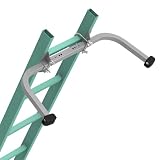
The Xtenda-Leg is a long-running bolt-on leg leveler sold as a pair with rubber feet. The manufacturer describes it for Type II, I and IA extension ladders up to 32 feet, with zinc-plated steel shafts and rubber feet that swivel to sit flat on a slope. You push down on the lock plates, set the ladder level and release, which is why it appeals to painters and window cleaners who reposition often.
One of the practical benefits of this pair is that replacement parts exist for the feet, so a worn pad does not mean replacing the whole leveler. The legs are mounted through the rail and lock with a spring plate, so adjusting them mid-job means stepping off, pressing the plate and resetting the length. Painters who move a ladder every few minutes tend to appreciate that rhythm. Remember that the swiveling rubber feet are described as a firm-surface design, so on grass or gravel you would want a cleated foot instead.
- Sold as one pair for both rails
- Fits Type II, I and IA extension ladders up to 32 feet per the manufacturer
- Steel shafts with a zinc-plated finish
- Swiveling rubber feet for firm surfaces
- Lock plates release with a downward push
Pros:
- Proven, widely used design with replaceable feet available separately
- Foot pivots to meet sloped ground
Cons:
- Rubber-foot version is meant for firm surfaces, not slick or loose ones
- Drilled hardware means the levelers stay on the ladder
Compared with the Levelok kit, it is less quick to remove, but the swiveling foot is easier to match to a slope.
3. Roof Leveler Platform Tool – Best for Sloped Ground Without Hardware

This listing uses the keywords roof leveler tool, ladder stabilizer and stable platform for uneven surfaces, which puts it in the same family as a pitch hopper. It is not a bolt-on leg, so you place it under the ladder foot and set the rail on top. The listing title does not give a weight rating, material or height range, so treat the claims cautiously and confirm those details on the product page before using it for anything but light work.
Because the title lists a handful of search phrases rather than hard specs, the safest way to think about this item is as a light-duty helper. It may suit a short step-ladder task on a gentle slope, or serve as a second platform in the garage, but it is hard to recommend for tall extension work until you have confirmed the rated load and the height of the step on the listing. If the product page does not state a capacity, move up to a model that does.
- Platform style leveler for one ladder foot
- Marketed for roofs and uneven surfaces
- No installation hardware implied by the listing
- Weight rating: confirm on listing
- Material and dimensions: confirm on listing
Pros:
- Portable and tool-free to place
- Useful as a spare for occasional jobs
Cons:
- Few stated specifications in the listing name
- A single platform levels one rail only, so footing on the other side still matters
Next to the VEVOR hopper, it is the less documented option, so choose the VEVOR if a stated load rating matters to you.
4. Levelok KeyLok Quick-Connect Kit – Best Overall
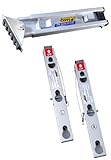
Levelok’s KeyLok kit uses base units that bolt to the ladder once, while the leveling legs click on and off as needed. According to the manufacturer, the leg extends up to 10 inches in 3/16-inch increments, and the system is designed for extension, articulating, straight, combination and step ladders up to a 375-pound duty rating. The quick-connect design means you carry the legs only when you need them, which is why it takes the top spot.
A good way to picture the KeyLok system is as a permanent socket with removable legs. The base units stay bolted to the rails and add little weight, and the leg clicks in when the ground is uneven and comes out when it is not. That makes it friendlier for people who transport a ladder on a rack or in a van, since the legs do not stick out. It also fits more than just extension ladders: the manufacturer lists articulating, straight, combination and step ladders as compatible types.
- Base units remain on the ladder; legs quick-connect
- Up to 10 inches of extension in 3/16-inch steps per the manufacturer
- Hardware sized for ladder rails 1/2 inch thick or less
- Kit includes two base units and a quick-connect leveler per the manufacturer
- Manufacturer lists a two-year warranty
Pros:
- Fine adjustment makes it easy to get plumb on uneven ground
- Legs come off, so the ladder transports more easily
Cons:
- Installation requires drilling into the rails
- Kit variants differ, so confirm which one the listing includes
It beats the Xtenda-Leg on adjustment resolution and removability, though the Xtenda-Leg uses a swiveling foot that some users prefer.
5. Pitch Hopper Leveler With Storage – Best for Stairs and Extension Ladders

This second pitch hopper is advertised for stairs and extension ladders and includes a storage compartment according to the title. It is a better fit than a bolt-on leg when you only occasionally meet stairs or a sloped patio, because you can toss it in the van and forget about it until the job needs it. Like the other platform listings, it does not specify its load rating in the name.
Think of this one as the garage-shelf option. It stays in a bin until you need to set a ladder on a staircase or a sloped step, and the integrated storage gives you somewhere to keep a few small items so you are not climbing back down for them. Make sure the rail sits fully on the platform rather than half on and half off, and try the setup at a low height, gently loading the ladder, before you commit your weight above the ground.
- Pitch hopper platform design
- Advertised for stairs and extension ladders
- Includes storage per the listing name
- Load rating and height range: confirm on listing
- Material: confirm on listing
Pros:
- Works on staircases where leg levelers cannot
- Storage keeps small fasteners or tools handy
Cons:
- No rated capacity in the listing name
- Placement takes judgment so the rail sits fully on the platform
Relative to the VEVOR, it is the choice if the storage compartment appeals more than the clearly stated load figure.
6. KARRYTON Adjustable Ladder Levelers – Best for a Threaded Anti-Slip Pair

KARRYTON markets these as adjustable extension ladder legs with an anti-slip threaded design, for Type II, I and IA extension ladders up to 32 feet. The listing in the catalog shows a standard 20-inch version, and variants such as a longer 23-inch model exist, so match the exact version you want. They fit users who want a steel-style bolt-on pair at a simple spec, with feet shaped for stairs and varied surfaces.
One thing to watch with this brand is that several versions are sold under similar names, each with its own length and capacity. The pair in this guide is listed as a standard-length version, and you should compare the model number you receive against the product page before drilling. The threaded foot is meant to resist sliding on stairs and varied surfaces, and the legs adjust by a locking plate, so a quick check that each leg is locked at the same length is part of every setup.
- Sold as a pair of adjustable extension legs
- Rated for Type II, I and IA extension ladders up to 32 feet per the listing
- Anti-slip threaded foot design
- Marketed for stairs and all surfaces
- Maximum extension and per-leg load: confirm on listing, as variants differ
Pros:
- Two legs in a single package give a full pair
- Threaded foot is meant to bite into surfaces
Cons:
- Several variants share the brand, so details can be confused
- Permanent mounting means drilling the rails
Compared with the Xtenda-Leg, it covers a similar ladder range, but the Xtenda-Leg has a longer track record and available replacement feet.
Specs Compared
| Product | Style | Ladder fit | Adjustment or capacity | Install |
|---|---|---|---|---|
| VEVOR Pitch Hopper Leveler | Platform (PP) | Stairs, extension ladders | 380 lb load per listing | None |
| Xtenda-Leg Ladder Leveler Pair | Bolt-on legs, rubber feet | Type II, I, IA extension up to 32 ft | Confirm on listing | Drilled hardware |
| Roof Leveler Platform Tool | Platform | Confirm on listing | Confirm on listing | None |
| Levelok KeyLok Quick-Connect Kit | Quick-connect legs | Extension, articulating, straight, step | Up to 10 in in 3/16 in steps (manufacturer) | Bolt-on base units |
| Pitch Hopper Leveler With Storage | Platform with storage | Stairs, extension ladders | Confirm on listing | None |
| KARRYTON Adjustable Ladder Levelers | Bolt-on legs, threaded feet | Type II, I, IA extension up to 32 ft | Confirm on listing | Drilled hardware |
How We Chose These
This guide is built from product listings, manufacturer specification pages and published ladder-safety guidance, not from our own use of the products. We looked for levelers that fit common extension ladders, separated bolt-on leg systems from portable platforms, and favored listings that state a load rating, ladder compatibility or an adjustment range. Where the listing name leaves out a number, we say to confirm on the product page rather than guess. We also leaned on the ladder duty-rating categories described in the ANSI A14 series, since any accessory must work within the ladder’s own rating.
What to Look For
Leg levelers or a platform
Bolt-on leg levelers extend one side of the ladder by sliding a leg along the rail and locking it, which is ideal for sloping lawns, driveways and uneven concrete. Platform-style pitch hoppers sit under a rail and are best on stairs, steps and ledges. Legs give finer control; platforms are quicker to move. If your work includes stairs regularly, owning one of each style makes sense. If you only climb in a yard, a leg pair is usually enough.
Adjustment range and increments
A typical bolt-on leveler gives about 10 inches of adjustment; the Levelok system quotes 10 inches in 3/16-inch steps. Ten inches of leg corrects the rise of a gentle slope, but a full stair rise may need a platform. A worked example: if the ground drops 8 inches between the two rails, you need a leg with at least 8 inches of travel, and you should plan on a leveler that offers roughly 10 to leave a margin. Increments matter too, because coarse steps leave the ladder slightly out of plumb.
Load rating and ladder duty rating
ANSI duty ratings are commonly described as Type IAA at 375 pounds, Type IA at 300, Type I at 250, Type II at 225 and Type III at 200. Your total load is the climber plus tools and materials. A leveler’s rating should meet or exceed the ladder’s, and a platform rated for 380 pounds is a different proposition from a leg rated for a 375-pound ladder. If a listing does not state a rating, assume you must confirm it before use.
Ground conditions and foot design
Rubber feet grip hard, dry surfaces but are not intended for slippery or loose ground. Cleats or threaded feet bite into soil. No leveler makes a muddy or soft surface safe, so if you can feel the ground give underfoot, put a firm base under the ladder first. Check each foot for wear before every use.
Installation and inspection habits
Bolt-on levelers must be fitted exactly as the instructions describe, with the legs sliding freely and the locks engaging fully. Mark the leg length you use most with a bit of tape so both sides match when the ground is level. Before each climb, look for bent shafts, loose bolts, cracked plastic and worn rubber. Store levelers clean and dry, and replace a worn foot or pad rather than hoping it holds. If a leg sticks, do not force it with a hammer, since a deformed track can fail to lock.
Ladder angle and safe use
Leveling is only half the setup. The widely used 4-to-1 rule puts the ladder base 1 foot out for every 4 feet of height, about a 75-degree angle. Keep three points of contact, keep your belt buckle between the rails, avoid the top three rungs and stay away from overhead power lines. For work near electricity use a non-conductive fiberglass ladder. If the surface is so uneven that you need more than the leveler’s range, find another approach, such as a different ladder or a scaffold platform.
Questions
What is a ladder leveler used for?
It compensates for uneven ground, a slope or a stair step so that both ladder rails carry weight evenly. A properly leveled ladder wobbles less and puts less side stress on the rails.
Can I use a ladder leveler on any ladder?
No. Bolt-on legs list compatible ladder types and rail thicknesses, and platforms list their own load rating. Read the compatibility notes for your ladder’s duty type before buying.
Is a pitch hopper safe on stairs?
It can work when the platform sits flat on a tread and the rail is fully seated, and when the ladder is within its angle and rating limits. Consider securing the top of the ladder and having a second person present.
Do levelers fit fiberglass and aluminum ladders?
Many do, but rail shape and thickness vary. Levelok, for example, publishes different kits for aluminum and fiberglass rails, so match the kit to your ladder.
How much unevenness can a leveler correct?
Many bolt-on legs offer about 10 inches of travel. Beyond that, look at a platform, a different ladder or a scaffold instead of pushing the equipment past its range.
Do I need two levelers or just one?
Bolt-on legs come as a pair so each rail can be set independently, which is what gives you the fine control. A platform levels one side only, so use it under the lower rail and make sure the other foot is on firm ground.
Should I still check the ladder’s angle?
Yes. A leveler corrects side-to-side tilt, but the base-to-wall distance still follows the 4-to-1 rule. Set both before climbing.
Update History
- October 20, 2026 – Initial publication; product set drawn from current catalog listings.
- Check the product page for current specifications and availability before buying.
Sources
- Manufacturer product and specification pages for Levelok and Xtenda-Leg
- Retailer listing titles and specification fields for every product named above
- Published summaries of ANSI A14 ladder duty-rating categories and the 4-to-1 setup rule