Our Top Picks

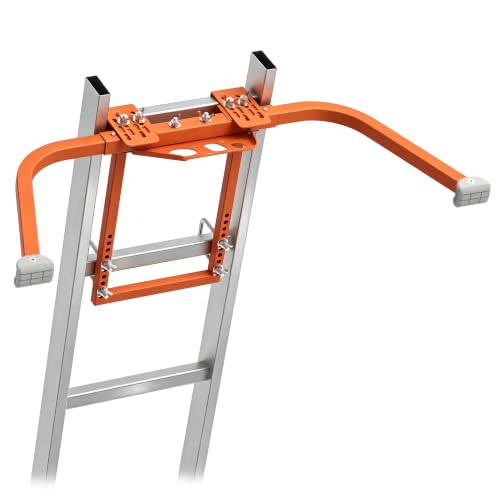
The best ladder stabilizer for most homeowners is the Werner AC78 QuickClick, a wing-span standoff with a published span and clearly stated limits, which most of the generic options here do not provide. A ladder stabilizer, also called a standoff, is a bar that mounts near the top of an extension ladder and rests on the wall or roof, so the rails do not press on gutters or siding and the ladder is much steadier from side to side. If you want an all-metal budget alternative, the steel and aluminum wing-span models below cover gutter, wall and window work.
Quick List
- Heavy-Duty Aluminum Wing-Span Stabilizer – best for lightweight handling during gutter cleaning
- Wing-Span Standoff Arms for Extension Ladders – best for general wall and roof edge work
- Startingtool Adjustable Standoff – best for gutters and windows where fit needs adjusting
- Roof Gutter Ladder Standoff Arms – best for a simple gutter-guard cleaning setup
- Werner AC78 QuickClick Stabilizer – best overall for documented fit and a trusted ladder brand
- Heavy-Duty Steel Stabilizer With Rubber Feet – best for a sturdy steel build with anti-slip feet
Which One Is Right for You?
| If you… | Choose |
|---|---|
| want published span, standoff and ladder limits | Werner AC78 QuickClick Stabilizer |
| need a stabilizer that bridges gutters and rests on the roof | Heavy-Duty Steel Stabilizer With Rubber Feet |
| care most about a light aluminum build | Heavy-Duty Aluminum Wing-Span Stabilizer |
| want an adjustable attachment for windows and gutters | Startingtool Adjustable Standoff |
| clean gutters and gutter guards a few times a year | Roof Gutter Ladder Standoff Arms |
| need basic wall-and-roof standoff arms | Wing-Span Standoff Arms for Extension Ladders |
The deciding factors are fit and documentation. Werner publishes how wide the span is, how far it stands off the wall and which ladders it suits, so it is the safest starting point. The generic aluminum and steel versions offer heavy-duty claims and similar shapes, but the listing names do not give a rated load, so confirm those details before you rely on one.
All 6 Picks in Detail
1. Heavy-Duty Aluminum Wing-Span Stabilizer – Best for Light Handling
As an Amazon Associate we earn from qualifying purchases at no extra cost to you.

This listing describes a heavy-duty aluminum extended ladder accessory that serves as a stand-off wing span for roofs, gutter guards and cleaning tools. Aluminum keeps the weight of the add-on low, which matters when you hoist an extension ladder with the stabilizer already mounted. It is a natural fit for homeowners cleaning gutters or washing upper windows a few times a year.
A light accessory also changes how you handle the ladder. Carrying a 20-foot extension ladder is awkward enough, and every extra pound at the top end makes it harder to raise and steady. Aluminum helps there, though it is worth remembering that aluminum conducts electricity, so none of these accessories belong anywhere near overhead lines or service drops.
The listing title does not give a span measurement, a standoff distance or a rated load. Before using it, check those figures on the product page, and make sure the clamps fit the rails of your ladder. If they are missing, treat the product as a light-duty accessory.
- Aluminum construction
- Wing-span design for roof, gutter and wall contact
- Marketed for gutter guard and roof cleaning work
- Sold as a ladder stand-off accessory
- Span, standoff distance, rated load: confirm on listing
Pros:
- Lighter than a steel version
- Wing shape spreads contact across a wider area
Cons:
- No dimensions or rating in the listing name
- Aluminum can dent if dropped or overloaded
Compared with the steel model in this list, it trades some rugged feel for lower weight.
2. Wing-Span Standoff Arms for Extension Ladders – Best for General Wall and Roof Work
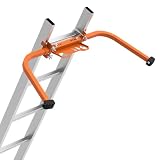
This product is labeled as wing-span, wall extension ladder standoff arms, an accessory for roof gutter guard work in a heavy-duty form. It follows the common design of two angled arms that bolt or clamp to the ladder’s top rails and keep the ladder away from the wall and roof edge. The aim is clear: it moves the load from fragile gutters to the wall or roof surface behind them.
Think about the surface you lean on most often. Against stucco or brick, wide arms with soft pads distribute the load nicely. Against a shingled roof edge, the arms need to land on solid decking rather than loose granules. Setting the arms to the same angle on both sides keeps the ladder from twisting as you step onto it.
As with the other generic models, the listing name is truncated before any specifications appear. Treat the product page as the source for size, material and weight rating, and compare the maximum ladder width it accepts with your ladder’s rail spacing.
- Wing-span standoff arms
- Intended for extension ladders
- Marketed for roof and gutter guard use
- Heavy-duty claim in the listing
- Material, span and rated load: confirm on listing
Pros:
- Standard arm design is easy to understand
- Useful on both walls and roof edges
Cons:
- Few concrete specs in the title
- Fit depends on your ladder’s rail width
Next to the Startingtool, it is the more traditional fixed-arm style, while the Startingtool leans on adjustability.
3. Startingtool Adjustable Standoff – Best for Gutters and Windows

Startingtool sells an adjustable ladder standoff attachment for roofs, gutters and windows in a heavy-duty form. The word adjustable matters because different ladders have different rail widths, and a standoff that can be tuned will fit more of them securely. It is a good candidate for people who clean windows or work around gutters with more than one ladder.
Adjustable accessories reward a short routine. Set the ladder at its angle first, clamp the standoff, and then step back to check that both arms sit square against the surface. Mark the bolt positions with a paint pen after you find the right width so you can set it quickly next time and spot any loosening between jobs.
The listing title does not give the adjustment range, standoff depth or weight rating, so confirm those details. Tighten every bolt after setting the width, since an arm that shifts under load defeats the purpose of the accessory.
- Adjustable attachment design
- For extension ladders used at roofs and gutters
- Marketed for windows as well as gutters
- Heavy-duty claim in the listing
- Adjustment range and rating: confirm on listing
Pros:
- Adjustability helps it fit different ladders
- Suits window and gutter jobs
Cons:
- More adjustment points mean more bolts to check
- Specifications are not stated in the title
Compared with the Werner, it offers more flexibility but less published detail.
4. Roof Gutter Ladder Standoff Arms – Best for Gutter Guard Cleaning
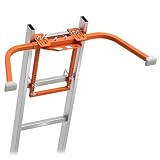
This listing groups the keywords extension ladder stabilizer, roof gutter, ladder accessory and gutter cleaning tools. In plain terms it is a standoff pair meant to keep a ladder off the gutter edge while you clean. It is the simplest idea in the guide: reach the roof, rest the arms against the surface and keep the weight off the gutter.
If you clean gutters only a couple of times each year, a plain accessory like this can be enough, provided it is in good condition. Keep it away from moisture in storage, wipe off grit before attaching it, and look at the pads for hardening. A stabilizer that is slightly worn can still slip on wet shingles, so choose dry weather for the work.
Because the title contains no numbers, treat this as an accessory to inspect carefully. Check that the bracket seats on both rails, that the contact points are padded and that the arms cannot rotate once clamped.
- Stabilizer and standoff arm design
- Meant for roof gutter and gutter guard work
- For use with extension ladders
- Marketed with gutter cleaning tools in mind
- Material, dimensions, load rating: confirm on listing
Pros:
- Focused on the most common use case
- Keeps the ladder off the gutter edge
Cons:
- No dimensions or ratings stated
- Less distinct from the other generics
It is close in purpose to the aluminum wing-span model, so decide based on which listing gives you the more complete specification sheet.
5. Werner AC78 QuickClick Stabilizer – Best Overall

Werner is a long-established ladder maker, and the AC78 QuickClick is the one stabilizer in this list whose limits are published by the manufacturer. Werner describes it as spanning 44 inches with a 10-inch standoff, designed for ladders up to 40 feet, and attaching without tools. The retailer title says 45 inches, so rely on the manufacturer’s figure and the product page when planning fit.
Werner also lists the limits that many generics skip. It is meant for ladders up to 40 feet, it should not be paired with ladder jacks that use planks, and it is not meant for the Multileader. That clarity makes planning easy: confirm your ladder’s series and duty rating, and then you know whether the accessory belongs on it. The paint can hook is a small touch that gets used more than you would expect.
It has a spring-loaded latch, mar-resistant rubber end caps and a paint can hook, and the manufacturer lists it at about 6.4 pounds. Importantly, Werner states it is not for Type III aluminum ladders, Type II fiberglass extension ladders or MT series ladders, so check your ladder’s duty rating and series before buying.
- 44-inch span and 10-inch standoff per the manufacturer
- Tool-free attachment with a spring-loaded latch
- For ladders up to 40 feet, with listed exclusions
- Mar-resistant rubber end caps and a paint can hook
- Weight about 6.4 pounds per the manufacturer
Pros:
- Clearly documented limits and a known brand
- Quick on-off without tools
Cons:
- Not compatible with several ladder types
- A 10-inch standoff may be shallow on roofs with overhangs
Compared with the generic wing-span models, it is the better documented option, which is why it ranks first.
6. Heavy-Duty Steel Stabilizer With Rubber Feet – Best for a Steel Build

The last listing is a heavy-duty steel extension ladder stabilizer for roofs, gutters and walls, with anti-slip rubber feet and a standoff wing design. Steel is heavier than aluminum but resists bending, and rubber feet protect siding and shingles from scratches while adding grip. It suits users who accept more weight in exchange for a rigid feel.
Steel stabilizers tend to feel planted once they are in position, which can be reassuring when you are reaching out to a gutter corner. The cost is handling: you will notice the extra weight when raising a long ladder alone, so consider a helper for taller extensions. Wipe the steel dry after wet jobs and touch up any chips in the finish to prevent rust.
As with the other generics, the title stops before giving dimensions or a rated load. Inspect the weld points and the rubber feet when it arrives, and check that the arm pivots lock fully before you climb.
- Heavy-duty steel construction
- Anti-slip rubber feet
- Wing standoff design for roof, gutter and wall use
- For extension ladders
- Span, standoff distance and rating: confirm on listing
Pros:
- Rigid steel feels solid on the ladder
- Rubber feet protect surfaces
Cons:
- Heavier to lift with the ladder
- Steel needs a protective finish to avoid rust
Relative to the aluminum wing-span model, it favors strength over low weight.
Specs Compared
| Product | Material | Span | Standoff | Stated limits |
|---|---|---|---|---|
| Heavy-Duty Aluminum Wing-Span Stabilizer | Aluminum | Confirm on listing | Confirm on listing | Confirm on listing |
| Wing-Span Standoff Arms for Extension Ladders | Confirm on listing | Confirm on listing | Confirm on listing | Confirm on listing |
| Startingtool Adjustable Standoff | Confirm on listing | Adjustable (range: confirm on listing) | Confirm on listing | Confirm on listing |
| Roof Gutter Ladder Standoff Arms | Confirm on listing | Confirm on listing | Confirm on listing | Confirm on listing |
| Werner AC78 QuickClick Stabilizer | Aluminum and steel | 44 in (manufacturer) | 10 in (manufacturer) | Ladders up to 40 ft; exclusions listed by Werner |
| Heavy-Duty Steel Stabilizer With Rubber Feet | Steel | Confirm on listing | Confirm on listing | Confirm on listing |
How We Chose These
This list comes from product listings, manufacturer specification pages and published ladder-safety guidance, not from our own use of the accessories. We looked for stabilizers meant for extension ladders working at gutters, roofs, walls and windows. We gave extra weight to listings that publish a span, a standoff distance and ladder compatibility, and we marked every unpublished number with a note to confirm it on the product page. Because ladder accessories are not covered by the main ANSI A14 ladder standards, we treated any “meets standard” language as a manufacturer claim.
What to Look For
Span width
The span is the distance between the two contact points, and a wider span steadies the ladder against side sway. Typical stabilizers range from about 36 to 48 inches, and Werner’s AC78 measures 44 inches. A wider span helps on a flat wall, while a narrower one may fit better into the corner of a roof edge or between obstacles.
Standoff distance
The standoff is how far the stabilizer holds the ladder from the surface. Ten inches is common for general use, while some pro-grade models offer closer to 19 inches. A deeper standoff clears gutters and fascia more easily, though it can move the ladder’s top further out and slightly change the angle. Worked example: if your gutter protrudes 6 inches from the wall, a 10-inch standoff gives about 4 inches of clearance at the contact point.
Compatibility and duty rating
A stabilizer must fit the ladder’s rail shape and respect its duty rating. Ladder ratings include Type IAA at 375 pounds, IA at 300, I at 250, II at 225 and III at 200. Werner, for instance, excludes some Type III aluminum and Type II fiberglass models, so a stabilizer is not a universal accessory. Always read the compatibility notes.
Material and contact surfaces
Aluminum is lighter and rust-proof, while steel is stiffer and heavier. Look for rubber or mar-resistant pads on the contact points, as bare metal can scratch siding and slip on slick surfaces. Check the pads for wear and replace them when they harden or split.
Reading generic listings carefully
Several listings in this category share similar photos and keywords, and the product title is often cut short. Look for four facts before you buy: the material, the span in inches, the distance the stabilizer stands off the surface and a stated load or ladder rating. If the listing offers none of them, ask the seller or choose a model that does. A good rule of thumb is that the less a listing tells you, the more cautious you should be about heavy or tall work with that accessory.
When a stabilizer is not enough
A stabilizer improves side-to-side steadiness and protects the surface, but it cannot fix a soft base or a ladder that is too short. If the ground is uneven, level the feet first; if you cannot reach the work without standing on the top three rungs, you need a taller ladder or a different access method such as a platform or lift. Wind, wet surfaces and tiredness make any ladder task riskier, so postpone the job when conditions are poor. For work above a single story or near a steep roof edge, consider hiring a professional with fall-protection equipment.
Storage and inspection
Before each use, look for bent arms, loose bolts, cracked welds, hardened pads and any play in the clamps. Store the stabilizer off the floor, away from moisture and chemicals, and never use one that has been bent and straightened. A damaged accessory should be replaced, not repaired in the field. Keep the manufacturer’s instructions with the product so you can recheck the compatible ladder types whenever you buy a new ladder.
Safe setup
Use the 4-to-1 rule, placing the base 1 foot out for every 4 feet of height, which is about a 75-degree angle. Attach the stabilizer to the top rails, extend the wings fully, and confirm both pads touch the surface evenly. Avoid resting bare ladder rails against vinyl or aluminum gutters, keep three points of contact, never stand on the top three rungs and keep clear of power lines.
Questions
What does a ladder stabilizer do?
It widens the contact points at the top of a ladder and holds the rails away from a wall or gutter. That reduces side sway and keeps the ladder from denting fragile gutters.
Will a stabilizer fit any extension ladder?
No. Fit depends on rail width and shape, and some manufacturers exclude certain duty ratings or series. Read the compatibility notes on the product page.
Can I use a stabilizer on a step ladder?
These are designed for extension ladders. Step ladders do not lean on a wall, so they do not need a standoff.
Is a longer span always better?
A wider span steadies the ladder, but it also has to fit the surface you are leaning on. Consider the roof edge, window frames and obstacles.
Do stabilizers protect gutters?
They can, because the arms shift the load to the wall or roof behind the gutter. Keep the pads in good condition and avoid resting the rails on the gutter itself.
Is a stabilizer a replacement for tying off the ladder?
No. A stabilizer helps with sway and surface contact, but securing the top of the ladder to a fixed point is still the more positive measure on tall or exposed jobs. Use both when the situation calls for it.
How do I know if the stabilizer is rated for my weight?
Check the product page for a rated load. If it is not stated, confirm it with the seller and do not exceed the ladder’s own duty rating.
Update History
- October 20, 2026 – Initial publication; product set drawn from current catalog listings.
- Check the product page for current specifications and availability before buying.
Sources
- Manufacturer product and specification pages for Werner ladder accessories
- Retailer listing titles and specification fields for every stabilizer named above
- Published guidance on ladder duty ratings and the 4-to-1 setup rule, including ANSI A14 summaries