
Key takeaways
- Battery system: platform matters. If you already own Ryobi, Makita, Greenworks or Sun Joe batteries, buying the bare tool or a kit that shares batteries can save money and charging hassle.
- Voltage and amp-hours: higher voltage and higher Ah ratings generally mean longer runtime and more power. Dual-battery tools deliver more output but weigh more.
- Brushless motor: found on the Ryobi RY404150 and others. Brushless motors are usually more efficient and last longer, according to makers.
- Airflow figures (CFM and MPH): useful for comparison, but only within the same maker’s testing method. Treat these as seller-stated unless an independent reviewer measures them.
- Collection bag size and weight: a large bag means fewer stops, but a full bag is heavy to carry. Shoulder straps and balanced designs help.
- Mulch ratio and impeller material: metal impellers resist damage from twigs; plastic ones cost less but can crack on hard debris.
- Weight and ergonomics: an ultralight tool such as a 2.2 lb handheld is easy on the arms but limited in power.
- Charge time: a spare battery or rapid charger lets you work longer without waiting.
For a medium-to-large yard where you want gas-like power without fumes, the Ryobi 40V RY404150 is the model LawnStarter ranks first among cordless leaf vacuums; for a smaller lot on a tight budget, the Greenworks G-Max 24322 or the Black + Decker LSWV36 are the lower-cost picks; and for long runtime on a lighter job, the Sun Joe 24V-X2-BVM143 is the option reviewers praise. Cordless leaf vacuums trade runtime and capacity for quiet operation and convenience, so the right choice depends on your yard size and how much you can charge.
Our top picks
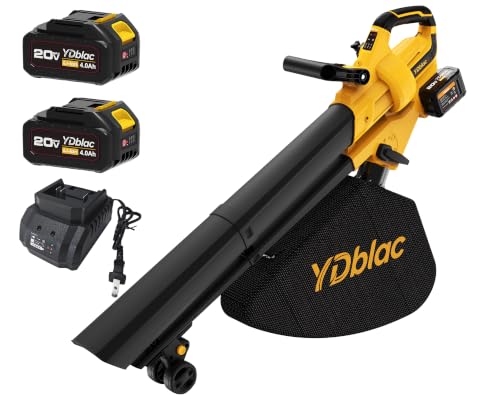


As an Amazon Associate we earn from qualifying purchases at no extra cost to you.
Cordless Leaf Vacuums at a Glance
| Model | Best for | Reported specs and traits | Limits |
|---|---|---|---|
| Ryobi 40V RY404150 | Larger yards, near-gas power | LawnStarter reports a brushless motor, two 40V batteries and up to about 18 minutes of runtime; ranks it first | Second most expensive on that list; heavier setup |
| Greenworks G-Max 24322 | Medium amounts of leaves on a budget | LawnStarter calls it the most affordable cordless electric option on its list | Not for heavy, wet leaf piles |
| Makita XBU04PTV (dual 18V) | Users in the Makita battery system | Ranked third by LawnStarter | Check the maker’s stated runtime and whether vacuum accessories are included |
| Sun Joe 24V-X2-BVM143 | Strong blow force and long runtime | LawnStarter reports up to 65 minutes of runtime | Runtime depends on speed setting and battery |
| Black + Decker LSWV36 | Small yards and budget buyers | Lowest-priced leaf vacuum on LawnStarter’s list | Lower power; small bag |
| Greenworks 48V cordless 3-in-1 | Versatility: blow, vacuum, mulch | Oh So Spotless names it best versatile | Heavier when full |
| Kimo 4-in-1 cordless | Lightweight for light jobs | The same site lists about 2.2 lb | Limited power for large yards |
| ZEGJAW 40V | Moderate work | Rated by the seller at 360 CFM and 170 MPH, with two 4 Ah batteries | Seller-stated figures; lesser-known brand |
What a Cordless Leaf Vacuum Does
A leaf vacuum is a blower that can reverse. In vacuum mode, an impeller pulls leaves and debris in through a tube, shreds them and drops them in a collection bag. Many models also offer blower mode, and some add mulching ratios, such as a stated 10 to 1 reduction, so you can shrink a pile into a bag. Cordless versions replace a gas engine or cord with a lithium-ion battery, so they start instantly, produce no exhaust and are quieter.
The trade-offs are runtime and sustained power. Maker-quoted runtime is often measured on a low setting, so expect less at full speed. Wet leaves, wood chips and heavy debris clog impellers and drain batteries quickly. Treat a cordless vacuum as a tool for dry leaves, grass clippings and light yard debris.
Key Features to Compare
- Battery system: platform matters. If you already own Ryobi, Makita, Greenworks or Sun Joe batteries, buying the bare tool or a kit that shares batteries can save money and charging hassle.
- Voltage and amp-hours: higher voltage and higher Ah ratings generally mean longer runtime and more power. Dual-battery tools deliver more output but weigh more.
- Brushless motor: found on the Ryobi RY404150 and others. Brushless motors are usually more efficient and last longer, according to makers.
- Airflow figures (CFM and MPH): useful for comparison, but only within the same maker’s testing method. Treat these as seller-stated unless an independent reviewer measures them.
- Collection bag size and weight: a large bag means fewer stops, but a full bag is heavy to carry. Shoulder straps and balanced designs help.
- Mulch ratio and impeller material: metal impellers resist damage from twigs; plastic ones cost less but can crack on hard debris.
- Weight and ergonomics: an ultralight tool such as a 2.2 lb handheld is easy on the arms but limited in power.
- Charge time: a spare battery or rapid charger lets you work longer without waiting.
Matching a Model to Your Yard
Small yards and patios
Budget and lightweight models cover decks, driveways and small lawns. The Black + Decker LSWV36 and Kimo-type handhelds are enough for quick cleanups but struggle with deep leaf drifts.
Medium yards
The Greenworks G-Max 24322 and Sun Joe 24V-X2 tackle a typical suburban lot. Sun Joe’s reported 65 minutes of runtime suits long sessions at lower speed, while the Greenworks gets the nod on price.
Large yards or heavy leaf fall
Dual-battery, brushless designs such as the Ryobi RY404150 are the most capable cordless option. Even so, reviewers note that runtime is limited, so large properties may need a spare battery or a gas or corded alternative.
Tool-brand loyalists
The Makita XBU04PTV dual-18V design makes sense if you already own LXT batteries. Confirm with the maker which accessories come with the tool, since some listings sell only the bare unit.
Safety and Care
- Wear eye protection, hearing protection if the maker advises it, closed-toe shoes and a dust mask in dusty conditions.
- Switch off and remove the battery before clearing a jam or changing the bag, and never reach into the impeller area.
- Keep vacuum tubes away from hair, loose clothing, pets and children.
- Do not vacuum anything hot, such as embers or ash, or flammable liquids; these can ignite or damage the unit.
- Avoid vacuuming glass, nails or large rocks, which can damage the impeller or be thrown out.
- Store and charge lithium-ion batteries according to the manual, indoors in a dry place and away from heat. Stop using any battery that is swollen, hot or damaged.
- Empty the bag and wipe dust off the housing after use.
Budget Tiers
Budget buyers get lightweight and small-bag models like the Black + Decker LSWV36 and the Greenworks G-Max 24322, which do fine on dry leaves in small spaces. Mid-range choices include the Sun Joe and Makita options with more power or runtime, depending on batteries. Premium buyers pay for dual-battery, brushless units like the Ryobi RY404150 and larger 48V Greenworks systems with stronger performance and a bigger battery platform.
Pick X If… Decision Table
| Pick this | If you… |
|---|---|
| Ryobi RY404150 | want the strongest cordless performance and have a bigger yard |
| Greenworks G-Max 24322 | need an affordable tool for moderate leaf fall |
| Sun Joe 24V-X2-BVM143 | prefer longer runtime on a typical lot |
| Makita XBU04PTV | already own Makita 18V batteries |
| Black + Decker LSWV36 | have a small yard and a tight budget |
| Greenworks 48V 3-in-1 | want blow, vacuum and mulch in one tool |
| Kimo 4-in-1 | want the lightest tool for light cleanup |
Alternatives to Consider
- Cordless leaf blowers: Consumer Reports covers battery blowers from Ego, Greenworks and Ryobi; they move leaves rather than collect them.
- Gas leaf vacuums: more runtime and power for big properties, but louder and need fuel.
- Corded electric vacuums: unlimited runtime within cord reach.
- Walk-behind or tow-behind leaf collectors: suit large lawns where hand vacuums would take hours.
- Mulching mower: chops light leaf cover back into the lawn.
Getting the Most From a Cordless Vacuum
Work in dry conditions and start with the tool on a lower setting, increasing power only where leaves are thick. Empty the bag before it is completely full so airflow stays strong, and keep the intake tube close to the ground at a slight angle. Charge batteries after each session instead of leaving them depleted for weeks, and store them away from freezing temperatures or heat as the manual advises. A second battery or a quick charger doubles your working time on large yards. If you only face a short, heavy leaf season, a mid-range kit that shares batteries with your other tools often costs less over time than a dedicated machine.
Noise, Neighbors and Local Rules
Battery tools are far quieter than gas engines, which is a real advantage on small lots. Even so, some towns restrict leaf-blower hours or types, so read your local rules before you start. Keep dust down by wetting very dry soil lightly or working in calm weather, and point the blower nozzle away from windows, cars and passersby. When bagging, check what your waste collector accepts, since many areas collect shredded leaves or compost them. Shredded leaf mulch is also useful in garden beds, which many owners prefer to sending it away.
Frequently Asked Questions
Are cordless leaf vacuums as powerful as gas?
The best brushless dual-battery models come close, according to LawnStarter’s comments on the Ryobi. They still lag on runtime and heavy, wet debris. For very large yards, gas or corded tools may be easier.
How long does the battery last?
It depends on voltage, battery size and speed setting. Reviewers cite about 18 minutes for the Ryobi with two batteries and up to 65 minutes for the Sun Joe. Treat the maker’s runtime as a best-case number.
Can I vacuum wet leaves?
It is not recommended. Wet leaves clog the impeller and bag, strain the motor and reduce runtime. Wait for them to dry or use a rake.
Do I need to buy extra batteries?
For anything beyond a small yard, a spare battery or a fast charger is worth considering. If you already own compatible batteries, buy a bare tool to save money.
Can a leaf vacuum pick up sticks and acorns?
Small twigs and acorns are usually fine, but large sticks, rocks and metal can damage the impeller. Read the manual for the maker’s limits.
Is a leaf vacuum better than a blower?
A vacuum collects and shrinks leaves in a bag, while a blower moves them to a pile or the curb. Many cordless tools do both, so you can pick the mode that fits the job.





