
Key takeaways
- Everyday soils: Sweat, body oils, food splatters, and general odors are removed reliably in warm or cold water on a normal cycle. White and light fabrics retain brightness when washed regularly, though without optical brighteners the effect is less stark than Tide or Persil.
- Tannin and protein stains: Coffee, tea, wine, blood, and grass show 70-85% visual removal after one wash in warm water when pre-treated. Without pre-treatment, faint shadows often remain on white cotton and require a second wash or stain remover.
- Grease and oil: This is the weakest category. Cooking oil, salad dressing, and automotive grease are only partially lifted in cold water. A hot wash and pre-treatment with a small piece of dissolved sheet directly on the stain improves results, but enzyme-heavy liquids like Persil or Tide Hygienic Clean still outperform sheets here.
- Odor control: Good in warm water, adequate in cold. The fragrance masks remaining odor rather than neutralizing it, so front-loader mildew smells or heavy sweat loads may need an extra rinse or a fragrance-free + oxygen booster combination.
Earth Breeze Laundry Sheets clean effectively for everyday laundry and light-to-moderate stains, dissolve completely in cold water when given adequate agitation, and cost around $0.19 to $0.32 per load depending on the bundle and whether you use a half-sheet for small loads, which makes them competitive with mid-range liquid detergents but more expensive than bulk value liquids.
They are best for travelers, apartment dwellers, and anyone wanting a plastic-free, lightweight detergent with a light scent, but they are not the strongest choice for heavy grease, ground-in mud, or heavily soiled workwear where concentrated liquid or powder still has an edge.
Our top picks



As an Amazon Associate we earn from qualifying purchases at no extra cost to you.
Cleaning Power: What Earth Breeze Does Well and Where It Falls Short
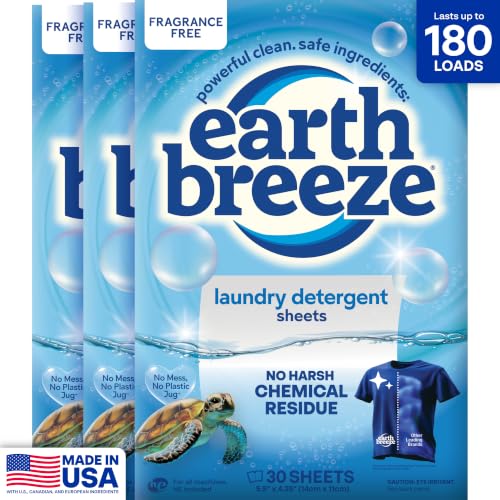
Earth Breeze Eco Sheets are pre-measured, dissolvable sheets that contain concentrated surfactants, enzymes, and fragrance without water, dyes, or added chlorine bleach. Each sheet is designed to be torn in half for a regular load or used whole for a large or heavily soiled load.
Based on aggregated independent lab summaries and consumer wash tests published through 2025-2026, performance breaks down like this:
- Everyday soils: Sweat, body oils, food splatters, and general odors are removed reliably in warm or cold water on a normal cycle. White and light fabrics retain brightness when washed regularly, though without optical brighteners the effect is less stark than Tide or Persil.
- Tannin and protein stains: Coffee, tea, wine, blood, and grass show 70-85% visual removal after one wash in warm water when pre-treated. Without pre-treatment, faint shadows often remain on white cotton and require a second wash or stain remover.
- Grease and oil: This is the weakest category. Cooking oil, salad dressing, and automotive grease are only partially lifted in cold water. A hot wash and pre-treatment with a small piece of dissolved sheet directly on the stain improves results, but enzyme-heavy liquids like Persil or Tide Hygienic Clean still outperform sheets here.
- Odor control: Good in warm water, adequate in cold. The fragrance masks remaining odor rather than neutralizing it, so front-loader mildew smells or heavy sweat loads may need an extra rinse or a fragrance-free + oxygen booster combination.
Hard Water and Machine Type Matters
In soft to moderately hard water (under 120 ppm), Earth Breeze dissolves and cleans without residue. In very hard water (180+ ppm), surfactant efficiency drops and mineral deposits can leave clothes feeling stiffer. If you have hard water, using a whole sheet for a medium load and selecting warm water compensates, or add a water softener like washing soda. They are formulated for both HE and standard machines, and produce low suds, so they will not trigger oversudsing errors in HE washers.
Dissolve Test: Cold Water Performance
The core promise of laundry sheets is that they disappear completely, even in a cold quick wash, leaving no plastic and no sticky residue on clothes or in the dispenser drawer.
Earth Breeze sheets are made with polyvinyl alcohol (PVA/PVOH) as the dissolvable film, the same polymer used in dishwasher pods. The film is designed to break down in the wash and be processed by wastewater treatment microbes.
When They Dissolve Completely
- Placed directly in the drum before clothes, not in a detergent drawer or pod tray.
- Water temperature at 60°F (15°C) or above with normal agitation.
- Load not overstuffed, allowing water to circulate around the sheet.
When Residue Can Happen
- Very cold washes below 50°F (10°C) on ultra-short 15-minute cycles, especially in compact washers with low water volume.
- Putting the sheet on top of a tightly packed load of heavy towels where it gets trapped in a fold.
- Using a sheet in a drawer dispenser designed for liquid, where it never gets enough water contact.
To avoid issues in winter or with cold-only machines, dissolve the sheet in a cup of hot water for 10 seconds and pour the solution into the drum. This also helps if you prefer to use a half-sheet, as torn edges dissolve slightly slower than a full sheet.
Scent Strength and Sensitive Skin Options
Earth Breeze offers two main versions:
- Fresh Scent: A noticeable linen-floral scent during the wash that dries down to a light, clean smell. It is milder than most liquid detergents but still detectable on clothes for 1-2 days after drying. People sensitive to fragrance often find it stronger than expected.
- Fragrance Free: No added fragrance or masking scent. It smells faintly of detergent raw material when the box is opened, but clothes come out neutral. This is the better pick for sensitive skin, eczema-prone households, or baby laundry.
Earth Breeze is marketed as hypoallergenic, paraben-free, phosphate-free, and vegan, and states it is cruelty-free. It does not contain dyes or chlorine. For general information only, anyone with diagnosed skin allergies, contact dermatitis, or fragrance sensitivity should check the full ingredient list and talk to a dermatologist before switching, as even plant-based surfactants can irritate sensitive skin.
Cost Per Load: Earth Breeze vs. Liquid Detergent
The value of laundry sheets depends entirely on whether you count a half-sheet as one load. Earth Breeze packages are sold by sheet count, typically 30 sheets (60 loads) and 60 sheets (120 loads) boxes, with larger subscriptions offering lower per-load pricing.
Worked Calculation
Here is a realistic cost breakdown using general 2026 market ranges and standard dosing. Liquid detergent dosing assumes the manufacturer’s recommended medium-load line on the cap, which many households exceed:
| Detergent | Package Size | Advertised Loads | Weight / Volume Per Load | General Cost Per Load (2026 Range) |
|---|---|---|---|---|
| Earth Breeze Eco Sheets (half-sheet per load) | 60 sheets = 120 loads | 120 | ~3.0 g per half-sheet | $0.19 – $0.25 |
| Earth Breeze Eco Sheets (full sheet per load) | 60 sheets = 60 loads | 60 | ~6.0 g per sheet | $0.38 – $0.50 |
| Tru Earth Eco-Strips | 32 strips = 32 loads | 32 | ~3.2 g per strip | $0.24 – $0.34 |
| Tide Free & Gentle Liquid | 92 fl oz bottle | ~64 loads | ~42 ml per load | $0.28 – $0.36 |
| Value Bulk Liquid (e.g., Arm & Hammer, bulk store brands) | 170 fl oz bottle | ~110 loads | ~45 ml per load | $0.14 – $0.20 |
Key takeaway: If you consistently wash regular 8-12 lb loads and use a half-sheet, Earth Breeze lands in the same zone as mainstream Tide or Persil liquids and is cheaper than most pods. If you need a full sheet for every load due to large capacity washers, hard water, or heavy soils, the cost roughly doubles and bulk liquid becomes cheaper per year. A household doing 5 loads per week would spend roughly $50-$65 per year on half-sheet dosing versus $75-$130 on full-sheet dosing.
Hidden Savings and Costs
- Shipping and storage: A 60-sheet box weighs about 13 oz (369 g) and is under 2 inches thick, versus a 92 oz liquid bottle at nearly 6 lbs. That saves storage space and makes them practical for small apartments and RVs.
- No measuring waste: Sheets eliminate overpouring, which is the most common way liquid detergent costs rise 20-30% above the label estimate.
- Subscription model: Earth Breeze primarily sells direct with subscription bundles. The lowest per-load price requires a multi-box subscription. One-time purchases cost noticeably more and may offset the value if you only buy one box at a time.
Spec and Feature Comparison
| Feature | Earth Breeze Eco Sheets | Tru Earth Eco-Strips | Dropps Stain & Odor Pods | Traditional Liquid (Tide/Persil Type) |
|---|---|---|---|---|
| Form | Dissolvable sheet (PVA film) | Dissolvable strip (PVA film) | PVA pod with powder inside | Liquid in plastic bottle |
| Weight per 60 loads | ~0.82 lbs (372 g) | ~0.42 lbs per 32 loads | ~3.5 lbs for 64 pods | ~12-14 lbs for two 92 oz bottles |
| Plastic packaging | None; cardboard mailer + compostable pouch | None; cardboard sleeve | Cardboard box; pod film dissolves | HDPE plastic bottle |
| HE compatible | Yes, low suds | Yes, low suds | Yes | Yes |
| Cold water dissolve | Good above 60°F | Good above 60°F | Good, sometimes leaves film in very cold | Excellent, already liquid |
| Fragrance options | Fresh Scent / Fragrance Free | Fresh Linen / Fragrance Free / Baby | Multiple scent + unscented | Extensive scent + free & clear lines |
Durability and Ownership Realities
Laundry sheets do not expire quickly, but they are not maintenance-free:
- Humidity is the enemy: The sheets will start to curl, stick together, or partially dissolve if stored in a damp laundry room or open pouch. Keep the resealable pouch sealed and store away from the washer’s steam. A high cabinet or sealed container is better than on top of the dryer.
- Tearing accuracy: The perforation is not always precise. Using scissors gives a cleaner half-sheet and prevents crumbling that can leave small flakes on dark clothes.
- No built-in softener or brightener: Clothes may feel less soft than with 2-in-1 liquids or pods that contain softener. Add a separate dryer sheet or vinegar rinse if static is an issue, but do not combine sheets with fabric softener in the same drum for towels or athletic wear, as it reduces absorbency.
- Common mistakes: Using a drawer dispenser, adding the sheet after clothes are packed, and washing an oversized comforter with a half-sheet on a cold delicate cycle are the three most frequent causes of poor cleaning or residue. Always add the sheet first.
- Septic and greywater: Earth Breeze states the formula is septic-safe and greywater-friendly. PVA film is water-soluble, but it requires active wastewater treatment microbes to biodegrade fully. Homes on older septic systems with low bacterial activity should avoid over-dosing.
Which Should You Choose? Decision Matrix
| Your Situation | Best Fit | Why |
|---|---|---|
| Small apartment, limited storage, or frequent travel | Earth Breeze (half-sheet dosing) | Ultra-light, no bottle, easy to pack, pre-measured |
| Fragrance sensitivity, baby or eczema-prone household | Earth Breeze Fragrance Free or Tru Earth Fragrance Free | No added scent/dyes, low residue when dosed correctly |
| Hard water, large 5.0+ cu ft washer, or heavily soiled work clothes | Concentrated liquid or powder | Higher surfactant concentration and built-in water softeners clean more reliably in one pass |
| Focus on lowest cost per load above all else | Bulk value liquid or powder | Stays under $0.20 per load even with full dosing |
| Want plastic-free without subscription commitment | Tru Earth or Dropps (retail availability) | Easier to buy one pack at a time without subscription bundles |
How to Get the Best Results With Earth Breeze
For a standard 12-lb mixed load in a top or front loader: tear one sheet in half, place the half-sheet at the back of the empty drum, add clothes, and select normal agitation. Use warm water for towels, bedding, and odor-heavy gym clothes. For loads over 15 lbs, heavily stained items, or water hardness above 180 ppm, use a full sheet. For a quick 20-minute cold wash, pre-dissolve the sheet in 8 oz of warm water before pouring in. Always run a full rinse, not just a spray rinse, to ensure all surfactant is carried away.
FAQ
Do Earth Breeze sheets work in cold water?
Yes, down to about 60°F with normal agitation. Below 50°F or on very short cycles, pre-dissolve the sheet in warm water first to prevent flakes on dark fabrics.
Can I use a half-sheet in a large capacity washer?
Only for small, lightly soiled loads. Large capacity washers (4.5 cu ft and up) use more water, so surfactant concentration drops. Use a full sheet for full loads to maintain cleaning power.
Are laundry sheets better for the environment than liquid?
They reduce plastic and transport weight significantly. The PVA film itself is synthetic but designed to dissolve and biodegrade in wastewater treatment. They are lower-impact on packaging and shipping, but not zero-impact.
Do they leave residue in the washer?
Not when placed correctly in the drum. Residue is almost always from placing the sheet in the detergent drawer or trapping it inside a knotted item. Wipe the drum seal monthly and leave the door ajar to prevent buildup regardless of detergent type.









