Key takeaways
- Finished wood (body, neck back, most maple fretboards) and unfinished wood (rosewood, ebony fretboards) need different products. Using fretboard oil on a lacquered board is a common mistake.
- A cloth does most of the cleaning. A good microfiber cloth with a light cleaner is better than a heavy polish used often.
- Avoid household cleaners, furniture polish with silicone and anything abrasive on a guitar finish, as makers’ care guides advise.
- A fretboard conditioner is a once-or-twice-a-year job for most players, not a weekly one.
The best guitar cleaners and polishes for home use are a one-step cleaner-polish for the body, a separate fretboard oil for unfinished wood, and a few microfiber cloths. If you want a single bottle, MusicNomad Guitar ONE is the easy pick for gloss finishes; if you own an acoustic, Martin’s spray polish is the maker-branded option; and if you want everything in one box, Ernie Ball and Dunlop both sell compact care kits. The real skill is matching the product to the part of the guitar you are cleaning, because body, fretboard, strings and hardware each need something different.
Our top picks


As an Amazon Associate we earn from qualifying purchases at no extra cost to you.
Key takeaways
- Finished wood (body, neck back, most maple fretboards) and unfinished wood (rosewood, ebony fretboards) need different products. Using fretboard oil on a lacquered board is a common mistake.
- A cloth does most of the cleaning. A good microfiber cloth with a light cleaner is better than a heavy polish used often.
- Avoid household cleaners, furniture polish with silicone and anything abrasive on a guitar finish, as makers’ care guides advise.
- A fretboard conditioner is a once-or-twice-a-year job for most players, not a weekly one.
Best guitar cleaners and polishes: quick comparison
Guitar care products look similar on a shelf, but they do very different jobs. A cleaner lifts sweat, skin oils and dust. A polish adds a thin layer that brings back shine. A conditioner feeds raw wood on a fretboard. A kit bundles some or all of these with cloths. The table below sorts the picks by what each one is for, so you can buy only what your guitar needs.
We did not use these products ourselves. The descriptions come from the makers’ product pages, label text on retailer listings, and published guitar-care guidance from the makers. Where a statement depends on your finish or your climate, we say so.
| Product | Type | Use on | Format | Best for |
|---|---|---|---|---|
| MusicNomad Guitar ONE | Cleaner, polish and wax in one | Gloss finishes | 4 oz bottle | Single-bottle body care |
| Dunlop Formula 65 Polish & Cleaner | Polish and cleaner | Finished body, neck back | 4 oz bottle | Budget routine polish |
| Martin Guitar Polish & Cleaner | Polish with carnauba wax | Acoustic guitar finishes | 4 oz spray | Acoustic owners |
| Ernie Ball Polish, Fretboard Conditioner and String Cleaner set | Three-part kit with cloth | Body, fretboard, strings | Boxed set | One-purchase starter kit |
| MusicNomad F-ONE Fretboard Oil | Cleaner and conditioner | Unfinished fretboards | 2 oz bottle | Rosewood and ebony boards |
| Ernie Ball Wonder Wipes combo | Pre-moistened wipes | Strings, body, fretboard | Individually wrapped | Gig bags and quick wipes |
| Dunlop System 65 Body & Fingerboard Kit | Cleaning kit | Body and fingerboard | Boxed kit | Complete routine without choosing |
How we chose
This is a research-based list. We read product pages, labels and maker care guides rather than using the products at home. Five criteria shaped the shortlist.
- Clear intended use. The product states which surfaces it is for. A bottle that says “for all guitar finishes” without detail was ranked lower than one that lists gloss, satin or unfinished wood.
- Finish compatibility. We looked for products that say they are safe on the common finishes, or that tell you to avoid certain ones.
- Maker support. Products from guitar and accessory makers, with named model numbers.
- Value in a home routine. A product should last through many cleanings.
- Current availability. No renewed items or unlabeled generic bundles as main picks.
1. MusicNomad Guitar ONE: Best one-bottle cleaner and polish
- All-in-one cleaner, polish and wax for gloss finishes · 4 oz bottle (a larger 12 oz size also exists)
- Designed to be wiped on and buffed off with a microfiber cloth
- Also sold in cloth-kit bundles
- Tier: budget
Best for: a player who wants one bottle that removes fingerprints, adds shine and protects the finish. The maker positions it for gloss finishes, which includes most polyester and nitrocellulose gloss guitars.
Skip if: your guitar has an unfinished or oiled body. A wax-based polish is not meant for raw wood.
Pros
- One step instead of three.
- A small bottle lasts a long time, because you use a few drops per cleaning.
- Available in several sizes and kits.
Cons
- Not meant for matte or satin finishes, where the maker sells a separate cleaner.
- Wax finishes build up if overused, so follow the label.
Home-use tip: with an all-in-one wax product, less is more. Put a few drops on the cloth rather than the guitar, wipe a section at a time, and buff with a clean dry part of the cloth. If the finish looks hazy afterwards, there is too much product left on the surface, and a clean damp cloth will usually take it off.
2. Dunlop Formula 65 Guitar Polish & Cleaner: Best budget polish
- Polish and cleaner in one · 4 oz bottle · a 16 oz size is also sold
- Made by a major accessory maker
- Used on the body and the back of the neck
- Tier: budget
Best for: routine polishing of a gloss-finished electric or acoustic. It is simple, familiar and cheap, which suits a household with several instruments.
Skip if: you need something for a satin neck or an unfinished fretboard.
Pros
- Widely stocked, with a large refill size.
- Does both jobs in one pass.
- Good value for multi-guitar homes.
Cons
- A general-purpose formula, with less guidance on specific finishes than some competitors.
- Not for raw wood.
Home-use tip: a budget polish is best treated as a periodic job. Wipe the guitar dry after playing, and save the polish for a monthly or quarterly session. That is the schedule that keeps a 4 oz bottle lasting for years.
3. Martin Guitar Polish & Cleaner: Best for acoustic guitars
- 4 oz spray bottle · cleans, restores and protects
- Made with carnauba wax for a natural shine
- Branded by an acoustic guitar maker
- Tier: low to mid-range
Best for: acoustic players who want a spray-on product that fits the maker’s own advice for its finishes. A spray is convenient on an acoustic’s large top and back.
Skip if: you own a satin or open-pore acoustic. Check with the guitar’s maker before using a wax polish on those.
Pros
- Spray format covers large areas easily.
- Carnauba wax is a traditional, non-abrasive polish ingredient.
- Product from a recognised acoustic maker.
Cons
- Spraying near the soundhole or bridge needs care. Spray the cloth, not the guitar.
- Not intended for unfinished fretboards.
Home-use tip: when using any spray, apply it to the cloth first, away from the guitar. Overspray can run into the soundhole, pickup cavities or the bridge, where it is hard to remove. Wipe the top and back with long strokes in the direction of the grain, and avoid circular rubbing, which is more likely to leave swirl marks.
4. Ernie Ball Polish, Fretboard Conditioner and String Cleaner set: Best starter kit
- Three products in one set: guitar polish, fretboard conditioner and string cleaner
- Includes a polish cloth
- Compact enough for a gig bag
- Tier: low to mid-range
Best for: someone who wants one purchase to cover the body, fretboard and strings. The cloth is included, so there is no additional shopping.
Skip if: you only have a satin-finish guitar, or an instrument that requires a specific product.
Pros
- A complete routine in one box.
- Includes the cloth.
- Small and easy to store.
Cons
- Small bottles, so heavy users run out faster than with standalone products.
- The fretboard conditioner is not suitable for lacquered boards.
Home-use tip: a boxed set suits a beginner, but check what it contains against what your guitar needs. If your fretboard is maple with a gloss finish, the conditioner in the set will not do anything useful, and you can simply use the polish and the string cleaner.
5. MusicNomad F-ONE Fretboard Oil: Best fretboard conditioner
- Cleaner and conditioner for unfinished fretboards · 2 oz bottle
- Intended for unfinished rosewood and ebony boards, according to the listing
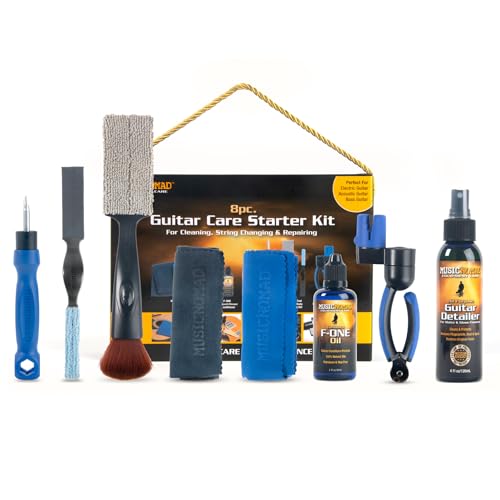
- Also sold in a kit with a cloth and brush
- Tier: budget
Best for: rosewood, pau ferro and ebony fretboards that look dry or grey. A light application brings out the colour and helps the wood resist small cracks.
Skip if: your fretboard is maple with a gloss lacquer. A finished surface does not absorb oil, and the oil will sit on top.
Pros
- Specific purpose, clearly labelled.
- A small bottle lasts years because you use a few drops.
- Kit versions include a brush and cloth.
Cons
- Overuse leaves the board greasy.
- Not for finished boards.
Home-use tip: before applying oil, remove the strings one at a time or mask the frets so the oil stays on the wood. Apply a few drops to a cloth, wipe along the board, wait a few minutes and buff away the excess. If the board still feels dry in a month, a second light coat is fine.
6. Ernie Ball Wonder Wipes combo: Best for quick wipes and gig bags
- Pre-moistened wipes in a combo pack covering strings, polish and fretboard conditioner
- Individually wrapped, so they stay moist
- Tier: budget
Best for: a quick wipe after a session or a gig. Wipes remove sweat from strings, which extends their life, and they are easy to carry.
Skip if: you want to deep-clean a dirty fretboard or remove built-up grime. Wipes are for maintenance.
Pros
- No bottles or cloths to carry.
- Good for strings, which are hard to clean with a cloth.
- Low cost per use.
Cons
- Single-use packaging creates waste.
- Can dry out if the pouch is not sealed properly.
Home-use tip: keep wipes in the case pocket, close to where you finish playing. A habit of wiping the strings once the last song ends does more for tone and string life than any occasional deep clean.
7. Dunlop System 65 Body & Fingerboard Cleaning Kit: Best complete routine
- Boxed kit covering both the body and the fingerboard
- Part of the Dunlop System 65 line, which also includes tech kits and polish kits
- Tier: low to mid-range
Best for: someone who likes a ready-made set and wants to follow a routine without choosing between products. The System 65 line has been a staple of guitar shops for many years.
Skip if: you only need a polish, in which case the single bottle is cheaper.
Pros
- Body and fingerboard covered in one kit.
- Maker’s instructions on the pack.
- Good gift for a new guitar owner.
Cons
- Kit contents mean you may pay for items you already own.
- Not tailored to matte finishes.
Home-use tip: a ready-made kit is useful the first time you clean a guitar. Once you know which items you actually use, replace the empty bottles with single products and keep the cloths. Kits often include items that stay in the box.
Also consider
- D’Addario Planet Waves Micro-Fiber Polish Cloth: a plain microfiber cloth, which is often all you need for a dusty guitar.
- Fender 4 oz Polish and Shop Cloth set: Fender-branded polish with a cloth, in a two-pack.
- D’Addario Planet Waves Guitar Care Kit: a compact set from another major accessory maker.
- MusicNomad Premium Guitar Cleaner: the maker’s cleaner that is labelled for gloss, matte and satin finishes; useful if your guitar has a matte finish.
Buying guide: how to choose guitar cleaners and polishes
Start with the finish
The type of finish on your guitar determines which products are safe. Most modern electric guitars have a polyester or polyurethane gloss, which handles most polishes. Many vintage-style guitars have a thin nitrocellulose lacquer, which is softer and can react with some rubbers and plastics. Satin and matte finishes are designed to look dull, and a wax polish can leave them shiny in patches. Raw or oiled woods need oil, not wax.
| Part | What it is | Best product type | Avoid |
|---|---|---|---|
| Gloss body and neck back | Polyester, polyurethane or nitro lacquer | Cleaner-polish, microfiber cloth | Abrasive compounds, household sprays |
| Satin or matte neck or body | Thin, low-sheen finish | Cleaner labelled for satin or matte | Wax polishes that add shine |
| Rosewood or ebony fretboard | Unfinished wood | Fretboard oil or conditioner | Water-heavy cleaners |
| Maple fretboard with gloss | Finished wood | Damp cloth, cleaner-polish | Fretboard oil |
| Strings | Metal or nylon | String wipe or dry cloth | Oil-based polishes |
| Metal hardware | Chrome, nickel or gold | Dry microfiber cloth | Strong polish that can strip plating |
Cleaner, polish or both?
A cleaner removes dirt and oils. A polish restores shine. Most players only need a cleaner day to day, with a polish used a few times a year. All-in-one products are convenient but can be overused, and a wax layer builds up if applied every week. A good routine is a dry wipe after playing, a damp cloth when needed, and a polish every few months.
Fretboard care
A fretboard of unfinished rosewood or ebony benefits from a light oil about once or twice a year, or when it looks dry. Apply a small amount to a cloth, wipe it along the grain, leave it for a few minutes and then wipe off the excess. Do not saturate the wood, and do not use oil on a finished maple board.
Cloths matter more than they seem
Use soft microfiber. Paper towels, rough cloths and old T-shirts can leave fine scratches in a gloss finish, and dust trapped in a dirty cloth acts as sandpaper. Keep one cloth for the body and another for the fretboard so oil does not transfer to the body.
What to avoid
- Household glass and furniture sprays. They can contain solvents or silicone that damage finishes or make later repairs difficult.
- Abrasive compounds. These are for repair work done by a technician.
- Too much liquid near pickups and electronics. Spray the cloth, not the guitar.
- Heavy oil on every fretboard. Only unfinished boards need it.
How long does a bottle last?
An illustrative calculation helps you compare sizes. A 4 oz bottle holds about 118 mL. If you use around 2 mL per wipe-down, which is a generous amount on a cloth, one bottle covers roughly 59 sessions. Cleaning one guitar monthly, that is nearly five years; cleaning three guitars monthly, it is a little over a year and a half. Those numbers are assumptions, not maker claims, but they show why a small bottle is usually plenty and why the 16 oz sizes are only worth it for a repair shop or a house full of instruments.
Fixing common problems
- Haze or streaks after polishing. Too much product was left on the surface. Buff with a clean cloth, or wipe with a barely damp cloth and then dry.
- Swirl marks in a gloss finish. Usually caused by a dirty or rough cloth. Switch to clean microfiber and use straight strokes. Deep swirls may need a technician.
- A sticky or greasy fretboard. Too much oil was applied. Wipe the board with a dry cloth until the surface feels clean, and wait a few weeks before the next treatment.
- White residue in the cracks near hardware. Wax polish can dry in tight corners. Use a soft brush or a cotton swab to lift it out.
- Sticky spots from a stand or hanger. Some foam and rubber materials can react with certain lacquers, and the maker of your guitar may advise which stands are safe. Clean the area with a damp cloth and avoid further contact.
- Dull-looking frets. A little fret polish or a fine abrasive pad can restore shine, but protect the fretboard with tape first. Fret work is a job for someone with experience.
Storage and climate at home
Cleaning supplies cannot fix what a dry or damp room does to a guitar. Keep a guitar away from radiators, heating vents, fireplaces and direct sunlight, and avoid leaving it in a car. Wood moves with humidity, and in a dry winter room a fretboard can feel rough at the edges, which is a sign that the guitar needs humidity control as well as oil. A hygrometer in the room is a cheap way to check.
String care at home
Strings collect sweat and skin oil faster than any other part of the guitar, and they are the first thing to wear out. Washing your hands before you play, wiping the strings with a dry cloth after, and keeping wax products away from them extends their life. Coated strings and string wipes reduce the effect further, but nothing replaces a regular change. If the strings feel gritty, look dull or will not stay in tune, they are due for replacement, no matter how clean they look.
A simple home routine
- Wipe the strings after playing. A dry cloth or a string wipe removes sweat and extends string life.
- Dust the body. A dry microfiber cloth is enough for most weeks.
- Clean with a damp cloth or cleaner when fingerprints build up. Apply the product to the cloth, not the guitar.
- Polish every few months. A small amount, buffed to a shine, is plenty.
- Condition the fretboard once or twice a year. Only for unfinished boards, and only a few drops of oil.
- Store the guitar in its case or on a stand away from heaters. Dry air is as hard on a guitar as dirt.
Frequently Asked Questions
What is the best polish for guitars?
For a gloss-finished guitar, a cleaner-polish such as MusicNomad Guitar ONE or Dunlop Formula 65 is an easy choice. For an acoustic, Martin’s spray polish is the maker-branded option. Satin finishes need a product labelled for satin or matte.
What is the best fretboard conditioner?
For unfinished rosewood or ebony, the MusicNomad F-ONE fretboard oil is a clearly labelled option. A little goes a long way, so apply it sparingly and wipe off the excess.
Can I use furniture polish on a guitar?
Maker care guides advise against it. Furniture polish can contain silicone or solvents that harm some finishes or complicate later repairs. Use products made for guitars.
How often should I clean my guitar?
Wipe the strings and body after each session, and do a fuller clean when fingerprints and grime build up. A polish every few months and a fretboard treatment once or twice a year is plenty for most players.
Is a guitar care kit worth buying?
A kit is worth it if you do not already own cloths and a cleaner. If you already have a good cloth, a single bottle of cleaner-polish and a small bottle of fretboard oil cost less than most kits.
Can I use guitar polish on a ukulele or violin?
Some polishes are labelled for other instruments, but check the label. A product designed for gloss guitar finishes may not suit an oil-varnished violin.
Do I need to remove the strings to clean the fretboard?
You do not have to, but it is easier and more thorough with the strings off, and it is the best time for fretboard oil. Change the strings one at a time if you want to keep tension on the neck.
Which one should you buy?
If you want one bottle and own a gloss-finish guitar, buy MusicNomad Guitar ONE. If you own an acoustic from a maker that publishes its own care advice, start with Martin’s spray polish. If your fretboard is rosewood or ebony and looks dry, add the MusicNomad F-ONE oil. If you want a set that covers everything, choose the Ernie Ball set or the Dunlop System 65 kit. And whichever you buy, keep a few clean microfiber cloths.
Sources
- MusicNomad, Guitar ONE and F-ONE product pages
- Jim Dunlop, Formula 65 and System 65 product pages
- C. F. Martin and Company, Guitar Polish & Cleaner product page and care guidance
- Ernie Ball, guitar care and Wonder Wipes product pages
- Fender and D’Addario, guitar care accessory product pages
Last updated: October 2026