
Our Top Picks
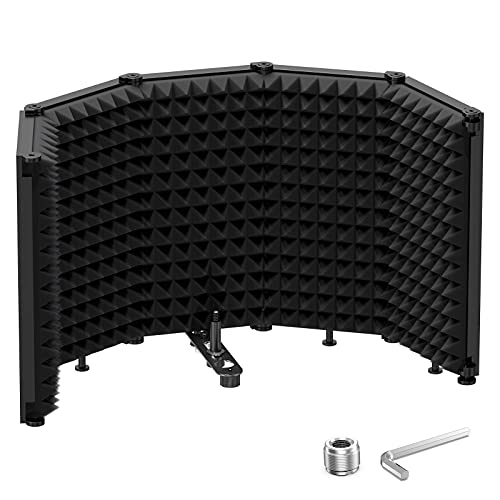 Moukey Microphone Insulation Sound Insulation Sound Shield IsolationL(29.9''x12.8'')3.26 PoundsCheck on Amazon
 Aokeo Professional Studio Recording Microphone Isolation ShieldFoldable Adjustable12.99 x 8.27 x 1.77 inches1.2 PoundsCheck on Amazon
 Aokeo Studio Recording Microphone Isolation Shield with PopAO-302 with stand12.2 x 2.95 x 16.6 inches0.9 poundsCheck on Amazon


The best microphone isolation shield for most home and project studios is the XTUGA MIS02 five-panel shield: five hinged panels wrap roughly a 180-degree arc around the capsule, the whole unit folds flat for storage, and its mid-range price tier leaves budget free for the room treatment that fixes the low-frequency problems no shield can touch. If you want the cheapest complete kit — shield, pop filter and a table stand in one box — the Moukey foldable shield with pop filter and table stand is the smarter buy, and if you record vocals daily in an untreated room, the TONOR isolation shield with tripod stand offers the widest coverage and the most stable mounting of the twelve options compared here. One thing to understand before you spend anything: these products are reflection filters, not soundproofing. They absorb and block the mid- and high-frequency energy bouncing off the wall in front of your microphone. They do not stop traffic, roommates, or the low-frequency build-up that only bass trapping and distance solve. Buy one to clean up the tone of a close-miked voice, not to silence a room.
Top 3 Picks
Best overall: XTUGA MIS02 Recording Microphone Isolation Shield
Five panels of foam-lined coverage give the MIS02 the widest effective arc of any mid-range shield here, and the foldable frame collapses into a rectangle you can slide behind a desk. It ships as a shield only, which keeps the price in the mid-range tier instead of bundling hardware you may already own. Choose it if you already have a boom arm, a pop filter and a microphone you like.
Best budget: Moukey Microphone Isolation Shield with Pop Filter & Table Stand
This is the only budget-tier option in this roundup that arrives as a complete recording station — foldable triple-layer shield, pop filter and a table stand in one box. The foam is thinner and the panels smaller than the mid-range picks, but for a first podcast, a voiceover side project or a student setup, it removes three separate purchases from your list. It suits anyone who wants to plug in and start recording the day it arrives.
Best premium: TONOR Microphone Isolation Shield with Tripod Stand
TONOR’s standalone shield with tripod stand is built around a vocal-booth idea: a larger enclosure, denser absorbent foam and a stand heavy enough to hold the shield plus a large-diaphragm condenser without tipping. It is the pick for daily recording, for rooms with hard parallel walls, and for anyone whose microphone stand currently wobbles under the weight of a shield. If you also need the microphone itself, the TONOR podcast bundle further down covers that in one purchase.
Quick Comparison
| Product | Best for | Key specs | Price tier |
|---|---|---|---|
| Moukey 5-Side Isolation Shield | Wide-arc coverage on an existing stand | 5 panels, foam-lined interior, foldable metal frame, shield only | Mid-range |
| Moukey Foldable Shield with Pop Filter & Table Stand | Cheapest complete starter kit | Foldable panels, triple sound insulation, pop filter, table stand | Budget |
| Aokeo Foldable Triple-Layer Shield | Fast folding and travel | 3-panel class, triple sound insulation, reflection filter design | Mid-range |
| Aokeo Professional Studio Shield | Large-diaphragm USB mics | Shield class built for Blue Yeti and similar condensers, studio frame | Budget |
| TIZECO Foldable Shield with Tripod Stand | Desk-based podcasting | Foldable foam shield, pop filter, tripod stand included | Premium |
| Aokeo Studio Shield with Pop Filter & Tripod Stand | High-density absorption | High-density absorbent foam, pop filter, tripod stand | Premium |
| XTUGA MIS02 Isolation Shield | Best overall home studio balance | 5 panels, soundproof foam lining, foldable frame | Mid-range |
| TONOR Isolation Shield with Tripod Stand | Vocal booth and loud rooms | Large enclosure class, dense foam, tripod stand, vocal-booth design | Premium |
| GDPONRM Isolation Ball Wind Shield | Handheld and on-camera mics | Ball-style acoustic foam windscreen, pop filter class, no frame | Budget |
| Frgyee Isolation Shield with Mic Stand & Pop Filter | One-box complete setup | Foldable shield, mic stand, pop filter, desk-friendly footprint | Budget |
| CAHAYA Foldable Isolation Shield | Small desks and tight corners | Foldable foam reflector, compact folded footprint, stand-mount class | Mid-range |
| TONOR Studio Mic with Isolation Shield Set | All-in-one podcast bundle | Condenser mic plus isolation shield set, podcast-oriented kit | Premium |
How We Chose
This roundup is built from published product specifications, brand documentation and established acoustic principles rather than hands-on measurement. Every entry had to clear four filters. First, category fit: the product must genuinely be a microphone isolation shield or reflection filter, not a foam windscreen or a generic acoustic panel pressed into a role it cannot fill. Second, specification transparency: panel count, frame material class, foam type, mounting method and included accessories all had to be described clearly enough that a buyer could predict how the unit behaves on a stand. Third, use-case match: we mapped each product to a recording situation — single vocalist at a desk, travelling podcaster, untreated bedroom, handheld field recording — and rejected options that only work in one narrow setup. Fourth, upgrade path: a good first shield should not become dead weight when you upgrade your microphone, so we favoured designs that mount on standard threaded stands and fold away rather than proprietary desk-only clamps. Price tiers reflect general market positioning, not live pricing, and no product here was tested, borrowed or owned by us.
1. Moukey 5-Side Microphone Isolation Shield – Best for Wide-Angle Coverage
As an Amazon Associate we earn from qualifying purchases at no extra cost to you.

The five-sided Moukey is the version of this design for someone who already owns a stand, a pop filter and a microphone, and simply wants the maximum amount of foam wrapped around the back and sides of the capsule. It suits vocalists, voiceover artists and podcast hosts working with a boom arm in a small room with a hard wall directly behind the mic — the exact geometry where a reflection filter earns its keep.
Key specs
- Five-panel enclosure: one rear panel plus four hinged wings that fold inward
- Interior faces lined with sound-absorbing acoustic foam
- Foldable frame with hinges, collapsing to a compact rectangle for storage
- Mounts on a standard microphone stand or boom arm using a threaded adapter in the 3/8-inch / 5/8-inch class
- Shield only — no pop filter, no stand, no carry bag in the listing
Where it performs
More panels means a wider arc of absorption, and a wider arc means fewer paths for high-frequency energy to sneak past the shield and back into the front of a cardioid capsule. In practice, five panels cover roughly the rear hemisphere, which is where the strongest early reflection from a nearby wall arrives. The trade-off is weight and bulk: a five-panel frame hanging off the end of a boom arm puts real leverage on the clutch and counterweight, so a lightweight desktop boom will sag unless you tighten it properly. On a heavier studio stand, that same mass becomes an advantage, because the shield stays exactly where you set it between takes instead of drifting.
Because the foam is a consumable — it compresses, sheds dust and loses resilience over years of use — the metal frame and hinge quality matter more than most buyers expect. A folding frame that holds its angle is the difference between a shield you use every session and one that lives in a drawer. Mounting hardware is standard rather than proprietary here, which is the single most useful long-term feature: when you upgrade your microphone, the shield comes with you.
Pros
- Widest arc of coverage in the Moukey range
- Folds flat for storage in a drawer or equipment bag
- Standard threaded mounting, so it fits almost any stand or boom arm
- No bundled accessories inflating the price — you pay for the shield
Cons
- No pop filter included, so plosives still need separate control
- No stand included, which is a hidden cost if you own nothing yet
- Five panels are heavier and bulkier than three-panel designs on a light boom
- Foam lining will need replacing or refreshing long before the frame does
How it compares
Against the budget Moukey foldable kit further down, this model trades bundled accessories for coverage: you get more panels and a sturdier enclosure, but you supply your own stand and pop filter. Against the XTUGA MIS02, the two are close in concept — both are five-panel, foam-lined, folding shields — and the deciding factor is usually mounting hardware and price tier rather than acoustic design. If you record at a desk with a boom arm and want the most wrap per unit of bulk, this is the straightforward choice.
2. Moukey Foldable Isolation Shield with Pop Filter and Table Stand – Best for Budget Starter Kits

This is the shield for someone who has a microphone and a laptop and nothing else. The listing describes a foldable mic shield with triple sound insulation, a pop filter and a table stand in one package, which turns a bare desk into a usable recording corner without three separate orders. It suits first-time podcasters, students, streamers and anyone recording voice memos, narration or video voiceover a few times a month rather than daily.
Key specs
- Foldable isolation shield with triple sound insulation layers
- Pop filter included, mounted on the shield assembly
- Table stand included, sized for desktop use
- Panels fold for storage when the desk is not in recording mode
- Budget tier — the accessories are the value, not the panel size
Where it performs
The honest framing of a budget kit is that you are buying convenience and a meaningful improvement, not a transformation. A small folding shield with a pop filter placed between your mouth and a hard wall behind the mic will reduce the bright, boxy reflections that make a bedroom recording sound like a bedroom recording. That is a real and audible gain on a spoken-word track. What it will not do is make a noisy room quiet, and it will not fix a room’s low-frequency boom.
The table stand is the part most buyers underestimate. A desktop stand puts the microphone at a fixed height above the desk surface, which is both a limitation and a benefit: limited because you cannot position the mic freely, beneficial because it removes the desk reflection problem entirely by lifting the capsule clear of the surface. If your previous setup was a microphone lying flat on the desk, this alone will change how your recordings sound.
The triple-layer insulation claim refers to the construction of the absorbent lining rather than three separate acoustic treatments. Think of it as a thicker, denser foam build than a single-layer shield, which extends useful absorption slightly lower in frequency. It is still a mid- and high-frequency tool.
Pros
- Complete kit — shield, pop filter and stand in one purchase
- Pop filter included removes the most common source of ruined takes
- Table stand lifts the mic clear of desk reflections
- Folds down small enough to live in a drawer between sessions
- Lowest entry cost of any complete setup in this roundup
Cons
- Smaller panels and thinner foam than mid-range five-panel designs
- Table stand is not height-adjustable in the way a boom arm is
- Not suitable for heavy large-diaphragm condensers on the included stand
- Limited upgrade path — you will outgrow it if you start recording daily
How it compares
Against the Frgyee shield with mic stand and pop filter, the two are direct competitors in the budget tier and both solve the same problem: getting a beginner from zero to recording. The Frgyee includes a microphone stand rather than a table stand, which suits floor or desk-edge placement; the Moukey favours a compact desk footprint. Against the five-sided Moukey shield above, you sacrifice panel coverage and foam depth but gain a pop filter and a stand for less money. If your goal is to record something this week and decide later whether to invest, this is the pragmatic entry point.
3. Aokeo Foldable Microphone Isolation Shield – Best for Fast Folding and Travel

Aokeo’s foldable triple-insulation shield is the travel-friendly mid-range option: a reflection filter with a three-panel class frame that collapses quickly and packs into a bag without dismantling anything. It suits podcasters who record in more than one location, teachers and streamers who set up and strike their gear around other uses of the same desk, and anyone whose recording space doubles as a dining table.
Key specs
- Three-panel class foldable frame with triple sound insulation
- Reflection filter design — absorbs and redirects energy rather than blocking it
- Folds on hinges for transport; no tools needed to collapse
- Stand-mount class fitting for standard threaded microphone stands and boom arms
- Mid-range tier, positioned between the budget kits and the large premium enclosures
Where it performs
A three-panel shield covers roughly the rear two-thirds of the space around a microphone. For a cardioid condenser pointed at a single speaker, that is usually enough: the capsule rejects most of what arrives from behind, and the shield removes the high-frequency energy that would otherwise reflect off the wall directly behind the mic and re-enter the front. The narrower arc also means less bulk on the stand, which translates directly into faster setup and less sag on a lightweight boom.
Portability is not only about weight. It is about the number of steps between “bag” and “recording.” A shield that folds in one motion and re-hangs on the stand in another is a shield you will actually use on a trip. A shield that needs a screwdriver, a counterweight adjustment and a pop filter re-thread does not travel. This model’s value is in that friction budget rather than in raw absorption area.
The trade-off with a three-panel design appears in difficult rooms. If you record with a hard, flat wall within half a metre of the microphone, the outer edges of the reflection path fall outside the shield’s arc, and you will hear a thin, hollow quality that a five-panel enclosure would have reduced. The fix costs nothing: move the microphone further from the wall, or angle the whole stand so the shield faces the closest reflective surface.
Pros
- Folds quickly and packs flat for transport
- Lighter than five-panel enclosures, so it suits lighter boom arms
- Triple-layer insulation build extends absorption beyond a basic single layer
- Standard mounting keeps it compatible with gear you already own
Cons
- Narrower arc leaves the outer reflection paths uncovered
- No pop filter or stand included in this configuration
- Less effective than a five-panel design against a wall within half a metre
- Foam lining is still the first component to wear
How it compares
Against the CAHAYA foldable shield, both are mid-range folding reflectors, and the choice comes down to folded footprint and how the hinge mechanism behaves after repeated cycles — the specification class is similar. Against the XTUGA MIS02, the Aokeo trades two panels of coverage for a smaller packed size and lighter weight on the stand. If your recording happens in one fixed spot, take the coverage; if your recording happens wherever you can find a quiet hour, take the portability.
4. Aokeo Professional Studio Recording Microphone Isolation Shield – Best for Large-Diaphragm USB Mics

This is the shield that names its target microphone class in the listing itself: it is described as suitable for a Blue Yeti and any condenser microphone. That matters because large-diaphragm USB condensers are physically wide, often mount on a desk stand rather than a boom, and sit close to the desk surface where reflections are worst. It suits streamers, YouTubers, gamers and home narrators using exactly that kind of microphone.
Key specs
- Studio-class isolation shield sized to sit behind a large-diaphragm condenser
- Explicitly compatible with Blue Yeti and general condenser microphones
- Foam-lined enclosure with a folding frame
- Stand-mount class fitting; works with desk stands and boom arms
- Budget tier, making it one of the cheapest ways to add absorption around a USB mic
Where it performs
Large-diaphragm USB microphones are sensitive, side-address and usually placed 15 to 30 centimetres from the speaker’s mouth on a desktop. That combination creates two problems a shield can genuinely solve: a strong reflection from the wall behind the microphone, and a boundary reflection from the desk surface below it. Positioning this shield behind the capsule intercepts the first, and raising the mic stand slightly handles the second.
There is a subtlety specific to side-address microphones that buyers get wrong. Because the capsule picks up from the side, the shield must sit behind the grille relative to your mouth — not behind the microphone body as a whole if the microphone is angled. Getting that geometry right is worth more than any difference between shield models in this price tier. Take two minutes to sight along the microphone’s axis and confirm the foam is in the reflection path.
The budget-tier construction shows up in the frame and the fittings rather than the acoustic concept. Hinges loosen with repeated folding, and the foam compresses where the shield presses against the stand. Treated gently and left assembled in one position, this class of shield can serve for years. Folded and unfolded twice a day, it will show wear within a year.
Pros
- Explicitly sized and specified for large-diaphragm USB condensers
- One of the lowest-cost ways to add absorption behind a desk mic
- Folding frame keeps it storable
- Compatible with the desk stands most USB microphones ship with
Cons
- Budget frame and hinges are the weak point under daily folding
- No pop filter or stand included
- Smaller effective arc than a five-panel enclosure
- Will not address low-frequency room boom at all
How it compares
Against the Aokeo foldable triple-insulation shield above, this model is positioned for a specific microphone shape rather than for travel, and it sits a tier lower on price. Against the Frgyee complete kit, you get a more purpose-built shield for a wide USB condenser but no stand or pop filter. If you own a Yeti-class microphone and want the cheapest credible improvement, this is the direct answer; if you own nothing yet, the bundles are the better starting point.
5. TIZECO Microphone Isolation Shield with Tripod Stand – Best for Desk-Based Podcasting

TIZECO’s foldable shield arrives with foam protection, a pop filter and a tripod stand, which makes it a self-contained podcasting station rather than a component. It suits two-host shows recorded at a table, solo podcasters who want a repeatable setup that never changes between episodes, and anyone who prefers a tripod footprint on the floor to a boom arm clamped to a desk.
Key specs
- Foldable isolation shield with acoustic foam protection
- Pop filter included on the shield assembly
- Tripod stand included — floor-standing, three-leg class
- Premium tier, reflecting the complete kit and the larger enclosure class
- Designed for seated, table-height recording rather than handheld use
Where it performs
The tripod changes the physics of the setup in a useful way. A floor tripod decouples the microphone from the desk entirely, which removes the structural path that carries keyboard taps, mouse clicks and knocks straight into the capsule. If your recordings are currently spoiled by low thumps every time you touch the table, a tripod-mounted shield is a bigger upgrade than any change of foam thickness.
It also fixes a problem that desk-mounted shields create: weight. Hanging a folding shield plus a pop filter on a desk boom puts a cantilever load on a clamp, and cheap clamps creep. A tripod carries the same load on the floor, where it does not matter. The cost is floor space and a fixed position — you lose the ability to swing the microphone out of the way mid-session without moving the whole stand.
For two-person recordings, the geometry needs thought. A single shield behind one microphone does not help the second speaker, and if the two of you share one microphone at a table, the shield should sit opposite the pair rather than behind the capsule. If you record a two-host show regularly, the practical answer is two microphones and two shields, or one microphone moved between speakers between segments.
Pros
- Complete kit with shield, pop filter and tripod stand
- Tripod mounting removes desk-borne thumps and vibrations
- Foldable shield stores flat when not in use
- Larger enclosure class than the budget kits in this roundup
Cons
- Premium tier pricing for a setup that still needs a good microphone
- Tripod occupies floor space and is slower to reposition than a boom
- Tripods are more prone to accidental knocks than a clamped boom
- Single shield does not serve a two-person table recording
How it compares
Against the Aokeo studio shield with pop filter and tripod stand, the two are near-identical in concept and both sit in the premium tier; the meaningful differences are enclosure size, foam density claims and the stability of the included tripod, which is worth checking in the specification before buying either. Against the TONOR shield with tripod stand, TIZECO leans toward seated podcasting while TONOR’s vocal-booth framing points at louder, more reflective rooms. If your problem is desk noise rather than wall reflections, this is the more targeted purchase.
6. Aokeo Studio Isolation Shield with Pop Filter and Tripod Stand – Best for High-Density Absorption

Aokeo’s premium studio shield pairs high-density absorbent foam with a pop filter and a tripod stand. The listing’s emphasis on foam density is the detail that separates it from cheaper shields in the same brand’s range: for a given thickness, a denser open-cell foam absorbs more energy across the mid-band, which is where a voice’s intelligibility and harshness live. It suits voiceover artists, audiobook narrators and singers who need a consistent, repeatable tone take after take.
Key specs
- High-density absorbent foam lining — the defining feature of this model
- Pop filter included
- Tripod stand included
- Studio-class enclosure with a folding frame
- Premium tier, positioned as the higher-specification Aokeo option
Where it performs
Foam density is the least visible and most consequential specification in this category. Low-density foam of a given thickness absorbs high frequencies well and mid frequencies poorly, which produces a recording that sounds dull at the top and still boxy in the middle. Higher-density foam extends useful absorption downward, so the shield removes the midrange honk that makes a small room obvious. If you have ever compared two shields of similar size and found one dramatically better, density and thickness were almost certainly the reason.
The pop filter earns its place on a shield like this because the two work on different problems. The foam handles reflections arriving from behind and beside the capsule; the pop filter handles the burst of air from plosive consonants hitting the diaphragm head-on. Neither substitutes for the other, and a shield without a pop filter leaves the most common cause of retakes unaddressed.
High-density foam also behaves better over time. It resists the compression and crumbling that turns cheap foam into dust, so the shield keeps its acoustic properties longer. That does not make it permanent — foam is still a consumable — but it changes how often you replace it.
Pros
- High-density foam absorbs more mid-band energy than basic linings
- Pop filter included for plosive control
- Tripod stand included, so the kit is ready out of the box
- Foam holds its shape better under repeated use
Cons
- Premium price for a category where the room still matters more
- Tripod takes floor space and is not ideal for tight desks
- Dense foam makes the shield heavier on the stand
- Still no effect on low-frequency room modes
How it compares
Against the TIZECO kit, this is the density-focused alternative: similar accessory list, different emphasis, and the choice usually comes down to which enclosure size suits your microphone. Against the budget Aokeo professional shield, the jump in price buys real acoustic difference — denser foam, a pop filter and a stand — rather than branding. If you record spoken word professionally and cannot treat the room, this is the tier where the upgrade stops being cosmetic.
7. XTUGA MIS02 Recording Microphone Isolation Shield – Best Overall for Home Studios
The MIS02 is a five-panel shield lined with soundproofing foam and built on a folding frame, and it is the best overall pick in this roundup because it gets the fundamentals right without bundling accessories you may not want. Five panels give a wide arc of coverage, the fold makes it storable in a small room, and the mid-range price tier keeps the total cost of a home studio within reach. It suits a single vocalist or podcaster working at a desk with a boom arm, a pop filter and a condenser microphone they already trust.
Key specs
- Five-panel construction for wide rear and side coverage
- Foam-lined interior faces
- Foldable frame for storage and transport
- Stand-mount class fitting for standard threaded microphone stands
- Mid-range tier — shield only, no stand or pop filter
Where it performs
The five-panel geometry is the reason this design wins for a fixed desk setup. Reflections from the wall behind the microphone, from the side walls of a narrow room, and from the ceiling above the stand all arrive from different angles. A three-panel shield covers the first; a five-panel enclosure covers the first two and reduces the third. In a small bedroom studio, where walls are close and parallel, that extra coverage is audible as a cleaner, less hollow midrange on a close-miked voice.
Because it ships as a shield alone, the MIS02 rewards buyers who already own decent hardware. A boom arm with a proper counterweight carries it without sag; a separate pop filter handles plosives; a shock mount isolates the capsule from floor vibration. That combination outperforms any all-in-one kit at the same total spend, because each component is doing its own job instead of being bundled at the lowest common specification.
Setup is a two-minute job: thread the mount onto the stand, set the hinge angle so the panels wrap the rear of the capsule without touching it, then sight along the microphone’s axis to confirm the foam sits in the reflection path. Keep the shield a few centimetres clear of the microphone body — foam touching the stand transmits vibration, and panels crowding the capsule can colour the sound. Once set, leave it set. Folding and unfolding is the main source of wear on any shield in this class.
Pros
- Five-panel arc covers rear and side reflections
- Folds flat for storage in small rooms
- Standard mounting keeps it compatible across stands and boom arms
- Mid-range price leaves budget for a pop filter and shock mount
- No bundled accessories to pay for twice
Cons
- Shield only — nothing else in the box
- Five panels are heavier than three-panel designs on light booms
- Foam lining remains the first component to degrade
- No effect on low-frequency room problems
How it compares
Against the Moukey five-sided shield, the two are functionally similar and the decision is mostly about mounting hardware and current price tier — both offer five-panel coverage with a folding frame. Against the CAHAYA foldable shield, the MIS02 gives up some compactness for two extra panels of absorption. If you want the best balance of coverage, storability and price without buying a kit you do not need, this is the one to start with.
8. TONOR Microphone Isolation Shield with Tripod Stand – Best for Vocal Booths and Loud Rooms

TONOR’s isolation shield with tripod stand is framed by the brand as a vocal booth, and that is the right way to read it: a larger enclosure, dense absorbent foam and a floor stand stable enough to hold the assembly without creeping. It suits singers tracking takes in a bedroom, narrators working in rooms with hard parallel walls, and anyone whose current shield tips or drifts on a lightweight desk boom.
Key specs
- Large vocal-booth class enclosure with folding panels
- Dense absorbent foam lining
- Tripod stand included for floor placement
- Stand-mount class fitting, designed as a complete recording position
- Premium tier
Where it performs
The value of a larger enclosure is geometric. Absorption scales with surface area, so a bigger shield of the same foam removes more reflected energy than a smaller one, and it does so over a wider arc. In a room with two hard parallel walls — the classic bedroom problem — the reflection that reaches the microphone is not only the one directly behind it but also the one that has bounced twice. A larger shield intercepts more of the first-order reflection and blocks part of the path for the second.
The tripod matters for a different reason: stability under a heavy microphone. A large-diaphragm condenser plus a shock mount plus a folding shield is a meaningful load, and desk clamps rated for a bare microphone will slip. A floor tripod with a wide leg spread carries that load without drama. The trade is footprint and a fixed position — once placed, the whole assembly stays put for the session, which is exactly what you want when tracking a full song.
The word “booth” deserves a caveat. No shield of this size creates a vocal booth in the acoustic sense; it creates a drier zone directly in front of the capsule. The remaining weak point is always the low end, because low frequencies diffract around a shield of this size rather than being absorbed by it. If your recordings have a boomy, one-note quality, treat the corners of the room or move the microphone toward the middle of the space. The shield handles the brightness; the room handles the boom.
Pros
- Larger enclosure absorbs more energy over a wider arc
- Dense foam suits spoken word and singing alike
- Tripod stand is stable under heavy condenser microphones
- Complete recording position out of the box
Cons
- Premium tier pricing
- Floor footprint is awkward in very small rooms
- Not portable in the way a folding three-panel shield is
- Does not address low-frequency room issues
How it compares
Against the TIZECO and Aokeo premium kits, TONOR’s enclosure is pitched at louder, more reflective rooms rather than at desk convenience, and the tripod is the component to scrutinise in the specification. Against the XTUGA MIS02, you are paying for size, density and a stand rather than for a different concept. If you record daily and your room fights you, the larger enclosure is the better use of money than a second accessory.
9. GDPONRM Microphone Wind Shield Pop Filter Isolation Ball – Best for Handheld and On-Camera Mics

The GDPONRM isolation ball is a different species from the panel shields above: a ball-shaped acoustic foam windscreen that slips over a microphone capsule to control wind noise, plosives and close-proximity reflections. It suits handheld dynamic microphones, on-camera interview mics, field recorders and any setup where a folding panel is physically impossible. It is the right tool when the microphone moves and the environment changes.
Key specs
- Ball-style acoustic foam windscreen fitting over the microphone capsule
- Functions as wind shield, pop filter and close-reflection absorber in one
- No frame, no stand and no mounting hardware
- Budget tier
- Suited to handheld, camera-mounted and portable recording rather than desk setups
Where it performs
A ball windscreen does three jobs that panel shields cannot. It blocks moving air from reaching the diaphragm, which is the only way to record usable audio outdoors on a breezy day. It softens plosives by spreading the burst of air across the foam surface instead of letting it strike the capsule. And because it surrounds the capsule, it suppresses the very short reflections that occur between the microphone and nearby surfaces — including the speaker’s own hand and the camera body.
What it cannot do is replace a reflection filter in a room. Its absorbent surface area is small and it sits in front of the capsule rather than between the capsule and the wall, so it has almost no effect on room reflections arriving from behind. If your recordings are made at a desk with a hard wall behind the microphone, a ball windscreen will not fix the hollowness; you need panels.
Fit is the practical consideration. A ball windscreen must grip the capsule firmly enough not to slip during handling but loosely enough to slide on and off without tearing. Foam of this type stretches and eventually loses its grip, which makes it a consumable in the truest sense — expect to replace it periodically, especially if it is used outdoors and exposed to sunlight.
Pros
- Effective wind and plosive control for handheld and outdoor recording
- Works where a panel shield physically cannot be used
- Adds almost no weight to a camera or handheld rig
- Cheapest way to improve a portable recording setup
Cons
- No meaningful control of room reflections
- Foam stretches and loses grip over time
- Not a substitute for a panel shield at a desk
- No frame or stand included
How it compares
Against every panel shield in this roundup, the comparison is not one of quality but of purpose: this is a portable problem-solver, not a studio fixture. Against the Frgyee kit or the budget Moukey bundle, it costs far less but only solves one of the three problems a desk recordist faces. Buy it to accompany a panel shield for outdoor segments, or as a standalone solution for handheld and on-camera work.
10. Frgyee Microphone Isolation Shield with Mic Stand and Pop Filter – Best for One-Box Complete Setups

Frgyee’s offering combines an isolation shield, a microphone stand and a pop filter in a single budget-tier package. It suits the buyer who wants a finished recording position — stand on the floor or desk edge, shield behind the microphone, pop filter in front — without researching three separate products. That makes it a reasonable fit for new streamers, voice-memo creators and anyone assembling a first setup for a hobby that may or may not stick.
Key specs
- Foldable isolation shield with foam lining
- Microphone stand included
- Pop filter included
- Budget tier
- Desk-friendly footprint with a folding shield for storage
Where it performs
The stand is the difference between this kit and a shield-only purchase. A stand establishes a repeatable microphone position, which is the single most valuable habit in home recording: if the microphone is in the same place at the same distance every session, your recordings are consistent, and consistency is what makes editing and processing predictable. A kit that includes the stand removes the temptation to improvise a position each time.
The pop filter placement matters as much as its presence. It should sit between the speaker’s mouth and the capsule, roughly two to three finger-widths off the grille, angled to face the mouth rather than the microphone. Too close and it colours the sound; too far and plosives slip past. Getting this right costs nothing and improves results more than upgrading the shield.
Where a budget kit like this shows its limits is in the stand’s weight rating and the shield’s panel size. A large-diaphragm condenser on a light stand will droop, and a small shield covers a narrower arc than a five-panel enclosure. Both are acceptable trade-offs at this tier, provided you match the kit to a lightweight microphone and keep the recording position clear of nearby walls.
Pros
- Complete setup in one purchase at the lowest tier
- Stand establishes a consistent microphone position
- Pop filter included for plosive control
- Folding shield stores easily in small spaces
Cons
- Stand weight rating limits which microphones it will hold
- Smaller shield arc than mid-range five-panel designs
- Budget foam and hinges wear faster under daily folding
- Little upgrade headroom as your recording improves
How it compares
Against the budget Moukey kit, the difference is stand type rather than concept: Frgyee includes a microphone stand, Moukey a table stand, and your choice depends on whether you want the microphone on the floor or on the desk. Against the XTUGA MIS02, you gain a stand and pop filter but lose two panels of coverage and foam density. If you are starting from nothing, the kit is the faster path; if you already own a stand, buy the shield.
11. CAHAYA Foldable Microphone Isolation Shield – Best for Small Desks and Tight Corners

CAHAYA’s foldable shield is a sound-absorbing foam reflector designed to fold down small, and that compactness is its reason to exist. It suits people recording at a small desk, in a corner where a wider enclosure would collide with a monitor or a wall, or in a shared room where the gear has to disappear into a cupboard afterwards. The mid-range tier puts it alongside the Aokeo folding shield and the XTUGA MIS02.
Key specs
- Foldable shield with sound-absorbing foam reflector panels
- Compact folded footprint for storage in tight spaces
- Stand-mount class fitting for standard microphone stands
- Mid-range tier
- Shield only — stand and pop filter are separate purchases
Where it performs
Small-desk recording has a specific failure mode that bigger shields make worse: the enclosure crowds the microphone, blocks sight of the screen, and forces the capsule closer to a wall than it should be. A compact folding shield lets you keep the microphone at a sensible distance from the wall while still fitting the whole rig into a desk corner. That geometric win can outweigh the acoustic cost of fewer panels.
The second advantage is domestic. Equipment that cannot be put away is equipment that gets left out, and equipment left out collects dust and gets knocked. A shield that folds into a cupboard in ten seconds gets used more often, and use frequency is the variable that most improves recordings. If you are choosing between a large enclosure that lives in a drawer because it is awkward and a small one that stays on the stand, take the small one.
The trade-off is coverage. Fewer panels mean more reflection paths remain open, so positioning does more of the work: keep the microphone at least a metre from the nearest wall where possible, angle the shield toward the closest reflective surface, and avoid recording in a corner where two walls meet, because corners concentrate low-frequency energy in a way no shield can absorb.
Pros
- Compact folded footprint suits small desks and shared rooms
- Folds quickly, so it actually gets stored
- Standard mounting keeps it compatible with existing stands
- Mid-range pricing without bundled accessories you may not need
Cons
- Narrower coverage than five-panel enclosures
- No stand or pop filter included
- Less effective in corner positions, which are common on small desks
- Foam lining remains the consumable component
How it compares
Against the Aokeo foldable shield, both are compact mid-range reflectors and the deciding factors are folded dimensions, hinge feel and how the foam is attached. Against the XTUGA MIS02, CAHAYA sacrifices panel coverage for a smaller packed size. If your recording space is a corner of a shared room and the gear has to vanish afterwards, the compactness is worth more than the extra panels.
12. TONOR Studio Recording Microphone with Isolation Shield Set – Best All-in-One Podcast Bundle
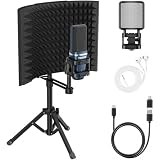
TONOR’s podcast set bundles a studio recording microphone with an isolation shield, which makes it the only entry here that solves the entire signal chain in a single purchase. It suits someone starting a podcast from scratch, a co-host joining an existing show, or a buyer who would rather make one decision than five. The premium tier reflects the fact that you are getting a microphone and a shield together.
Key specs
- Studio recording condenser microphone included
- Isolation shield set included
- Podcast-oriented bundle, positioned as a complete recording solution
- Premium tier
- Designed for seated, spoken-word recording
Where it performs
Bundles are usually criticised for compromising on components, but there is a real argument for them at the start of a podcast. The hardest part of a first setup is matching parts — a microphone that suits the stand, a shield that fits the microphone, a pop filter that sits in the right place. A matched set removes those compatibility risks, and compatibility problems are what stop beginners from recording at all.
The microphone in a bundle like this is typically a cardioid condenser intended for close speech, which pairs naturally with a shield: the closer the microphone, the more the direct sound dominates the room, and the shield cleans up what remains. Used at a hand-span distance with the shield behind the capsule and a pop filter in front, this class of kit can produce a broadcast-style tone in an ordinary room.
The upgrade path deserves thought before buying. If you already own a microphone you like, this bundle duplicates it. If you own nothing, the bundle is efficient. And if you plan to expand to a two-host show, check whether the stand and shield in the set can be bought separately later, so the second position can be matched to the first.
Pros
- Microphone and shield matched for compatibility out of the box
- One purchase covers the whole recording position
- Podcast-focused design for seated spoken-word use
- Removes the risk of buying parts that do not fit together
Cons
- Premium tier, and you pay for parts you may already own
- Bundle microphones rarely match a dedicated microphone of the same price
- Less flexibility if you later want a different capsule type
- Still limited by the room’s low-frequency behaviour
How it compares
Against the standalone TONOR shield with tripod stand, this set trades the larger enclosure and floor tripod for an included microphone and a lower total outlay than buying both separately at premium prices. Against the Frgyee and Moukey budget kits, it costs more but removes the weakest link — the microphone — from the equation. If you are starting a show and own no gear, the bundle is the shortest path to episode one.
How to Choose
Understand what a shield actually does
An isolation shield is a reflection filter. Its job is to absorb and block the mid- and high-frequency energy that leaves your mouth, strikes a hard surface and arrives back at the microphone a few milliseconds after the direct sound. When that delayed copy of your voice meets the direct sound at the capsule, the two combine and produce a comb filter — a series of peaks and notches across the frequency spectrum that makes a voice sound hollow, cupped or distant. Removing the reflection removes the comb filter.
The delay is easy to calculate and it tells you how urgent the problem is. Sound travels at roughly 343 metres per second. If your microphone sits one metre from the wall behind it, the reflection travels two metres further than the direct sound, arriving about 5.8 milliseconds late. The first cancellation notch falls at roughly 1 ÷ (2 × 0.0058) ≈ 86 Hz, with further notches at about 258 Hz, 430 Hz and upward. Move the microphone to half a metre from the wall and the delay halves to 2.9 ms, pushing the first notch up to about 172 Hz — right in the fundamental range of a male voice, where it does the most audible damage. That is why positioning beats shopping: moving the microphone away from the wall is free and often more effective than any upgrade.
Match panel count to your room
Three-panel shields cover roughly the rear two-thirds of









