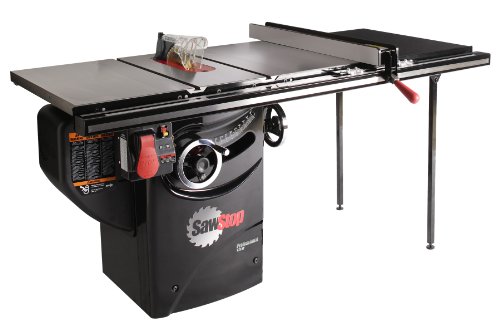
A cabinet table saw is the right choice for serious woodworkers and small professional shops that cut thick hardwood regularly, need a heavy and stable machine, and have access to 240-volt power. The SawStop Professional Cabinet Saw suits buyers who put the flesh-sensing brake first, Powermatic and Jet suit those who prefer a traditional heavy build, and Grizzly or Shop Fox suit those who want more machine per unit of budget.
Our top picks


As an Amazon Associate we earn from qualifying purchases at no extra cost to you.
What defines a cabinet saw
A cabinet saw has a fully enclosed cast-iron or steel cabinet, with the trunnion mounted to the cabinet rather than the table. Motors are typically 3 to 5 horsepower induction types, often running on 230 or 240 volts, though some makers list 120-volt versions in smaller horsepower ratings. The weight, commonly several hundred pounds, absorbs vibration and keeps cuts smooth. Enclosed bases help dust collection, and a large cast-iron table with extension wings provides a stable surface for sheet goods and long stock.
At a glance
| Saw | Best for | Key stated traits | Limits |
|---|---|---|---|
| SawStop Professional Cabinet Saw (PCS) | Shops prioritizing the flesh-sensing brake | Maker lists 3 HP and 1.75 HP configurations, a 10-inch blade and a T-glide fence system with several rail lengths | Premium tier; brake cartridge replacement after a trigger |
| SawStop Industrial Cabinet Saw (ICS) | Production shops | Maker lists higher horsepower options (up to 5 HP) and a heavier build | Premium tier; needs 240-volt, often three-phase options |
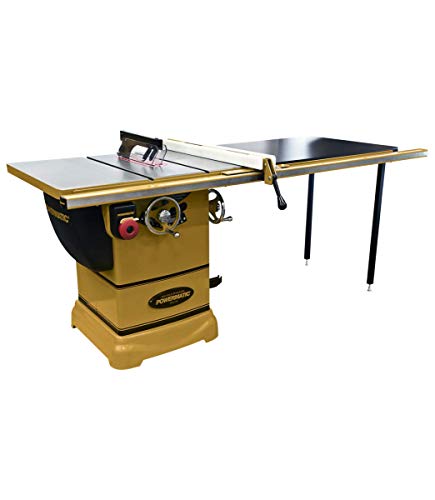
| Powermatic PM2000B / PM66 class | Buyers wanting a heavy traditional machine | Maker lists a 3 HP class motor, a cast-iron table and a rail-mounted fence | No flesh-sensing brake; premium tier |
| Jet Xacta or ProShop cabinet saws | Serious hobbyists | Maker lists a 3 HP class motor and a precision fence | Lineup changes; confirm the exact model |
| Grizzly cabinet saws | Cost-conscious buyers | Maker lists 3 to 5 HP options and cast-iron tops across several models | Fit and finish vary; expect tuning time |
| Delta Unisaw | Buyers who like the classic design | Maker positions it as a long-running cabinet saw design | Check the revision you are buying and its fence package |
What to look at
Motor and electrical supply
Cabinet saws typically ask for a dedicated 240-volt circuit. Check the saw’s amperage listing and the breaker requirement in the manual. Installing a new circuit is a job for a licensed electrician. If your shop has only 120-volt outlets, consider the lower horsepower 120-volt options some makers list, or choose a hybrid saw.
Fence system
The fence is where cabinet saws differ most. Reviewers repeatedly highlight T-square fences that clamp at the front and glide smoothly, with rip capacity options such as 30, 36, 52 inches. Pick a capacity that matches your sheet goods. A 52-inch rip capacity is common for cabinetry work, though it needs a larger footprint.
Trunnion, arbor and alignment
Because the trunnion hangs from the cabinet, the top can be removed or adjusted without disturbing blade alignment. Look for solid arbor bearings, a smooth tilt mechanism and positive stops at 90 and 45 degrees. These details affect accuracy over years of use.
Dust collection
Cabinet saws list a 4-inch dust port in most cases, and some offer an overarm collection guard. Dust capture is better than open bases but still depends on a good collector. Wear a respirator suited to fine wood dust, and ventilate the shop.
Safety features
Every cabinet saw should have a riving knife that moves with the blade, a blade guard with anti-kickback pawls and a magnetic switch with a paddle off. SawStop’s brake is a separate safety technology that the maker says detects skin contact and stops the blade. It does not replace safe technique: use push sticks, stay out of the line of kickback, and keep guards in place unless a specific cut requires removal.
Budget tier trade-offs
Value tier
Value cabinet saws provide the structure and motor of a cabinet saw at a lower cost. The compromise is usually in the fence, the included accessories and the factory alignment. Owners should plan for setup time and may want to upgrade the blade and miter gauge.
Mid-range tier
Mid-range saws, including some Jet and Shop Fox models, add better fences, smoother lift mechanisms and tighter tolerances. Reviewers say these often work well for serious hobbyists and small shops.
Premium tier
Premium saws from SawStop and Powermatic provide refined fences, strong castings, quiet motors and strong support networks. SawStop adds the brake system. The price is the main drawback, as are the weight and space needs.
Pick X if you …
| If you … | Pick | Why |
|---|---|---|
| Want the brake technology in a full cabinet saw | SawStop PCS | Maker pairs the brake with a 3 HP option |
| Run a production shop | SawStop ICS or Powermatic | Higher horsepower, heavier build |
| Want a classic, tunable machine | Delta Unisaw or Jet | Long-standing designs with strong aftermarket |
| Need the most machine for the least money | Grizzly | Many horsepower and fence combinations |
| Only have 120-volt power | A hybrid saw | Easier circuit requirements |
Fit, size and care notes
Cabinet saws are heavy and often ship crated at several hundred pounds. Plan how the crate will get from the truck to the shop floor and whether you need a pallet jack or help. Allow space for outfeed support and the full rip capacity to the right of the blade. A mobile base is popular because it lets you reposition the saw, but make sure it is rated for the saw weight and locks firmly.
Maintenance is simple: keep the table waxed or treated with a rust-preventive product the maker approves, vacuum dust out of the cabinet, check the belts and keep the trunnion lubricated according to the manual. Unplug the saw or lock out power before changing blades.
Alternatives to consider
- Hybrid saws if you only have 120-volt power and less floor space.
- Sliding table saws for larger sheet goods or professional cabinetry, though they are bigger and costlier.
- Used cabinet saws from reputable older lines, if you can inspect the arbor bearings and trunnion.
Buying and setup considerations
Before the saw arrives
Decide where the saw will live and plan the dust hose, power and outfeed support before delivery. Most cabinet saws need a clear area larger than the table itself, because the fence rails extend to the right and long boards need support at the back. Mark the footprint on the floor with tape and walk through a typical cut. If the shop floor is uneven, plan for levelling feet or a mobile base that can be shimmed.
Assembly and alignment
Crated saws typically arrive with the wings, fence rails and motor cover separated. Follow the manual for bolting on the wings, then check that the surfaces are flush with a straightedge. Align the blade to the miter slot with a dial indicator or a reliable gauge, then square the fence to the blade. Makers usually give a recommended tolerance; stay within it, and recheck after a few weeks of use as the machine settles.
Accessories worth considering
- A quality blade matched to your most common cuts, such as a combination blade for general work and a dedicated rip blade for thick stock.
- A crosscut sled or a high-quality miter gauge for accurate small-part work.
- Zero-clearance inserts, which reduce tear-out and keep small offcuts from dropping into the cabinet.
- Push sticks, push blocks and featherboards, so your hands stay away from the blade.
- A dust collector with enough airflow for the saw port, and a separate air filter for the shop.
Noise and hearing
Induction motors are quieter than universal motors, but the blade cutting wood is still loud. Wear hearing protection every time you run the saw, and consider a respirator rated for fine dust when cutting sheet goods such as MDF.
Frequently Asked Questions
Is a cabinet saw worth it for a home shop?
If you cut thick hardwood, build furniture often and have 240-volt power, yes. For lighter use, a hybrid saw may do the job with less cost and less space.
What size motor do I need?
Many woodworkers are satisfied with a 3 HP motor, while heavy production use may call for 5 HP. Match motor size to your electrical service and typical stock thickness.
Do all cabinet saws need 240 volts?
Most do, though some makers list 120-volt versions at lower horsepower. Check the manual and have an electrician confirm your circuit capacity.
Is SawStop’s brake worth the premium?
The maker states that the brake is designed to reduce injury severity. It is a back-up, not a replacement for safe technique. Consider the number of users and your budget.
How wide should the rip capacity be?
Thirty to 36 inches suits general furniture work, while 52 inches is popular for handling sheet goods. Check that your shop has room for the larger rails.
How do I move a cabinet saw into my shop?
Use a pallet jack, a engine hoist or help from several people. Remove the extension wings and motor cover if the manual allows, and follow the maker’s lifting instructions.