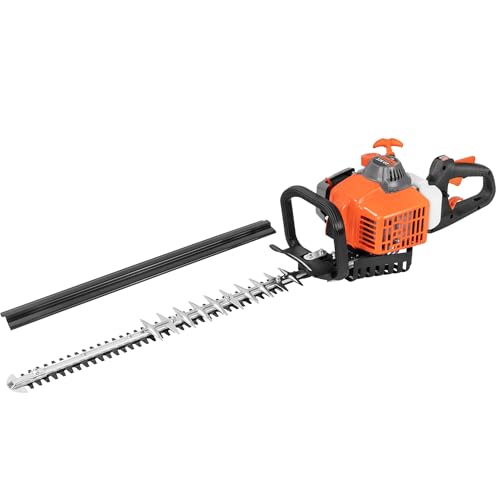
A gas hedge trimmer suits homeowners with long or thick hedges, properties without outlets nearby and professionals who need all-day run time. Echo, Stihl and Husqvarna are the brands most often discussed for dependable gas models, with Echo and Husqvarna popular for homeowners and Stihl’s longer reach models popular with landscapers. If your hedges are small and close to the house, a battery or corded trimmer is usually simpler.
Our top picks



As an Amazon Associate we earn from qualifying purchases at no extra cost to you.
How gas hedge trimmers differ
Gas hedge trimmers use a two-stroke or four-stroke engine, typically mixed-fuel two-stroke in the home segment. They provide more sustained power for thick branches than many battery trimmers, and refuelling is quick. The trade-offs are weight, vibration, noise, fuel handling and seasonal maintenance. Models differ in blade length, blade type (single-sided or double-sided), shaft design and whether the head rotates.
At a glance
| Model family | Best for | Key stated traits | Limits |
|---|---|---|---|
| Echo HC-series (for example HC-225 or HC-185) | Homeowners and light commercial use | Maker lists double-sided blades, a two-stroke engine and blade lengths around 18 to 24 inches depending on model | Mixed fuel required; model numbers change over time |
| Stihl HS series (HS 56 C-E, HS 82 R) | Dealers’ customers wanting professional-grade tools | Maker lists 24-inch class blades with a vibration-reducing design on certain models | Premium tier; sold through dealers |
| Husqvarna 122HD series | Homeowners with medium hedges | Maker lists 24-inch class blades and a two-stroke engine | Heavier than electric; confirm blade length for your model |
| Husqvarna 522HD60S | Professionals needing reach | Maker lists a long-reach style trimmer with a split shaft | Premium tier; larger and heavier |
| Poulan Pro or Craftsman gas trimmers | Budget-minded homeowners | Makers list lower-cost gas trimmers with blade lengths around 22 to 24 inches | Fit and durability vary; confirm current models |
What to look at
Blade length and cutting capacity
Blade lengths on gas trimmers commonly range from about 18 to 30 inches. Longer blades cut more per pass but weigh more and are harder to control. Tooth spacing determines how thick a branch the blade can cut; the manual lists capacity. For hedges with woody branches, look for wider tooth spacing.
Weight and vibration
Gas trimmers are heavier than electric models, and vibration builds up over time. Anti-vibration systems, rubber handle mounts and well-placed handles reduce fatigue. If you have hand or wrist problems, speak to a doctor before using vibrating tools for extended periods.
Engine and fuel
Most home gas hedge trimmers use two-stroke engines that need fuel mixed with oil at the ratio the maker specifies. Use fresh fuel, mix only the amount needed, and avoid ethanol blends the manual does not allow. Store fuel in approved containers away from heat and ignition sources.
Starting system
Many models use primer bulbs and easier pull starters. Reviewers often point to starter design as a key point for comfort, especially for older users.
Shaft and head design
Fixed-head models are simple and comfortable for hedge tops and sides. Rotating-handle models help with vertical cuts. Pole hedge trimmers add reach for tall hedges, but they require good technique and awareness of overhead hazards.
Safety
Wear eye protection, hearing protection, gloves and long trousers. Keep both hands on the handles, and do not use the trimmer above shoulder height unless the model is designed for it. Stop the engine before clearing jams, and keep hands clear of the blade even after the engine stops. Do not refuel a hot engine, and refuel outdoors away from sparks. Keep bystanders and pets away from the work area.
Budget tier trade-offs
Budget tier
Budget gas trimmers cost less but often vibrate more and may have shorter service lives. They suit homeowners who trim a few times a year.
Mid-range tier
Mid-range models from Echo and Husqvarna balance weight, power and service support. Reviewers regularly recommend this tier for most households with sizeable hedges.
Premium tier
Premium models, including Stihl dealer-sold units and professional Echo and Husqvarna lines, focus on durability, anti-vibration and service. They cost more but suit daily use.
Pick X if you …
| If you … | Pick | Why |
|---|---|---|
| Have large hedges and no power outlet nearby | Echo or Husqvarna gas trimmer | Run time and power |
| Cut professionally | Stihl HS series | Dealer support and durability |
| Need to reach tall hedges | Pole hedge trimmer | Extended reach, with caution |
| Trim small hedges rarely | Battery or corded trimmer | No fuel handling |
| Are on a tight budget | Poulan Pro or similar | Lower cost, accept trade-offs |
Care notes
Clean the blades after each use, lubricate them with blade oil as the maker directs, and check the air filter and spark plug at intervals specified in the manual. For winter storage, run the fuel out or use a fuel stabiliser the maker approves, and store the trimmer with the blade cover on. Have a dealer service the carburettor if the engine runs poorly.
Alternatives to consider
- Battery hedge trimmers for quieter, lower maintenance work.
- Corded electric trimmers for small gardens near outlets.
- Professional hedge services for very large or tall hedges.
Choosing for your hedge type
Formal, evergreen hedges
Dense evergreen hedges such as privet or boxwood need frequent light trims, and a double-sided blade of moderate length handles them well. A 22 to 24 inch blade lets you shape flat tops and sides in fewer passes without becoming too heavy to hold level. If the hedge is tall, a pole hedge trimmer or a stable platform may be safer than reaching overhead.
Overgrown or woody hedges
Hedges that have been left to grow often contain branches thicker than a trimmer is designed to cut. Use loppers or a pruning saw for the thickest stems, then use the trimmer for finishing. Forcing the blades through stems beyond the stated capacity can bend them and strain the gearbox.
Long boundary hedges
For long runs, a gas trimmer’s independence from outlets and battery packs is its main advantage. Reviewers often note that anti-vibration handles and good balance matter more than raw power on a large job. Take breaks, because vibration and noise tire the operator.
Starting and running tips
- Mix fuel in an approved container using the oil ratio the maker specifies.
- Fill the tank outdoors on level ground, with the engine cold and away from ignition sources.
- Follow the manual starting sequence, including the primer and choke positions.
- Let the engine idle briefly before cutting, and cut with a steady sweeping motion.
- Stop the engine to clear debris and let it cool before refuelling or storing.
Noise and neighbours
Gas trimmers are noticeably louder than battery models. Check any local noise rules about permitted hours, and wear hearing protection whenever the engine is running.
Why blade condition matters
Dull or gummed blades tear leaves, slow the work and put extra load on the engine. Clean resin from the blades after each session and apply blade lubricant as the maker directs. Nicked or bent blades should be replaced or serviced by a qualified technician rather than used as they are.
Frequently Asked Questions
Are gas hedge trimmers better than battery ones?
Gas models usually give longer run time and strong power for thick growth, while battery models are quieter and need less maintenance. Many homeowners now choose battery models for convenience.
What fuel mix do I use?
Use the ratio and oil type listed in the manual. Mixing incorrectly can damage the engine.
How long should the blade be?
Blades around 22 to 24 inches suit most home hedges. Longer blades are heavier and better for large flat surfaces.
How often should I sharpen the blades?
Sharpen when cuts become ragged or the blade tears leaves. Many owners have blades sharpened at a service centre once a season.
Can I use a hedge trimmer on thick branches?
Only up to the capacity listed in the manual. Use loppers or a saw for thicker branches.