Key takeaways
- Battery backpack blowers: quieter, no fuel, increasingly competitive on force.
- Handheld battery blowers: light and easy for small yards.
- Wheeled gas blowers: for very large areas.
- Rakes and leaf mulching with a mower: no noise or fuel, suited to modest leaf fall.
For big properties and frequent leaf clearing, the Echo PB-9010T is the gas backpack blower reviewers most often call the most powerful, the Stihl BR 800 suits buyers who want lower weight and quieter operation, and the Husqvarna 360BT suits homeowners who want a lighter backpack blower for large lawns. Gas leaf blowers still beat most battery models on sustained force and runtime, but they bring noise, emissions, fuel handling and local-rule considerations. This guide compares the main models, explains the specs that matter, and sets out the trade-offs.
Our top picks



As an Amazon Associate we earn from qualifying purchases at no extra cost to you.
Gas leaf blowers at a glance
| Model | Type | Best for | Reported or stated points |
|---|---|---|---|
| Echo PB-9010T | Backpack | Maximum power and value among pro blowers | Reported 79.9 cc engine, 220 mph, 1,110 cfm, 48 N rated force, 26.7 lb dry weight; Pro Tool Reviews measured 52 N; louder and heavier than Stihl |
| Stihl BR 800 (C-E Magnum / X) | Backpack | Suburban work, lighter and quieter profile | Reported 41 N force, 239 mph air speed, about 23.1 lb; chosen as best gas backpack by Pro Tool Reviews |
| Husqvarna 580BTS | Backpack | Pro users already in the Husqvarna network | Reported 1,000 cfm, 220 mph, 47 N; one shootout weight near 26.8 lb; some users call it louder than Stihl |
| Husqvarna 590BTS | Backpack | Highest-force option in the maker’s line | Pro Tool Reviews lists it as the most powerful backpack blower; costs more than the Echo |
| Husqvarna 360BT | Backpack | Property owners clearing large areas | About 30 N per Pro Tool Reviews; Bob Vila named it best overall in a backpack roundup |
Backpack, handheld or wheeled
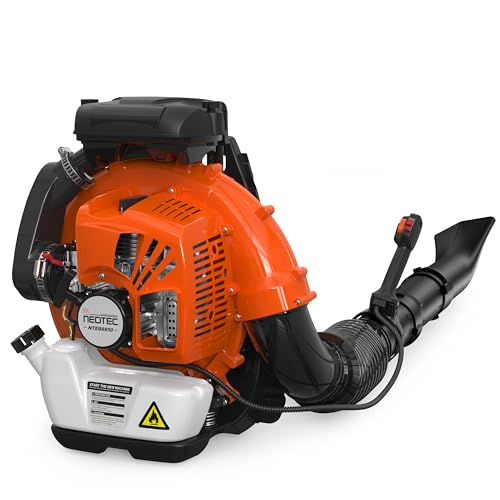
Gas leaf blowers come in three main forms. Handheld models are the lightest and cheapest, suited to patios, driveways and small yards. Backpack blowers carry the engine on your back, which reduces arm fatigue and allows bigger engines and higher airflow. Wheeled blowers are the most powerful and suit very large lots, parking areas and sports grounds, but are bulky.
For most gas buyers searching this topic, a backpack blower is the sweet spot between power and comfort. If your lot is under a quarter acre, a handheld or a battery model may be enough.
Understanding the specs
Force in newtons
Force, usually in newtons (N), describes how hard the air stream pushes. Reviewers consider it a better indicator of leaf-moving ability than cfm or mph alone. Pro Tool Reviews measured 52 N on the Echo PB-9010T, above the maker’s 48 N rating.
Air volume and speed
Cubic feet per minute (cfm) measures volume, and miles per hour (mph) measures speed. Volume moves piles, while speed dislodges wet or stuck debris. The Stihl BR 800 is listed with higher air speed than the Echo, though lower force.
Engine size and type
Larger displacement means more power but more weight. Two-stroke engines need a fuel and oil mix in the ratio the maker specifies. Some newer models use four-stroke or low-emission designs.
Weight and harness
A heavy blower is tiring over a full day. The Stihl at about 23 lb is lighter than the Echo’s 26.7 lb dry weight. Look for padded straps, a back panel and a hip belt that distributes load. Dry weight excludes fuel, so expect more when full.
Noise
Bob Vila’s test group found the Echo a few decibels louder than the Husqvarna and Stihl. Noise matters for neighbors and for local rules, and you should wear hearing protection in all cases.
Controls
Cruise control keeps throttle at a set level, a tilt-adjustable tube helps with different tasks, and a comfortable throttle grip reduces fatigue.
Budget tiers
| Tier | What to expect | Trade-off |
|---|---|---|
| Budget | Handheld gas blowers and light backpacks from homeowner lines | Lower force, heavier per unit of power, shorter expected life |
| Mid-range | Husqvarna 360BT and similar homeowner backpacks | Good balance for large lots |
| Premium | Echo PB-9010T, Stihl BR 800, Husqvarna 580BTS or 590BTS | Highest force and durability; high purchase cost and weight |
Pick the right one
| Pick this if you | Consider | Why |
|---|---|---|
| Want the most force for the money | Echo PB-9010T | Reviewers cite top power and lower cost than some rivals |
| Want lighter, quieter operation | Stihl BR 800 | Lower weight and a suburban-friendly profile |
| Prefer Husqvarna service | Husqvarna 580BTS or 590BTS | Competitive force, higher price |
| Own a large lot but not a pro | Husqvarna 360BT | Praised by Bob Vila and Pro Tool Reviews for large property owners |
| Have a small yard | Battery or handheld blower | Less weight and noise |
| Live where gas blowers are restricted | Battery blower | Local rules may limit gas use |
Rules, noise and safety
Several towns and cities restrict gas leaf blowers by season, hour or noise level, and some have banned them. Check your local ordinance before buying. Wear hearing protection, eye protection, a dust mask and sturdy footwear. Never fuel the machine while hot or indoors, store fuel in an approved container away from ignition sources, and follow the maker’s fuel mix ratio. Direct the air stream away from people, pets, windows and parked cars, and be considerate of neighbors by avoiding early or late hours.
Maintenance
Use fresh fuel and the correct oil ratio, replace the air filter and spark plug at the manual’s intervals, and clean cooling fins. Drain or stabilize fuel before long storage. Keep screens and the intake free of debris. Have a dealer service the machine if it surges, stalls or is hard to start.
Alternatives
- Battery backpack blowers: quieter, no fuel, increasingly competitive on force.
- Handheld battery blowers: light and easy for small yards.
- Wheeled gas blowers: for very large areas.
- Rakes and leaf mulching with a mower: no noise or fuel, suited to modest leaf fall.
Buying checklist before you commit
Start with local rules. Some municipalities limit gas blower use by hour, season or decibel level, and a few restrict sales or use altogether. Learn what applies to you before spending money. Then size the machine to your property: a handheld or small backpack is plenty for a modest lot, while a pro-grade backpack only makes sense where you clear large volumes regularly.
Think about the person who will carry it. Reported dry weights range from roughly 23 to 27 pounds for the backpack models above, and a full tank adds more. A well-fitted harness and a lighter machine can matter more than a few extra newtons of force. Finally, consider dealer support, since carburetors and pull-start parts occasionally need professional attention.
Common mistakes to avoid
- Using the wrong fuel mix ratio, which can damage a two-stroke engine.
- Running stale fuel left over from the previous season.
- Skipping hearing protection because the job is short.
- Blowing dust and debris toward neighbors, cars or open windows.
- Ignoring the air filter, which reduces power and shortens engine life.
Several of the cited reviews are months old and some comparisons are older still, so model numbers and specifications are best read from the maker’s own pages before buying.
Gas or battery for leaf work
Battery backpack blowers have improved and suit many suburban yards, with lower noise and no fuel handling. Gas models keep an advantage when you clear heavy, wet leaves across large areas for hours, because they do not slow down as a battery drains and refuelling takes a minute. Reviewers also point out that the best gas blowers show their strength on matted, damp leaf layers and gravel, where force matters more than volume.
If your yard is modest and your neighborhood is noise-sensitive, a battery blower may be the more practical option. If you manage acreage, clear parking areas or work in heavy leaf season, a gas backpack remains a sensible tool, provided you follow local rules and the maker’s safety and maintenance guidance.
Frequently Asked Questions
Which gas leaf blower is the most powerful?
Reviewers often name the Echo PB-9010T the most powerful of the established models, while Pro Tool Reviews lists the Husqvarna 590BTS as the most powerful backpack blower. Compare measured force figures, not only cfm and mph.
Is a backpack blower worth it for a home?
For a large lot with many trees, yes. A backpack distributes weight better than a handheld, so it is more comfortable during long sessions.
What fuel do gas blowers use?
Many use a mix of gasoline and two-stroke oil in a ratio the maker specifies, while four-stroke models take straight fuel. Follow the manual.
Are gas blowers louder than battery models?
Generally yes. Gas engines are louder and produce exhaust, so hearing protection is important and local rules may apply.
How heavy are backpack blowers?
Reported dry weights range from about 23 pounds for the Stihl BR 800 to about 27 pounds for the Echo PB-9010T and Husqvarna 580BTS, and more when fueled.
How often should I service a gas blower?
Follow the manual’s schedule for air filter, spark plug and fuel system care, and service it before storage. Have a dealer inspect it if performance changes.