
The best kitchen scale for coffee is the Timemore Black Mirror Basic 2 for most home brewers: it combines 0.1-gram resolution, a fast readout, a built-in timer, a coffee-friendly platform, and a moderate price without the size compromises of a pocket scale.
Our top picks
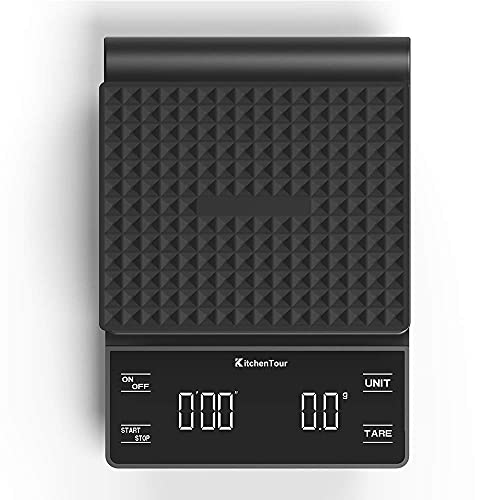 KitchenTour Coffee Scale with Timer
- KitchenTour EK6002 defines the latest in precision weighing…
- The electronic coffee scale has a built-in timer…
- This Kitchen Drip Coffee Scale is crafted to…
 Greater Goods Coffee Scale with Timer
- Barista-Level Precision: A 0.1g high-precision sensor with a…
- Integrated Brew Timer: A built-in count-up and count-down…
- Durable Waterproof Silicone Cover: The heat-resistant, dishwasher-safe silicone…
 Maestri House S2 Espresso Coffee Scale with
- 【Ultra Small, Yet Professional】The Espresso Scale is small…
- 【0.1g High Precision】This digital kitchen coffee scale is…
- 【Three Units & Dual Timekeeping Modes】The Espresso Digital…
| Product | Key specs | |
|---|---|---|
| KitchenTour Coffee Scale with Timer | KitchenTour EK6002 defines the latest in precision weighing… The electronic coffee scale has a built-in timer… This Kitchen Drip Coffee Scale is crafted to… | Check price |
| Greater Goods Coffee Scale with Timer | Barista-Level Precision: A 0.1g high-precision sensor with a… Integrated Brew Timer: A built-in count-up and count-down… Durable Waterproof Silicone Cover: The heat-resistant, dishwasher-safe silicone… | Check price |
| Maestri House S2 Espresso Coffee Scale with | 【Ultra Small, Yet Professional】The Espresso Scale is small… 【0.1g High Precision】This digital kitchen coffee scale is… 【Three Units & Dual Timekeeping Modes】The Espresso Digital… | Check price |
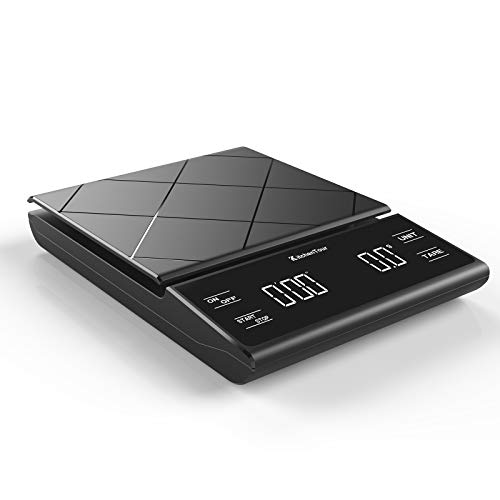 KitchenTour Coffee Scale with Timer for Brew | #Make Coffee Better every time# - KitchenTour EK6012… #Designed for Coffee # - The electronic coffee… #SUPERIOR QUALITY MATERIAL# - This Kitchen Drip Coffee… | Check price |
As an Amazon Associate we earn from qualifying purchases at no extra cost to you.
Quick picks by brewing situation
| Situation | Best fit | Why it makes sense | Typical market range |
|---|---|---|---|
| Most pour-over and everyday brewing | Timemore Black Mirror Basic 2 | Fast 0.1 g readings, integrated timer, broad platform, rechargeable battery | $45–$75 |
| Best interface and guided workflow | Fellow Tally Pro | Clear display, physical controls, brew modes, and a generous weighing surface | $165–$195 |
| Maximum app connectivity and data | Acaia Pearl S | 0.1 g resolution, timer, multiple modes, and smartphone integration | $180–$250 |
| Espresso under a tight drip tray | Acaia Lunar | Compact 105 × 105 mm footprint and quick response in a very small body | $200–$275 |
| Lowest-cost reliable starting point | Hario V60 Drip Scale | Simple 0.1 g weighing and an integrated brew timer | $45–$65 |
What matters when weighing coffee
Precision versus repeatability
A scale displaying 0.1 g is the practical standard for coffee. It lets you measure a 15 g dose, monitor a 250 g pour, and compare recipes without large rounding errors. More decimal places do not automatically improve brewing: a scale that flickers between readings or reacts slowly can be less useful than a stable 0.1 g model.
For espresso, 0.1 g is particularly helpful because a small change in dose or beverage weight can alter the brew ratio. For a large French press, 1 g resolution may be adequate, but a coffee scale remains useful if you also weigh water and compare recipes precisely.
Response time
Fast response is most valuable during pour-over. If the display lags behind the water entering the brewer, you may stop pouring too late and overshoot the target. Look for a scale designed specifically for brewing rather than a general food scale with a slow averaging function.
Very fast scales can introduce a different problem: the number may move constantly while a thin stream is landing. The best balance is a responsive display that settles quickly after the pour stops. Acaia, Timemore, Fellow, and Brewista coffee scales generally target this use more effectively than basic kitchen scales.
Timer controls
An integrated timer is not essential, but it removes one more object from the counter. For pour-over, the useful features are an easy-start timer, a readable elapsed-time display, and buttons that can be pressed without shifting the scale. Some models offer an auto-start mode that begins timing when water is detected; this is convenient but can be less predictable if the brewer is placed down heavily.
For espresso, a timer that starts automatically when the pump runs or the cup receives liquid can be valuable. Otherwise, manual timing is perfectly adequate and may be more reliable than a poorly configured automatic mode.
Platform size and clearance
A scale must fit both the brewer and the machine. A platform around 130–160 mm wide works well for a V60, Kalita Wave, Chemex server, or small carafe. Espresso is more demanding: measure the space between the drip tray, portafilter, and machine body before buying.
The compact Acaia Lunar is designed for tight espresso setups. A larger scale such as the Fellow Tally Pro or Hario V60 Drip Scale can be easier to read with pour-over but may not fit beneath some group heads. Low height matters too. A scale that is only a few millimeters thicker can make a cup touch the espresso spouts or prevent a portafilter from locking into place.
Splash resistance is not waterproofing
Coffee brewing involves drips, condensation, and occasional spills, so a sealed or water-resistant control surface is preferable. However, most coffee scales should be treated as splash-resistant appliances, not devices for rinsing under a tap. Water can enter through charging ports, seams, or buttons even when the top surface is protected.
Keep the scale on a dry tray or silicone mat, wipe spills immediately, and avoid placing a wet brewer directly on the electronics. A separate thin protective mat can help, but it also adds height and may reduce stability under an espresso machine.
Head-to-head: the leading choices
Timemore Black Mirror Basic 2: best overall value
The Basic 2 is a strong choice for most home pour-over users because it combines the features that matter daily rather than emphasizing app functions. Its 2,000 g capacity covers coffee, water, and a typical server; 0.1 g readability is suitable for espresso and filter; and the broad, low platform accommodates common brewers.
Its interface is simple enough for quick recipes, while its rechargeable design avoids regular disposable batteries. The main ownership caution is spill management: the scale is made for brewing splashes, not immersion. The surface can also become harder to read when a large opaque server blocks part of the display, so place the vessel carefully.
Fellow Tally Pro: best for a polished workflow
The Tally Pro is appealing when you want the scale to guide the routine. Its physical dial and distinct modes make it easier to select a target weight or monitor a brew than on a scale with tiny touch buttons. The relatively large platform suits pour-over servers, and the display is positioned for visibility beside the brewer.
It costs substantially more than a basic coffee scale. That premium buys usability and design rather than a fundamentally different measurement standard: it still weighs to 0.1 g and has a 2 kg maximum. Choose it if you brew frequently, share the station with other people, or dislike fiddly controls—not simply because it has more features.
Acaia Pearl S: best for connected brewing
The Pearl S provides 0.1 g resolution, a 2 kg capacity, a built-in timer, multiple weighing modes, and app connectivity. Its strongest advantage is repeatable recipe work: you can use flow-rate or brewing data features when refining a pour pattern, rather than recording only the final dose and beverage weight.
It is expensive for a scale whose core job is still weighing. Wireless features also add setup and charging considerations. For someone who only wants to brew a 1:16 V60 recipe, a less expensive model will deliver nearly the same practical result.
Acaia Lunar: best compact espresso scale
The Lunar’s small 105 × 105 mm platform is its defining advantage. It can fit where a larger pour-over scale cannot, making it useful for weighing espresso output directly on a drip tray. It is quick, highly readable, and built around espresso workflows.
The same compact size is a disadvantage for large mugs, Chemex brewers, and wide servers. If you brew both espresso and filter coffee, measure your largest vessel first. A scale that fits the machine may feel cramped everywhere else.
Hario V60 Drip Scale: best simple budget option
The Hario V60 Drip Scale remains a sensible choice when you want straightforward weighing and timing from an established coffee-equipment maker. Its 2 kg capacity and 0.1 g increments cover normal home brewing, and its elongated platform works naturally with a V60 and server.
Compared with newer premium scales, it has a more utilitarian interface and may feel less immediate during very fast pours. It is best for deliberate pour-over rather than users seeking app data, flow-rate graphs, or advanced automatic modes.
Decision matrix: match the scale to your habits
| Your priority | Recommended type | Minimum specification | Trade-off |
|---|---|---|---|
| Beginner, occasional brewing | Basic coffee scale | 2 kg capacity, 0.1 g display, manual timer | Fewer automation and connectivity features |
| Daily pour-over | Fast rechargeable scale | 130 mm or wider platform, responsive display, splash-resistant top | Higher price than a general kitchen scale |
| Daily espresso | Compact espresso scale | Low profile, roughly 105–120 mm platform, quick stabilization | Less room for large brewers |
| Small kitchen or shared counter | Low-profile multipurpose scale | Under 30 mm thick, rechargeable battery, easy storage | May sacrifice display size or platform width |
| Recipe development | Connected coffee scale | Timer modes, stable readings, app or flow-rate support | More cost, charging, and software complexity |
How to use and maintain a coffee scale
- Check the fit first. Put the scale in the intended espresso or pour-over position before adding a brewer. Confirm that the display remains visible and that no part of the vessel touches the machine.
- Protect the platform. Use a dry, heat-safe mat when appropriate, but confirm that it does not make the setup unstable or too tall.
- Tare before each stage. Tare the empty brewer, then add coffee. For brewing, tare again with the brewer and grounds in place so the display measures water only.
- Keep water away from charging ports. Do not charge immediately after a spill. Turn the scale off, dry it externally, and allow the port area to dry fully.
- Clean without flooding it. Remove loose grounds with a soft brush and wipe the surface with a barely damp cloth. Avoid abrasive cleaners and do not immerse the scale.
- Check accuracy occasionally. A known calibration weight is preferable. Household coins are not reliable calibration standards because wear and dirt affect their mass.
Final recommendation
Buy the Timemore Black Mirror Basic 2 if you want the best balance of precision, speed, timer convenience, platform size, and cost for both pour-over and occasional espresso. Choose the Fellow Tally Pro for the clearest premium workflow, the Acaia Pearl S for connected recipe analysis, the Acaia Lunar for cramped espresso setups, and the Hario V60 Drip Scale when simple, capable brewing equipment matters more than advanced features.









