
Our Top Picks



The best TENS unit for back pain overall is the TENS 7000 Digital TENS Unit with Accessories. Its two independent channels, five preset modes and continuously variable analog intensity dials give it the widest usable adjustment range of anything in this roundup, and it suits anyone who wants a no-nonsense device that runs on a standard 9-volt battery and accepts inexpensive generic electrodes. If your discomfort sits mainly across the lower back and you would rather cover that area with one large pad than tape down four small squares, the Comfytemp 3-in-1 TENS Unit with Large Back Pad is the more comfortable starting point. If the wires themselves are the reason a unit ends up in a drawer, the AUVON Wireless 24 Modes stimulator is the premium wire-free answer. Everything below is intended for the temporary relief of minor aches and pains. A TENS device does not address the underlying cause of back pain, and pain that is severe, worsening, radiating down a leg, or accompanied by numbness or weakness should be assessed by a clinician rather than managed with a consumer device.
Top 3 Picks
Best overall: TENS 7000 Digital TENS Unit with Accessories
The TENS 7000 earns the top spot because its rotary intensity dials are continuous rather than stepped, which matters more on the back than anywhere else: you can creep up on a comfortable level instead of jumping from “barely there” to “too much” in one button press. Two channels let you run four pads across the lumbar region at once, and the 9-volt battery means a flat cell never ends a session. It suits someone who wants the controls to behave the same way every time.
Best budget: AUVON Dual Channel TENS Unit with 20 Modes
This is the least expensive way to get genuine dual-channel output, and it arrives with both 2″ and 2″x4″ pads so you can start on the lower back without buying anything extra. Twenty modes is more than most people will ever use, but the two-channel architecture and the rechargeable battery are the parts that actually matter day to day. It is the sensible first unit for anyone who is not yet sure how much they will use one.
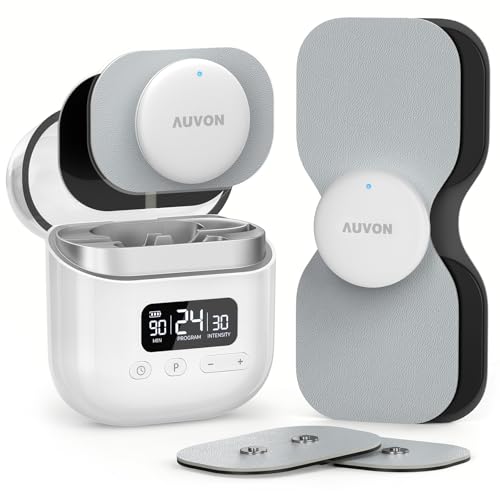
Best premium: AUVON Wireless 24 Modes TENS Unit
The wireless design removes the two most common reasons people stop using a TENS unit on the back: lead wires snagging on clothing and pads pulling loose when you move. Six pads are included, so you can run a full four-pad lumbar setup and still have spares. It costs the most per channel here, but for anyone who wants to wear a unit under a shirt while doing light activity, the wire-free format is the whole point.
Quick Comparison
Every unit below is a real, currently listed product. “Channel class” describes how many independent output circuits the device supports, which is what determines how many pads you can run at once. Prices are given only as tiers because retail pricing moves constantly.
| Product | Best for | Channel class | Modes / levels | Electrodes included | Power | Price tier |
|---|---|---|---|---|---|---|
| TENS 7000 Digital TENS Unit with Accessories | Adjustable dual-channel control | 2 (dual channel) | 5 preset modes | 4 self-adhesive pads + lead wires | 9V battery (replaceable) | Premium |
| AUVON 3-in-1 TENS Unit (40 Levels) | Fine-grained intensity stepping | 2 (dual channel) | 3-in-1 with 40 intensity levels | Multiple pad sizes | Rechargeable | Mid-range |
| Comfytemp 3-in-1 TENS Unit with Large Back Pad | Broad lower-back coverage | 2 (dual channel) | 3-in-1: TENS, EMS, user mode | Includes one large back pad | Rechargeable | Budget |
| AUVON Dual Channel TENS Unit (20 Modes) | Lowest-cost all-rounder | 2 (dual channel) | 20 modes | 2″ and 2″x4″ pads | Rechargeable | Budget |
| NEOCARBON TENS Unit Muscle Stimulator Pro | Premium compact body, red finish | Dual-channel class | Multiple preset programs | Reusable self-adhesive pads | Rechargeable class | Premium |
| AUVON Wireless 24 Modes TENS Unit | Wire-free use under clothing | Wireless, no lead wires | 24 modes | 6 pads | Rechargeable | Premium |
| AVCOO 3-in-1 TENS Unit (30 Modes) | Mid-range mode variety | Dual-channel class | 30 modes, 3-in-1 | Multiple pad sizes | Rechargeable | Mid-range |
| AVCOO 30 Modes TENS EMS Unit (12 Pcs Pads) | Maximum pads per purchase | Dual-channel class | 30 modes | 12 pads | Rechargeable | Budget |
| Comfytemp TENS Unit with Specialized Pads | Shaped pads for lower back, neck and shoulder | Dual-channel class | Multiple preset modes | Specialized shaped pads | Rechargeable | Budget |
How We Chose
Selection here is based on published specifications, listing details and the practical requirements of back-focused use, not on physical trials of the units. The first filter was channel architecture, because a single-channel device can only run two pads and that is not enough to bracket the lumbar spine properly. The second was intensity control granularity: a 40-step digital ladder and a continuous analog dial both work, but a unit with only eight or ten coarse steps often cannot be dialled into the narrow band between “I can feel it” and “that is too sharp,” which is exactly the band back users spend their sessions in. The third filter was pad supply and pad format, since electrodes are the consumable that decides your ongoing cost and the shape that decides where you can actually place them. Fourth, we weighed timer behaviour and power source, because a device that cannot shut itself off and a device that dies mid-session both kill consistency. Finally, each pick had to offer a clear upgrade path to something else in this list, so a reader can move up a tier without starting over.
1. TENS 7000 Digital TENS Unit – Best for adjustable dual-channel control
As an Amazon Associate we earn from qualifying purchases at no extra cost to you.

The TENS 7000 is the unit to look at if you want to feel your way into a comfortable setting rather than tap a button and hope. It is the most traditional design in this roundup: a rectangular body, two rotary intensity dials, five preset programs and a 9-volt battery. That traditionalism is the appeal. There is no menu to navigate, no mode you have to remember the number of, and no charging routine to build into your day. People who use a TENS unit several times a week for lower-back tightness tend to value exactly this kind of predictability, because the setup is identical every single time.
It suits two distinct buyers. The first is someone who has never used a TENS unit before and wants the simplest possible device that still supports a proper four-pad lumbar arrangement. The second is a long-term user who has already been through a rechargeable digital unit, got tired of stepping through 30 modes to find the one that worked, and wants to go back to two dials and five programs. It is less well suited to anyone who wants EMS muscle-stimulation programs, a customisable “user” mode, or a device light enough to forget you are wearing it.
Key specifications
- Channels: Two independent channels, each with its own intensity dial
- Modes: Five presets – normal (continuous), burst, modulation, and two strength-duration variants
- Intensity control: Analog rotary dials, continuous rather than stepped, so there is no fixed minimum jump
- Power: One 9-volt battery, user-replaceable
- Included: Four self-adhesive electrodes, two lead wires, a hard carry case and a belt clip
- Timer: Manual on/off rather than a selectable 15/30/60-minute menu
- Pad match: 2″x2″ pads for neck and shoulder work, 2″x4″ pads for the lumbar spine
The strongest argument for the TENS 7000 on the back is the interaction between the two channels and the dials. Lower-back discomfort is rarely symmetrical – one side is often tighter than the other – and independent intensity per channel means you can run the left pair stronger than the right pair without moving pads around. Add the continuous dial and you get a level of control that most digital units with 20 or 30 modes cannot match, because a digital unit’s intensity ladder is quantised even when the mode list is long.
The second argument is ownership cost. A 9-volt battery is available anywhere, costs very little, and can be swapped in seconds; a rechargeable unit that you forget to charge is a unit that does not get used. The included pads are standard 2mm-pin electrodes, which means the enormous aftermarket of generic replacement pads fits it. You are not locked into a proprietary pad shape or a proprietary connector.
Pros
- Continuous analog intensity dials give finer control than stepped digital buttons
- Two fully independent channels, so left and right sides of the back can be set differently
- Standard 9-volt battery and generic 2mm-pin pads keep running costs low and predictable
- Five modes is enough variety without turning every session into a menu scroll
- Hard carry case protects the unit and keeps leads and pads together
Cons
- No rechargeable battery, so you need to keep a spare cell on hand
- No EMS muscle-stimulation programs and no user-definable mode
- No selectable session timer menu; you manage duration yourself
- Bulkiest and heaviest format here, and the lead wires are unavoidable
- Priced in the premium tier despite offering fewer modes than mid-range rivals
Against the nearest alternative, the AUVON 3-in-1 with 40 levels, the trade-off is control philosophy. The AUVON gives you 40 discrete intensity steps, three operating families including EMS, and a rechargeable battery in a smaller body – more features, more convenience. The TENS 7000 gives you a continuous dial and independent per-channel adjustment. If you find that digital step 12 is too weak and step 13 is too strong, the TENS 7000 is the fix; if you want an all-in-one device that also does EMS work and never needs a battery, the AUVON is the better fit.
2. AUVON 3-in-1 TENS Unit – Best for fine-grained intensity stepping

This is the unit for the person who has used a cheap TENS device, found the intensity ladder too coarse, and wants something finer without giving up digital convenience. Forty intensity levels is a lot for a consumer stimulator, and the practical effect is that the gap between each step is small enough to land on a setting that feels strong but not sharp. The 3-in-1 designation covers TENS, EMS and a massage-style mode, so the same device can be used for a standard back session and for the pulsing, rhythmic programmes that some people prefer when the discomfort is more about muscular tightness than sharp pain.
It suits regular users who want one device that covers several jobs, and anyone who prefers a rechargeable unit to a battery drawer. It is also a reasonable choice for someone who shares a device with a partner, since the wide level range accommodates very different tolerance thresholds without either person having to settle for a setting that is nearly right. It is less suited to someone who wants purely mechanical, two-dial simplicity, and less suited to anyone who needs a large single pad to cover the whole lower back – the included pads here are conventional sizes.
Key specifications
- Type: 3-in-1 unit covering TENS, EMS and a massage-style mode
- Intensity: 40 discrete levels, which translates to small increments between steps
- Channels: Dual-channel class, so four pads can run at once
- Power: Rechargeable, with no disposable battery to replace
- Included: Multiple pad sizes, lead wires and the standard accessory set
- Body: Handheld format with a display-driven control scheme
The reason 40 levels matters specifically for back use is that the back is a large, thick muscle group with a lot of variation between the upper lumbar area and the erector spinae alongside the spine. The same absolute current feels very different depending on exactly where the pad sits and how much adipose tissue is under it. A coarse ladder forces you to change pad position to change sensation; a fine ladder lets you change the setting instead. That is a meaningful quality-of-life difference over months of use.
The rechargeable design is the second advantage. A single charge covers many sessions, so the routine becomes “plug it in on Sunday” rather than “check the battery before every use.” The counterargument is that a rechargeable cell is a wear item in a way that a 9-volt battery is not: eventually the cell holds less, and how gracefully the unit handles that depends on the design. For a mid-range device intended for a few years of home use, that is an acceptable trade.
Pros
- 40 intensity levels give unusually fine control for a consumer unit
- Three operating families in one body – TENS, EMS and a massage-style mode
- Rechargeable, so no ongoing battery purchases
- Dual-channel class output supports a four-pad lumbar arrangement
- Mid-range pricing for a feature set that overlaps with premium units
Cons
- Digital stepping, however fine, is still not the continuous sweep of an analog dial
- Mode list takes time to learn; there is a real temptation to over-tinker
- Included pads are conventional sizes, so broad lower-back coverage means buying a larger pad separately
- Battery is not user-replaceable in the way a 9-volt is
Compared with the AUVON Dual Channel 20 Modes unit further down this list, this 40-level model is the upgrade rather than the alternative: you get double the intensity resolution and the EMS/massage modes for a step up in price, while the pad formats are broadly similar. Compared with the TENS 7000, it trades continuous dial control for finer digital control plus rechargeability. If your priority is the smoothest possible adjustment, the TENS 7000 still edges it; if your priority is a single modern device that does more, this is the better buy.
3. Comfytemp 3-in-1 TENS Unit with Large Back Pad – Best for broad lower-back coverage
Most TENS units are sold with small square pads, and most people then discover that covering the lower back properly needs four of them arranged in a square around the spine. This Comfytemp unit sidesteps that by including a large back pad sized for lumbar coverage, which changes the setup from a taping exercise into a single placement. That is a genuinely different experience, and it is the reason this unit sits in the budget tier yet still earns a place on the shortlist.
It suits anyone whose discomfort is concentrated across the lower back rather than localised to one small spot, and anyone with limited shoulder mobility or hand dexterity who finds positioning four small pads behind their own back fiddly. It also suits a first-time buyer who wants to know whether TENS works for them without investing much. It is less suited to someone who needs precise, targeted placement around a specific point, because a large pad spreads current over a wider area rather than concentrating it, and less suited to neck or shoulder work, where a big pad simply will not sit correctly.
Key specifications
- Type: 3-in-1 – TENS, EMS and a user mode
- Included pad: One large back pad designed for lumbar coverage, plus conventional pads
- Channels: Dual-channel class output
- Power: Rechargeable
- Controls: Button and display driven, with preset programs
- Price tier: Budget
The user mode is worth calling out because it is the feature that separates this from a generic budget stimulator. A user mode lets you settle on a frequency and pulse-width combination you like and return to it directly, rather than scrolling to the same numbered preset every session. On the back, where the useful settings tend to be consistent once you find them, that is a small but real convenience.
The trade-off with a large pad is current density. The same output spread across a bigger electrode surface produces a softer, more diffuse sensation, and some users find that a large pad at maximum comfortable intensity never produces the crisp, localised feeling they get from a small pad. Others find the opposite: the diffuse coverage is exactly what they want across a broad band of tightness. Neither response is wrong, but it is the single biggest reason to think about pad format before you think about mode count.
Pros
- Large back pad included, so a lower-back session needs one placement, not four
- Three operating modes including a user mode you can return to directly
- Budget pricing for a device with a genuinely useful specialisation
- Rechargeable, so no battery purchases
- Good option for anyone who struggles to reach their own mid-back
Cons
- Large pad is the wrong tool for neck, shoulder or small-area placement
- Diffuse current spread may feel weaker than four small pads at the same setting
- Replacement large pads are a narrower aftermarket than standard 2″x2″ and 2″x4″ sizes
- Fewer intensity steps than the mid-range AUVON units
Against the TENS 7000, the comparison is coverage versus control. The TENS 7000 with four 2″x4″ pads can be arranged to bracket the spine precisely and adjusted per channel; this Comfytemp unit covers the same area with one pad and less fuss, but with less ability to shape the current field. If your back discomfort is a broad band of tightness, the Comfytemp is easier to live with; if it is asymmetric or concentrated on one side, the TENS 7000 gives you the tools to address that.
4. AUVON Dual Channel TENS Unit with 20 Modes – Best budget all-rounder

This is the unit to buy if you want to find out whether TENS helps your back without spending much, and you do not want to be limited to a single channel while you find out. Twenty modes is generous at this price, but the two features that matter are the dual-channel output and the fact that the box includes both 2″ and 2″x4″ pads. That combination means you can run a proper four-pad lumbar arrangement on day one, which is the configuration most back users actually need, rather than a two-pad compromise.
It suits first-time buyers, occasional users who want a device in the drawer for bad days, and anyone buying a second unit for a different room or for travel. It also suits someone who wants to experiment with pad placement and mode combinations before committing to a more expensive device. It is less suited to heavy daily users who want fine intensity resolution, and less suited to anyone who needs EMS programmes or a large-format back pad.
Key specifications
- Modes: 20 preset programmes
- Channels: Dual channel, supporting four pads simultaneously
- Included pads: 2″ pads and 2″x4″ pads, covering both small-area and lumbar placement
- Power: Rechargeable
- Format: Handheld body with display and button controls
- Price tier: Budget
The 2″x4″ pads are the important inclusion. A 2″x4″ rectangle placed vertically alongside the spine covers more of the erector spinae than a 2″ square, and two of them on each side of the midline is the standard four-pad lumbar layout. Buying those pads separately usually costs a meaningful fraction of what this whole kit costs, so their inclusion is worth more than the mode count suggests.
The main limitation is intensity granularity. Twenty modes is a long list, but the number of intensity steps is the specification that governs how comfortable the device is to use, and budget units in this class typically offer a coarser ladder than the 40-level AUVON or the continuous dial of the TENS 7000. In practice, most people find a workable setting; the risk is landing between two steps that are both slightly wrong.
Pros
- Dual-channel output at the lowest price point in this roundup
- Both 2″ and 2″x4″ pads included, enabling a proper four-pad lumbar setup immediately
- Twenty modes give plenty of room to experiment
- Rechargeable, so no recurring battery cost
- Low enough cost to keep as a travel or backup unit
Cons
- Coarser intensity steps than mid-range and premium units
- No EMS or user mode
- No large-format back pad in the box
- Long mode list can be tedious if you settle on one programme
Compared with the AVCOO 30 Modes unit with 12 pads, the decision is straightforward: the AVCOO gives you more modes and far more pads for a similar budget outlay, which matters if you go through electrodes quickly. The AUVON counters with a simpler, better-known control layout and a pad mix that already covers both lumbar and neck placement. If you want the maximum number of electrodes per purchase, the AVCOO wins; if you want a tidy, well-balanced starter kit, this AUVON does.
5. NEOCARBON TENS Unit Muscle Stimulator Pro – Best premium compact body

The NEOCARBON Pro is the pick for someone who has decided that the device itself should feel like a considered object rather than a plastic accessory, and who is willing to pay for that. The red finish is the most visible signal, but the more relevant point is the compact, pocketable body format: it is designed to be carried and used away from a bedside table, which changes how often a unit actually gets used for a back that stiffens during a long working day.
It suits commuters, office workers and anyone who wants to run a short session during a break rather than waiting until they get home. It also suits users who have already owned a basic stimulator and now want something better built, with the same core functionality. It is less suited to a first-time buyer on a tight budget, because the premium tier here buys build and format rather than a longer feature list, and less suited to anyone who needs a large single pad or EMS-specific programmes.
Key specifications
- Class: Compact handheld muscle stimulator with a premium body finish
- Channels: Dual-channel class output
- Modes: Multiple preset programmes covering the standard TENS families
- Power: Rechargeable class
- Included: Reusable self-adhesive pads and lead wires
- Price tier: Premium
The practical argument for a compact premium unit on the back is adherence. The most common reason a TENS unit stops helping is not that it failed but that it stopped being used, and the usual cause of that is friction: getting it out, untangling leads, finding pads that still stick, sitting still for half an hour. A device that lives in a bag and takes thirty seconds to set up removes some of that friction. That is a real benefit, even though it does not show up on a specification sheet next to a mode count.
The counterargument is value density. At the premium tier you are paying for build quality and portability, and the mode count and intensity resolution are not necessarily better than a mid-range AUVON. If your sessions happen at home, seated, at a fixed time of day, a cheaper unit with a better intensity ladder will serve you just as well. The premium is justified specifically by the carrying case scenario, not by the therapy itself.
Pros
- Compact, pocketable format that supports use away from home
- Premium build and finish that stands up better to being carried daily
- Dual-channel class output supports a four-pad lumbar arrangement
- Rechargeable, with reusable pads included
- Removes the setup friction that causes most units to be abandoned
Cons
- Premium price for a feature list that mid-range units match or exceed
- No large-format back pad included
- Compact body means a smaller display and smaller buttons than a full-size unit
- Replacement pads are less commoditised than standard 2mm-pin electrodes
Against the AUVON Wireless 24 Modes unit, the NEOCARBON is the wired premium option while the AUVON is the wireless one. Both target the same buyer – someone who wants a unit that travels well – but they solve it differently: the NEOCARBON shrinks the control unit, while the AUVON removes the lead wires entirely and puts the electronics at the pad. If you mostly use it seated during a break, the NEOCARBON is fine; if you want to move around while it runs, the wireless AUVON is the better answer.
6. AUVON Wireless 24 Modes TENS Unit – Best for wire-free use

This is the unit for anyone whose main complaint about TENS is the wires. On the back, lead wires are a genuine problem: they snag on chair backs, they tug the pads loose when you stand up, and they make it obvious you are wearing a device. The AUVON wireless design puts the stimulator directly on the pad, so there is nothing to catch and nothing to route under clothing. Six pads are included, which means a full four-pad lumbar setup plus two spares, or a two-pad session with plenty of rotation while others are being cleaned.
It suits people who want to run a session while doing light tasks around the house, and people who have tried a wired unit and stopped using it because the setup was annoying. It also suits anyone who wants a clean, discreet profile under a shirt. It is less suited to someone who wants a single central control unit with large physical dials, since each wireless pod must be switched on and adjusted individually, and less suited to anyone who wants the lowest possible cost per channel.
Key specifications
- Design: Wireless – the stimulator attaches to the electrode, with no lead wires between pads and a control unit
- Modes: 24 preset programmes
- Included pads: 6
- Power: Rechargeable
- Control: Remote or app-style control depending on the current revision, plus controls on the pods themselves
- Price tier: Premium
Six pads is a more significant inclusion than it first appears. Electrodes are the consumable in this category, and they degrade with use. Having six means you can rotate sets and always have a dry, fully adhering set available, which extends the working life of the whole collection and reduces the chance of a session being cancelled because the pads will not stick. That is a genuine ownership benefit that a mode count cannot provide.
The main practical difference from a wired unit is how intensity is set. With a wired device you turn one dial and both channels respond. With wireless pods, each pod has its own control, so a two-pod lumbar setup means setting two devices. For some users this is a small extra step; for others it is an advantage, because the left and right sides can be tuned completely independently without sharing a housing.
Pros
- No lead wires, so nothing snags and nothing pulls pads loose
- Six pads included, enough for a four-pad lumbar setup plus spares
- Discreet enough to wear under clothing during light activity
- Each pod is independently adjustable, giving per-side control
- Rechargeable with no disposable batteries
Cons
- Premium price, and the highest cost per channel in this roundup
- Each pod must be switched on and adjusted separately
- Pods add bulk to the pad itself, which can lift edges on curved areas of the back
- Smaller controls than a full-size handheld unit
Compared with the wired AUVON 40-level unit, the trade is control granularity for freedom of movement. The wired unit gives you 40 intensity steps from one housing; this wireless unit gives you 24 modes spread across independently adjustable pods. If your sessions are seated and stationary, the wired unit is better value; if you want to keep moving, the wireless unit is the one you will actually use.
7. AVCOO 3-in-1 TENS Unit with 30 Modes – Best mid-range for mode variety

The AVCOO 3-in-1 sits in the middle of this list and behaves like it: 30 modes, three operating families, a rechargeable battery and a dual-channel class output, at a price between the budget starter kits and the premium units. It suits the user who has decided they want options – someone who wants to alternate between a steady conventional programme on a bad day and a rhythmic pulsing programme on a stiff day, without buying two devices.
It is a sensible choice for a household where more than one person uses the unit, because the wide mode list means each person can find a programme that suits them and simply remember its number. It is also a reasonable pick for someone who wants EMS capability alongside TENS for muscular tightness after activity. It is less suited to a minimalist who wants two dials and five programs, and less suited to anyone who prioritises continuous intensity adjustment over mode count.
Key specifications
- Type: 3-in-1 covering TENS and EMS families plus a third operating mode
- Modes: 30 preset programmes
- Channels: Dual-channel class, supporting four pads
- Power: Rechargeable
- Included: Multiple pad sizes and the standard accessory set
- Price tier: Mid-range
The practical question with 30 modes is whether the extra programmes do any work. They do, but only if you treat the list as three families rather than thirty discrete choices. Conventional high-frequency programmes suit a steady, buzzing sensation that is easy to tolerate for a long session. Burst-style programmes deliver pulses in clusters and feel more like a rhythmic tapping. Longer-pulse programmes feel deeper and are typically used at lower intensities. Once you map the 30 numbers onto those three families, the list becomes manageable rather than intimidating.
The rechargeable battery and dual-channel output are the specifications that decide whether the device is usable for back work at all, and both are present. What you are not getting at this tier is the continuous analog adjustment of the TENS 7000 or the 40-step ladder of the mid-range AUVON. If you have previously found that no setting on a 20-mode unit felt right, adding ten more modes will not fix that; a finer intensity ladder will.
Pros
- 30 modes across three operating families, giving genuine variety
- Dual-channel class output for a four-pad lumbar setup
- Rechargeable, with no battery purchases
- Mid-range price for a feature set that overlaps premium units
- Multiple pad sizes included, covering lumbar and smaller placements
Cons
- Mode list is long enough to be confusing without a system for organising it
- Intensity stepping is not as fine as the 40-level AUVON or an analog dial
- No large-format back pad included
- Feature overlap with the budget AVCOO 30-mode unit may not justify the premium for everyone
Against the AVCOO 30 Modes budget unit with 12 pads, this 3-in-1 model is the better-built version of a similar idea. The budget unit wins on sheer pad quantity – twelve electrodes is a lot of consumable value – while this one wins on the third operating mode and the general fit and finish. If your priority is minimising the cost of electrodes over the first year, the 12-pad kit is the smarter buy; if you want the device you will keep using after the first set of pads is gone, this is the one to choose.
8. AVCOO 30 Modes TENS EMS Unit with 12 Pcs Pads – Best budget for pad quantity

Twelve pads in the box is the headline here, and for a back user it is a more useful headline than a mode count. Electrodes are the only part of a TENS unit that wears out with normal use, and the difference between owning four pads and owning twelve is the difference between a device you ration and a device you use. This AVCOO kit is aimed squarely at people who intend to use a unit often and do not want to be ordering replacements within a month.
It suits frequent users, people running two-channel four-pad sessions several times









