
Key takeaways
- Glue is the main consumable. Budget glue sticks are fine for practice; pro-grade glue offers more consistent pulls in hot or cold weather.
- Tabs wear and deform over time, especially the smallest sizes. Keep a range of shapes, including oval or crease tabs.
- A line board or reflection light is the biggest upgrade after the kit itself. Without one, it is hard to see small high and low spots.
- Practice first. A junkyard panel or an old appliance door is ideal for learning how much pull the metal tolerates.
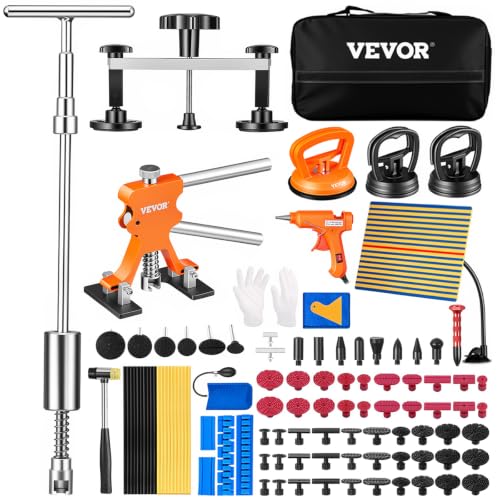
The best paintless dent removal kit for most car owners is a mid-size glue-pulling kit such as the Super PDR 75-piece set, which combines a bridge puller, T-bar puller, slide hammer, and enough tabs to handle door dings and small hail dents; pros and serious hobbyists should look at the KECO Glue Pulling Starter Kit instead. No kit fixes every dent, though, so the first decision is whether your dent is a candidate for DIY repair at all.
Our top picks


As an Amazon Associate we earn from qualifying purchases at no extra cost to you.
Is Your Dent Fixable With a Home Kit?
Glue-pull kits work by bonding a plastic tab to the dent with hot-melt glue, then pulling the metal back out. They do best on shallow, rounded dents in flat or gently curved panels where the paint is intact. Use this quick screen before buying anything:
| Dent characteristic | Good DIY candidate | Likely needs a pro |
|---|---|---|
| Diameter | 0.5–3 in (1–8 cm) | Over 4 in, or long creases |
| Depth | Shallow, smooth bowl | Sharp, deep, or stretched metal |
| Location | Flat middle of door, hood, roof, fender | Body lines, panel edges, double-wall areas |
| Paint | Factory paint, no cracks | Cracked, chipped, or repainted panels |
| Panel material | Steel | Aluminum (needs more skill and heat control) |
Repainted panels deserve special caution: aftermarket paint and body filler can lift off with the glue tab, turning a dent into a paint repair.
The Kits Worth Considering
Super PDR 22-Piece Bridge Puller Kit: Best for a Single Door Ding
This compact kit includes a bridge (lifter) puller, a small hot-melt glue gun, glue sticks, and an assortment of tabs. The bridge puller rests on the panel on both sides of the dent and lifts slowly with a knob, which gives beginners control and reduces the risk of over-pulling. It is the right size for one or two parking-lot dings.
Super PDR 75-Piece Kit: Best Overall for DIY
The larger Super PDR kit adds a T-bar puller for bigger dents and a slide hammer alongside the bridge lifter, plus many more tab sizes and a tool bag. That variety matters: a tab that is too large spreads the pull and does little, while one that is too small can create a high spot. With three pulling methods, you can start gently and escalate only if needed. Super PDR also sells larger bundles with a 100W glue gun and an LED line board for reading panel distortion.
KECO Glue Pulling Starter Kit: Best for Serious Hobbyists
KECO is widely used by collision and PDR technicians. The starter kit centers on the Robo Mini Lifter, a modular, ergonomic mini lifter made in the US, together with an adjustable-temperature glue gun, Anson PDR glue sticks, flip tabs, and knockdowns for tapping high spots. Adjustable glue temperature is a meaningful upgrade over the fixed-heat guns in budget kits, because glue that is too hot or too cold either fails to grip or bonds too aggressively.
KECO K-Bar Kit: Best for Larger Dents and Collision Work
The K-Bar system is built for collision repair and large dents, using long bonded bars to pull wide areas evenly. It costs several times more than a DIY kit and assumes real technique, so it suits body shop staff and dedicated PDR technicians rather than weekend users. KECO offers a lifetime warranty to the original purchaser on its cold glue tabs and K-Bars.
Side-by-Side Comparison
| Kit | Pull methods | Glue gun | Best dent size | Skill level | Typical price range |
|---|---|---|---|---|---|
| Super PDR 22-piece | Bridge lifter | Basic fixed-heat | Under 2 in | Beginner | $25–$45 |
| Super PDR 75-piece | Bridge lifter, T-bar, slide hammer | Basic fixed-heat | 0.5–3 in | Beginner to intermediate | $50–$90 |
| KECO Glue Pulling Starter Kit | Mini lifter, knockdowns | Adjustable temperature | Small hail and door dings | Intermediate | $180–$250 |
| KECO K-Bar Kit | Bar pulling system | Adjustable temperature | Large dents, collision | Professional | $450–$800 |
How a Glue Pull Actually Goes
- Clean the panel with isopropyl alcohol so wax and road film do not weaken the glue bond.
- Warm the panel slightly in cold weather. Metal below roughly 60°F (15°C) makes glue set too fast and grip poorly.
- Choose a tab slightly smaller than the dent and apply a full, even bead of glue.
- Place the tab in the center of the low spot and let the glue set for about 30–60 seconds, depending on the glue and temperature.
- Pull gradually. Several small pulls beat one hard pull. Over-pulling creates a high crown that is harder to fix than the original dent.
- Release with alcohol. A few drops of 90% isopropyl alcohol around the glue edge releases the tab; a plastic scraper removes residue.
- Tap down high spots with a knockdown tool and repeat with smaller tabs as needed.
Ownership Realities
- Glue is the main consumable. Budget glue sticks are fine for practice; pro-grade glue offers more consistent pulls in hot or cold weather.
- Tabs wear and deform over time, especially the smallest sizes. Keep a range of shapes, including oval or crease tabs.
- A line board or reflection light is the biggest upgrade after the kit itself. Without one, it is hard to see small high and low spots.
- Practice first. A junkyard panel or an old appliance door is ideal for learning how much pull the metal tolerates.
Cost Comparison: DIY vs Professional
Mobile PDR technicians in the US often charge roughly $75–$150 for a single small door ding, with prices rising for larger dents or difficult locations. A $50–$90 DIY kit can pay for itself on the first successful repair, but it is not a guaranteed win: an over-pulled or cracked-paint dent can cost more to fix professionally than the original ding. If the car is new, leased, or has a dent on a body line, a professional is usually the safer choice.
Recommendation
For one or two door dings, start with the Super PDR 22-piece kit. For general DIY use, including small hail dents, the Super PDR 75-piece kit gives the most flexibility for the money. If you plan to repair dents regularly and want adjustable glue temperature and pro-grade tabs, step up to the KECO Glue Pulling Starter Kit, and reserve the KECO K-Bar Kit for collision-level work.









