
The best leather care kits are Leather Honey for thirsty finished leather, Bickmore Bick 4 for low-effort routine care, Furniture Clinic’s Leather Care Kit for a complete furniture-focused system, and a dedicated Colourlock kit when you own aniline leather or need professional-level cleaning and protection.
The right choice depends less on the brand than on the leather’s finish. Most car seats, sofas, handbags, and dining chairs use protected or “finished” leather, which tolerates a mild cleaner and water-based conditioner. Aniline and semi-aniline leather have less surface protection and need gentler products. Faux leather, vinyl, and polyurethane-coated upholstery need a compatible synthetic-leather cleaner rather than a penetrating oil or wax.
Our top picks
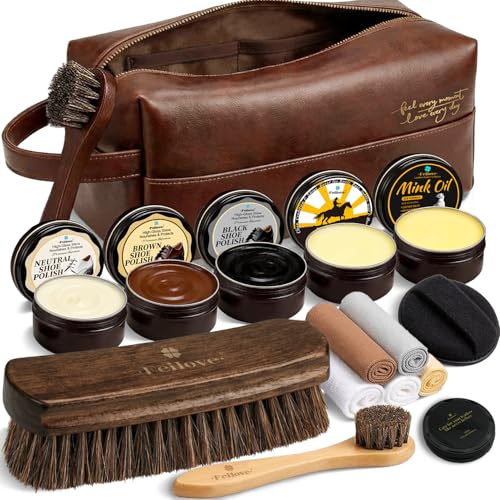 Shoe Care Kit
- Everything for premium leather care in one complete…
- CLEAN CONDITION POLISH: Unlike most shoe shine kits,…
- The large horsehair brush removes dirt and dust
 Feilove 4-in-1 Mink Oil Leather Conditioner and
- Each mink oil kit includes premium mink oil,…
- The 2026 upgraded Mink Oil offers polish, conditioning,…
- Made from pure, premium ingredients without silicone, the…
 Leather Honey Complete Leather Care Kit
- Leather Honey penetrates deep to protect new leather…
- NON-TOXIC, GENTLE CLEANER: Our proven, rejuvenating formula is…
- Clean & Condition leather furniture, car seats, shoes…
| Product | Key specs | |
|---|---|---|
| Shoe Care Kit | Everything for premium leather care in one complete… CLEAN CONDITION POLISH: Unlike most shoe shine kits,… The large horsehair brush removes dirt and dust | Check price |
| Feilove 4-in-1 Mink Oil Leather Conditioner and | Each mink oil kit includes premium mink oil,… The 2026 upgraded Mink Oil offers polish, conditioning,… Made from pure, premium ingredients without silicone, the… | Check price |
| Leather Honey Complete Leather Care Kit | Leather Honey penetrates deep to protect new leather… NON-TOXIC, GENTLE CLEANER: Our proven, rejuvenating formula is… Clean & Condition leather furniture, car seats, shoes… | Check price |
 Bickmore Boot Care Kit | This professional leather care kit includes Bick 1… WON’T DARKEN OR STAIN LIKE MINK OIL -… Safe and effective for use on much more… | Check price |
As an Amazon Associate we earn from qualifying purchases at no extra cost to you.
Best leather care kits by situation
| Best for | Recommended kit or type | Typical contents | Typical size | Application effort |
|---|---|---|---|---|
| Finished leather furniture and car interiors | Furniture Clinic Leather Care Kit | Cleaner, conditioner, cloths or applicator tools | About 250–500 ml total liquid | Moderate; clean, dry, then condition |
| Frequent maintenance with minimal residue | Bickmore Bick 4 Leather Conditioner with a separate leather cleaner | Conditioner, usually applied with a cloth | 8–16 fl oz bottles are common | Low; one thin coat |
| Dry, finished leather that needs strong conditioning | Leather Honey Leather Conditioner kit or bottle-and-cloth bundle | Concentrated conditioner and application cloth | 8 fl oz or larger bottles | Moderate to high; very thin application and long buffing time |
| Aniline or semi-aniline furniture | Colourlock Aniline Leather Cleaner and matching protection product | Low-moisture cleaner, protector, sponge or cloth | Commonly 150–250 ml per liquid product | High; patch testing and controlled moisture are essential |
| Faux leather, vinyl, and PU upholstery | Water-based synthetic-leather cleaner and protectant | Cleaner, protectant, microfiber cloth, soft brush | About 250–500 ml total liquid | Low to moderate; avoid oil-based conditioners |
The capacities above are useful for estimating value, but kit contents vary by seller and bundle. Check the label before buying, especially when a “kit” contains a small sample bottle rather than a full-size cleaner and conditioner.
Head-to-head: which kit is the better fit?
Furniture Clinic Leather Care Kit: best all-round furniture system
Furniture Clinic’s leather care kits are practical when you want the two essential stages in one purchase: a cleaner to remove body oil and surface grime, followed by a conditioner or protector. They are particularly suitable for finished leather sofas, recliners, dining chairs, and ottomans.
The advantage is process clarity. You do not have to guess whether a conditioner can safely be used over dirt. The disadvantage is that application takes longer than wiping on a single multipurpose product. Large sofas may also require more liquid than a small kit supplies, so calculate the area before ordering.
Choose this type if you maintain several pieces of furniture twice a year and want supplied cloths or sponges rather than assembling your own kit.
Bickmore Bick 4: best for easy routine conditioning
Bickmore Bick 4 is a widely known leather conditioner designed for many smooth leather goods and upholstery applications. It is valued for a relatively light feel and for being easier to spread than thick, waxy balms. It works best as a maintenance conditioner on clean, finished leather rather than as a heavy-duty stain remover.
For a car interior or frequently used chair, pair it with a separate pH-balanced leather cleaner. That costs more than a single bottle but prevents the common mistake of rubbing accumulated grime deeper into the grain. Apply a small amount to a cloth, not directly to perforated seats or seams.
Leather Honey: best for dry finished leather
Leather Honey is a concentrated conditioner intended to penetrate and soften many types of smooth leather. Its strength is economical coverage: a small amount can treat a substantial area when spread thinly. Its weakness is application discipline. Too much product can leave a tacky or glossy surface that attracts dust, especially in warm car interiors.
Use it on finished leather only after a compatibility test. It is a poor default for pale aniline leather, suede, nubuck, or faux leather. Expect a longer settling and buffing period than with a light lotion-style conditioner.
Colourlock: best when leather type and finish matter
Colourlock offers separate systems for smooth finished leather, aniline leather, vinyl, and repairs. That specialization is valuable when a sofa has a delicate open-pore surface, when dye transfer is a concern, or when you need more than basic cleaning.
The trade-off is complexity. You must identify the material, select the matching cleaner and protector, and follow the sequence carefully. This is a sensible choice for expensive furniture, vintage interiors, or leather with a known finish. If the surface is cracked, peeling, heavily stained, or structurally damaged, a leather restoration professional may be more appropriate than a consumer kit.
Decision matrix: match the kit to your situation
| Your situation | Best direction | Why | Avoid |
|---|---|---|---|
| First-time user, one sofa, limited time | Complete finished-leather kit | Cleaner, conditioner, and tools reduce compatibility guesses | Concentrated balm without instructions |
| Weekly-use car with perforated seats | Low-residue cleaner plus light conditioner | Less buildup around holes and stitching | Spraying liquid directly onto the seat |
| Dry, dark finished leather | Leather Honey or another penetrating conditioner | Efficient coverage for thirsty smooth leather | Applying a thick coat to improve appearance quickly |
| High-value aniline sofa | Dedicated aniline system, such as Colourlock’s | Lower moisture and finish-specific protection | Generic oil, saddle soap, or household polish |
| PU, vinyl, or faux-leather chair | Water-based synthetic-leather cleaner and protectant | Designed for a coated plastic surface | Penetrating conditioners and mineral oils |
Coverage and cost: how much kit do you really need?
A useful estimate is to assume that a 250 ml bottle of cleaner or conditioner covers approximately 20–40 square metres on light maintenance, but only 10–20 square metres when the surface is heavily soiled or the product is applied too generously. Actual coverage varies with leather texture, absorbency, and the applicator.
For example, suppose a sofa and matching chair present about 8 square metres of usable leather. A 250 ml cleaner used at 15 ml per square metre provides roughly 16 applications of that size:
250 ml ÷ 15 ml per square metre = about 16.7 square metres of coverage.
A 500 ml two-step kit priced in the general $25–$50 range may therefore provide several maintenance sessions, while a $10–$20 small bottle can be cheaper for a single car interior. Compare usable capacity, not just the number of bottles or accessories.
How to use a leather care kit without damaging the finish
- Identify the material. Check the furniture or vehicle documentation. A uniform, slightly plastic-feeling surface is usually finished leather or faux leather; a soft, visibly porous surface may be aniline or semi-aniline.
- Vacuum first. Use a soft brush attachment to remove grit from seams. Dirt left in the grain can act like abrasive paste during wiping.
- Patch-test. Apply the cleaner and conditioner to a hidden area. Wait until dry and check for darkening, stickiness, color transfer, or a change in sheen.
- Clean in small sections. Put product on a microfiber cloth or soft sponge, work gently, and avoid soaking seams, perforations, and piping.
- Allow the surface to dry. Conditioner applied over damp cleaner can create uneven sheen and prolong drying.
- Condition sparingly. Spread a thin, even film. After the recommended dwell time, buff away excess with a clean cloth.
- Let it cure before use. Keep the surface ventilated and avoid sitting on it until it feels dry and non-tacky.
Ownership realities and common mistakes
Microfiber cloths usually wear out before the bottles do. Keep separate cloths for cleaning and conditioning; otherwise, a cloth loaded with oils can reduce the effectiveness of the cleaner. Wash reusable cloths without fabric softener, which can leave a coating behind.
Do not use household disinfectant, alcohol, vinegar, furniture polish, or dish soap as a substitute unless the leather manufacturer specifically permits it. These products may strip protective finishes, cause uneven color, or leave residue. Steam cleaning is also risky on many leather surfaces because heat and moisture can affect adhesives, dyes, and coatings.
Conditioning is not a repair for peeling polyurethane, split grain, exposed filler, or deep dye loss. It can improve the feel of intact leather, but it cannot rebuild a missing finish. For those problems, stop applying products and obtain a material-specific assessment.
Final recommendation
For most finished sofas and car interiors, buy a complete cleaner-and-conditioner kit with microfiber cloths and use it lightly twice a year. Choose Bickmore Bick 4 when easy routine conditioning is the priority, Leather Honey when dry finished leather needs economical deep conditioning, Furniture Clinic when you want a complete furniture workflow, and Colourlock when the leather is aniline, valuable, unusual, or in need of finish-specific care. For faux leather, skip conventional penetrating conditioners and select a water-based synthetic-leather system instead.









