
The best home safes match the safe’s interior capacity and burglary rating to what you own: a small bolted safe suits passports and cash, a fire-rated document safe suits paper records, and a heavier UL-rated safe is the better choice for jewelry, watches, electronics, and larger collections.
Our top picks
 SentrySafe 1-Hour Fireproof Safe
- Fireproof safe is UL Classified to endure 1…
- Waterproof safe is ETL Verified for 24 hours…
- Set your own digital combination fire safe with…
 SentrySafe Fireproof Waterproof Safe Dial Combination 1.23
- The safe is UL Classified to endure 1…
- The home safe is ETL Verified for 24…
- Combination safe features 4 live-locking bolts, steel construction,…
 SentrySafe Fireproof Safe Box with Key Lock
- Lifetime after-fire replacement guarantee
- Fire safe box is UL classified for fire…
- Fire resistant safe has a privacy key lock…
| Product | Key specs | |
|---|---|---|
| SentrySafe 1-Hour Fireproof Safe | Fireproof safe is UL Classified to endure 1… Waterproof safe is ETL Verified for 24 hours… Set your own digital combination fire safe with… | Check price |
| SentrySafe Fireproof Waterproof Safe Dial Combination 1.23 | The safe is UL Classified to endure 1… The home safe is ETL Verified for 24… Combination safe features 4 live-locking bolts, steel construction,… | Check price |
| SentrySafe Fireproof Safe Box with Key Lock | Lifetime after-fire replacement guarantee Fire safe box is UL classified for fire… Fire resistant safe has a privacy key lock… | Check price |
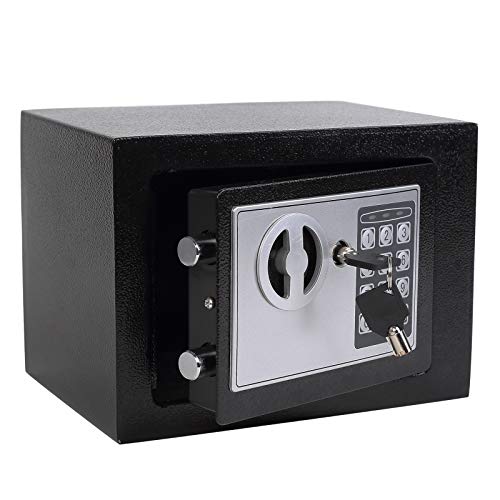 Yuanshikj Small Steel Security Safe Box with | Digital Locking- the Electronic Safety Lock Box Is… 0.2-cubic-feet, Exterior :9.05" x 6.69"x 6.69", Interior size:… The mini safe box is made of reinforced… | Check price |
As an Amazon Associate we earn from qualifying purchases at no extra cost to you.
Quick picks by situation
| Situation | Best safe type | Useful target specifications | Why it fits |
|---|---|---|---|
| Passports, birth certificates, a small cash reserve | Compact fire-resistant safe | 0.3–0.8 cu. ft.; 30–60 minutes of fire protection; 40–100 lb | Enough room for folders without consuming a closet shelf |
| Jewelry, watches, and emergency cash | Steel burglary safe, bolted down | 0.5–1.5 cu. ft.; 10-gauge or thicker body; 1/2-inch or larger locking bolts | Prioritizes pry resistance and anchoring over fire insulation |
| Documents and a few external drives | Fire-rated home safe with adjustable shelves | 1.0–2.0 cu. ft.; 60 minutes at approximately 1,700°F; water-resistant seal | Protects paper while allowing modest organization |
| Many valuables or frequent access | Heavy residential security safe | 2.0–4.0 cu. ft.; 300 lb or more; UL Residential Security Container rating | Weight and a tested attack standard make removal and forced entry harder |
| Apartment or rental where drilling is restricted | Portable safe with a security cable | Under 25 lb; steel construction; cable loop or tether point | Provides basic deterrence, though it is not equivalent to a bolted safe |
What matters more than a large capacity number
Burglary resistance
Fire protection and burglary protection are different tests. A safe can insulate paper from heat yet have a thin body that can be pried open or carried away. For theft protection, look for a steel body, recessed door, multiple locking bolts, anti-pry flanges, and a published security standard.
A UL Residential Security Container (RSC) rating is a useful baseline for home use. It indicates that the container has passed a defined attack test, but it is not the same as a high commercial burglary rating. “Solid steel” by itself is not a security rating, and a thick door does not compensate for a weak hinge side, poor lock housing, or an unanchored cabinet.
For jewelry with substantial replacement value, ask your insurer whether it requires a particular burglary classification or alarm system. A consumer safe’s label should not be treated as automatic insurance approval.
Fire protection
Fire ratings generally state how long the interior remains below a temperature suitable for paper, commonly around 350°F, during a standardized test near 1,700°F. A 30-minute rating may be adequate for basic records; a 60-minute rating gives more margin in a serious house fire.
Do not assume that a paper-safe rating protects every item inside. Magnetic media, photographs, USB drives, and some electronics need a lower internal temperature than paper. If digital media is important, use a safe specifically rated for data media or maintain encrypted off-site and cloud backups. Fire insulation also consumes interior space, so compare usable dimensions rather than exterior measurements.
Lock type and access speed
- Mechanical combination: No batteries and dependable long-term storage, but slower to open and less convenient in an emergency.
- Electronic keypad: Fast access and easy code changes. Choose a model with low-battery warning, external emergency power, and a protected lock compartment.
- Biometric fingerprint: Convenient for repeated access, but performance can vary with dirty, wet, or damaged fingers. It should have a keypad or key override.
- Dual-control or time-delay locks: Better for high-risk situations but slower and more complex for ordinary household use.
For a safe opened weekly, an electronic keypad is usually the practical compromise. For valuables stored for months at a time, a mechanical lock avoids battery maintenance. Keep the override key outside the safe but not in the same obvious drawer as the safe’s paperwork.
Head-to-head: the main safe categories
Compact document safe versus steel burglary safe
A compact fire safe is usually the better choice for passports, deeds, insurance papers, and a small amount of cash. Its insulation and door seal address fire and smoke, while its lighter construction may provide limited resistance to a determined thief.
A steel burglary safe is better for jewelry, watches, firearms where legally applicable, and items that are more attractive to a burglar than paperwork. It may offer little or no meaningful fire protection. If you need both protections, look for a heavier composite safe with a published fire rating and an RSC classification rather than assuming one feature implies the other.
Floor safe versus freestanding safe
A floor safe can be concealed and is difficult to remove when installed correctly in concrete, but installation is disruptive and access can be awkward. A freestanding safe is easier to position and replace, but it must be anchored through its prepared holes into structural material. Bolting a 150-pound safe to a thin closet floor may not provide the intended security.
Wall safes are useful for concealment between correctly spaced studs, though their shallow depth limits jewelry boxes, cameras, and document binders. A hidden location is a bonus, not a substitute for steel, a quality lock, and anchoring.
How to choose the right size
Measure the largest object first, then add room for the way you will actually store it. A letter-size document folder needs roughly 12 inches of width and 10 inches of height when laid flat; binders and expanding files require more. Electronics need clearance for cables and protective cases.
Use this simple capacity check:
- List each item’s packed width, height, and depth.
- Group flat documents separately from bulky objects.
- Add at least 25% empty space for future purchases and easier access.
- Compare the internal dimensions, shelf openings, and door clearances—not just the stated cubic feet.
For example, six document folders occupying approximately 12 × 10 × 2 inches each require about 1,440 cubic inches, or 0.83 cubic feet. Adding 25% produces a target of about 1.04 cubic feet before allowing for shelves, hinges, and wall thickness. In practice, a nominal 1.2–1.3-cubic-foot safe may be a more comfortable choice.
Established examples and useful specifications
| Example | Published type and capacity | Approximate weight | Notable protection | Best use |
|---|---|---|---|---|
| SentrySafe SFW123GTC | Fire/water-resistant home safe; about 1.2 cu. ft. | About 85–90 lb | Up to 1 hour of fire protection; electronic keypad; bolt-down capability | Documents, cash, and modest household valuables |
| First Alert 2087DF | Fire-resistant home safe; about 0.8 cu. ft. | About 80 lb | Fire protection marketed around 1 hour; electronic keypad; bolt-down hardware | Paper records and small valuables |
| Compact steel security safe | Typically 0.3–0.8 cu. ft. | About 20–60 lb | Steel door, electronic or key lock; usually limited fire protection | Daily-access cash, passports, and small electronics |
| Residential security container | Typically 1.5–4.0 cu. ft. | About 250–700 lb | Published RSC burglary testing; heavier steel construction | Jewelry collections and higher-value property |
Specifications and lock options can vary by production version and region, so confirm the manufacturer’s current data sheet before purchase. Market pricing commonly ranges from about $80–$250 for compact safes, $250–$700 for larger fire-rated home models, and $700 to several thousand dollars for heavy, tested security containers.
Installation and ownership details that affect security
- Choose the location first. Avoid obvious bedroom locations if concealment matters, and avoid areas vulnerable to flooding unless the safe is elevated.
- Check the structure. Identify joists, concrete, or masonry before drilling. Use the manufacturer’s specified anchor size and do not improvise with short wood screws.
- Level and square the safe. A twisted cabinet can prevent bolts from extending fully and can accelerate lock or hinge wear.
- Program and test the lock with the door open. Enter the code several times, test the override procedure, and replace factory codes immediately.
- Keep an inventory elsewhere. Record serial numbers, photographs, receipts, and insurance documents outside the safe. A safe protects objects; it does not create a replacement-value record.
Batteries are the most common consumable in electronic locks. Replace them on a schedule—often annually—or whenever the low-battery warning appears. Do not lubricate the electronic keypad. For mechanical bolts and hinges, follow the manual; excess oil can attract dust and migrate into the lock. Wipe the exterior with a slightly damp cloth, keep documents in sealed sleeves where appropriate, and inspect the door seal for cracking or compression.
Bottom line
Choose a compact fire-rated safe for essential papers, a bolted steel safe for daily-access valuables, and a heavy RSC-rated safe for higher-value jewelry and collections. If you need both theft and fire protection, verify both ratings independently. The most secure model is one that fits your belongings with room to spare, can be anchored to real structure, and is convenient enough that you will use it consistently.









