
The best high end turntables with built in preamp for most buyers in 2026 are the Cambridge Audio Alva TT V2 for audiophile-grade sound with modern wireless connectivity, the Technics SL-1500C for rock-solid speed stability and low maintenance, and the McIntosh MTI100 for an all-in-one luxury system, with the choice depending on whether you prioritize phono-stage quality, direct-drive accuracy, or integrated amplification.
High-end turntables with built-in preamps solve a specific problem: you want reference-level mechanical engineering without adding a separate phono stage, extra cables, and another power supply. The trade-off is that the internal preamp determines your system’s noise floor and loading options, so you need to judge the turntable as two products in one – a mechanical platform and an electronic stage.
Our top picks
 Fluance PA10 High Fidelity Phono Preamp
- Precisely converts the turntable phono signal to line…
- High accuracy components, low noise power supply, and…
- Utilizing individual left and right channel OP amps…
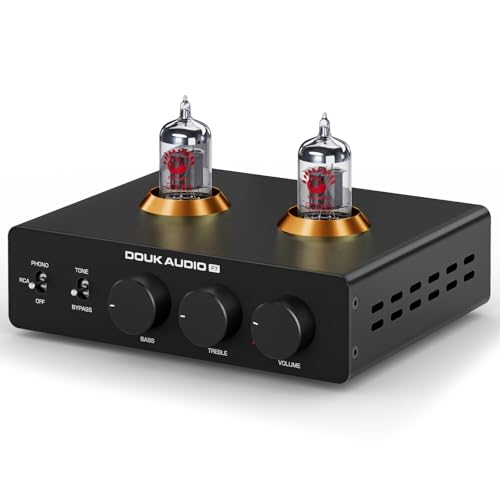 Douk Audio P7 Phono Preamp: Vacuum Tube
- MM Phono/RCA Input Flexibility: Serves as both a…
- XLR Output for Pristine Audio: Besides standard RCA,…
- Clearer Vinyl Playback with HPF: The integrated high-pass…
 Phono Turntable Preamp
- Convert Phono Signal: The turntable preamp converts phono…
- Low Noise Operation: The phono preamp offers outstanding…
- RCA Input & RCA Output: This mini preamp…
As an Amazon Associate we earn from qualifying purchases at no extra cost to you.
What Makes a Built-In Preamp Truly High-End
At budget levels, a built-in preamp is just convenience. At premium levels, it should rival a standalone $300-$700 phono stage. Here is how to evaluate it:
- Discrete vs. op-amp design: High-end designs like the Cambridge Audio Alva TT V2 use a discrete transistor stage derived from the Alva Duo phono preamp, with lower noise and more headroom than generic IC-based stages.
- Gain and loading options: Look for switchable MM/MC support or at least proper capacitive loading for moving magnet. Most integrated stages are MM-only, which limits future cartridge upgrades.
- Defeat switch: A true high-end table lets you completely bypass the internal stage with a hard switch, not just mute it. This preserves an upgrade path to an external tube or solid-state phono stage later.
- Grounding and shielding: The phono stage should have its own shielded enclosure inside the plinth to prevent motor and transformer hum. Coreless direct-drive motors, like in Technics models, help here.
Spec Comparison: Premium Turntables With Built-In Phono Stages
These models all offer a switchable built-in preamp and represent different engineering philosophies. Specifications are manufacturer-published values for 2026 production models.
| Model | Drive Type | Wow & Flutter | S/N Ratio | Tonearm | Cartridge Included | Weight | Key Connectivity |
|---|---|---|---|---|---|---|---|
| Cambridge Audio Alva TT V2 | Belt Drive (DC motor) | <0.06% WRMS | >82 dB | 9-inch custom low-resonance, adjustable VTA | Alva MC High-Output Moving Coil (factory fitted) | 23.8 lbs / 10.8 kg | RCA (phono/line switchable), aptX HD Bluetooth |
| Technics SL-1500C | Direct Drive (coreless) | 0.025% WRMS | 78 dB | 9-inch S-shaped aluminum, adjustable height/VTA | Ortofon 2M Red (MM) | 21.8 lbs / 9.9 kg | RCA (phono/line switchable), Auto-lift |
| McIntosh MTI100 | Belt Drive (DC motor) | <0.06% WRMS | 82 dB | 9-inch aluminum, fixed headshell | Sumiko Oyster (MM) | 27.0 lbs / 12.2 kg | RCA (phono/line switchable), Bluetooth 4.2, coax/optical/USB, 50Wpc amp + sub out |
| Yamaha TT-S303 / MusicCast Vinyl 500 (TT-N503) | Belt Drive (DC motor) | 0.20% WRMS | 67 dB | 8.8-inch straight aluminum, adjustable counterweight | Audio-Technica AT-VM95E (MM) | 12.6 lbs / 5.7 kg (TT-S303) / 15.2 lbs / 6.9 kg (TT-N503) | RCA (phono/line switchable), Wi-Fi, AirPlay, Bluetooth (N503 only) |
| TEAC TN-5BB | Belt Drive (PRS3 platter rotation sensing) | 0.10% WRMS | 75 dB | 9-inch knife-edge, VTA/S-arm height adjustable | Sumiko Oyster (MM) | 21.6 lbs / 9.8 kg | RCA (phono/line switchable), Balanced XLR, USB digital out |
Takeaway: Direct-drive holds the measurable speed advantage, while heavier belt-drive designs focus on isolating motor vibration through mass and suspension.
How to Choose by Engineering Priority
1. Speed Stability and Vibration Control
For pitch stability on piano and sustained notes, wow and flutter below 0.05% is the high-end threshold. The Technics coreless direct-drive system eliminates cogging and achieves 0.025% without a belt that can stretch or slip. It also reaches speed in 0.7 seconds and holds it via quartz-locked control.
Belt-drive flagships take the opposite approach: mass and decoupling. The Alva TT V2 uses a 7.3 lb / 3.3 kg POM (polyoxymethylene) platter and an elastomer-damped plinth to absorb resonance, while the TEAC TN-5BB adds an optical PRS3 sensor that detects platter speed in real time and corrects the servo 1,000 times per second. Both handle footfall and speaker vibration better than lightweight decks, but benefit more from a solid wall shelf or isolation platform.
If your floor is springy or your speakers share the same furniture, prioritize weight and isolation over absolute wow and flutter specs. If you play a lot of electronic or dance records where absolute tempo matters, direct-drive is more reliable long-term.
2. Tonearm Adjustment and Cartridge Path
A high-end table should not lock you into one cartridge. Check these adjustments:
- VTA / Arm Height: Technics SL-1500C, Alva TT V2, and TEAC TN-5BB offer continuous height adjustment. This is essential if you plan to move from the included 17-18mm tall Ortofon/Sumiko to a taller or shorter high-end cartridge like an Ortofon 2M Black, Nagaoka MP-500, or Hana SL.
- Overhang and Offset: S-shaped arms (Technics) and straight arms with removable headshells make alignment easier with a protractor. Fixed headshell designs limit fine tuning.
- Counterweight range: Verify the arm can balance 5-10g cartridges if you intend to experiment with low-output MC cartridges in the future. Most premium arms can, but lightweight straight arms may not handle heavy MC bodies without an auxiliary weight.
The Alva TT V2 ships with a factory-aligned high-output MC, which is unusual at this level. It sounds more detailed than the typical MM, but its output is designed to work with an MM-stage input, so you cannot directly swap to a low-output MC without an external step-up or different phono stage.
3. Connectivity and System Fit
Built-in preamps are not all line-level equals. Consider where the signal is going:
- To powered speakers or a line-only integrated: Any of these will work. Switch the turntable to LINE and use standard RCA.
- To wireless / multi-room: The Yamaha TT-N503 streams vinyl over Wi-Fi via MusicCast to other Yamaha speakers, and the Alva TT V2 transmits aptX HD Bluetooth directly to headphones or Bluetooth speakers without digitizing through an extra ADC/DAC box. Bluetooth adds compression, but aptX HD at 24-bit/48kHz is audibly cleaner than standard SBC.
- To a recording chain: The TEAC TN-5BB’s balanced XLR out and USB output let you bypass the single-ended RCA entirely for lower noise over long cable runs or for needle-drop archiving at 24-bit/192kHz.
- To a future separate phono stage: Buy a table with a true bypass. The McIntosh MTI100, Technics, and Cambridge Audio models fully disconnect the internal stage when set to PHONO, so you are not double-amplifying.
Decision Matrix: Which Turntable Fits Your Situation
| If You Are… | Best Match | Why |
|---|---|---|
| You want the simplest high-end sound with no extra boxes and you own quality powered or passive speakers | Cambridge Audio Alva TT V2 | Discrete high-output MC stage is genuinely hi-fi, POM platter and Bluetooth cover both critical and casual listening without upgrades |
| You value set-and-forget reliability, precise speed, and plan to swap cartridges often | Technics SL-1500C | Coreless direct drive never needs belt replacement, gimbal arm with 0-6mm VTA and universal headshell makes cartridge rolling easy, auto-lift protects stylus |
| You want one piece of furniture to run a full vinyl system in a living room | McIntosh MTI100 | Integrated 50Wpc amplifier, Bluetooth receiver, and multiple digital inputs mean you only add speakers; built for low hours but high convenience |
| You want streaming vinyl to multiple rooms or digitizing records | Yamaha TT-N503 or TEAC TN-5BB | Yamaha for Wi-Fi whole-home audio, TEAC for balanced and USB archival workflows |
| You plan to upgrade to a $1,000+ external phono stage within 2 years | Technics SL-1500C or TEAC TN-5BB | Best mechanical platforms under $1,500 where the internal stage is good now but fully defeatable later without paying for a premium internal MC stage you will abandon |
Ownership Realities: What Wears Out and How to Avoid Damage
High-end tables last decades, but consumables do not. Plan for these costs:
- Stylus life: A bonded elliptical stylus (2M Red, AT-VM95E, Sumiko Oyster) lasts 600-1,000 hours. A nude elliptical or Shibata lasts 800-1,200 hours. At 8 hours per week, that is 18 to 30 months before diamond wear dulls high frequencies and risks groove damage. Budget for a replacement stylus or retip as a general market range of $100-$400 for MM and $400-$800+ for MC. Clean the stylus with a dry stylus brush front-to-back after every side, never side-to-side.
- Belt aging: Belt drives need a new belt every 3-5 years even with low use. Rubber hardens and slips, causing slow startup and elevated wow. Keep a spare and avoid touching the belt with bare fingers. Direct drives avoid this entirely.
- Record hygiene: Dust is the primary cause of pops and stylus wear. Use a carbon fiber brush before each play and a wet record cleaning system monthly if you buy used vinyl. Never use tap water to clean records, minerals leave residue in grooves.
- Setup mistakes: The two most common errors are incorrect tracking force and leaving the internal preamp on while connected to an external phono input. The first causes distortion and record wear, the second causes loud hum and double EQ. Set tracking force with a digital gauge, not just the counterweight dial, and double-check the PHONO/LINE switch on the rear panel before powering on.
Worked Example: True Cost Per Hour of Listening
To compare a table with an expensive MC cartridge versus a cheaper MM, calculate total cost over 5 years at 6 hours per week (1,560 hours):
Example A: Turntable with $250 MM cartridge, stylus replacement at 900 hours ($180). Total consumable cost = $180 x 1 (one replacement at hour 900) = $180. Cost per hour = $180 / 1,560 = $0.12 per hour plus the initial table.
Example B: Turntable with $750 high-output MC cartridge, replacement requires full cartridge swap at 1,000 hours ($750). Total consumable cost = $750 x 1 = $750. Cost per hour = $0.48 per hour.
This does not make MM better, but it shows why a defeatable MM stage with an MM cartridge is cheaper to run if you listen daily, while an MC is a deliberate choice for resolution over economy.
Setup Steps That Protect Sound Quality
Even with a built-in preamp, setup determines noise and distortion.
- Place the turntable on a level, rigid surface away from speaker vibration. Use a bubble level on the platter, not the plinth.
- Set tracking force to the cartridge maker’s midpoint (e.g., 1.8g for a 1.6-2.0g range), then set anti-skate to the same value.
- Adjust arm height so the arm tube is parallel to the record surface when playing. Raise slightly if highs sound harsh, lower if sound is dull.
- Connect to LINE input on your amplifier or speakers when the turntable’s switch is set to LINE, or to PHONO when set to PHONO. Never connect LINE out to a PHONO input.
- Grounding is handled internally when using the built-in stage, so no external ground wire is needed. If you bypass to an external stage, reconnect the ground wire to eliminate hum.
Frequently Asked Questions
Does a built-in preamp sound worse than a separate phono stage?
Not necessarily at high-end levels. A well-isolated discrete stage like in the Alva TT V2 measures within 1-2 dB noise and 0.5 dB RIAA accuracy of comparably priced separate units. The difference is flexibility: a separate stage lets you precisely match capacitance for MM (100-200 pF) or resistance for MC (30-1k ohms), while most internal stages are fixed at 47k ohms / 100-150 pF.
Can I use a low-output MC cartridge with these built-in preamps?
Generally no, except via an external step-up transformer or head amp. Most built-in stages provide 40-42 dB of gain for MM/high-output MC. A low-output MC needs 58-65 dB and lower loading. If you want that path, choose a table with a true bypass switch and plan for an external MC stage.
Will Bluetooth or Wi-Fi degrade vinyl sound?
Wired RCA in LINE or PHONO mode is still the most transparent path. aptX HD Bluetooth is close to CD quality and fine for casual listening, but critical listeners will hear less air and dynamic range. Wi-Fi streaming via MusicCast re-encodes analog to 48kHz/24-bit PCM, which is very good but not bit-perfect analog.









