
The best heavy bags for powerful home workouts are usually 100–150 lb hanging bags for full-power boxing, 70–100 lb bags for mixed boxing and kickboxing, and compact 40–70 lb bags when floor space, ceiling strength, or noise is limited.
Our top picks
 Everlast Elite 2 Heavy Bag
- Strong PVC exterior resists wear and tear from…
- Sand & recycled cloth interior provides superior shock…
- Includes bottom tie-down strap for stability during use
 Everlast Elite 2 Heavy Bag Wood Beam
- Solid Steel Wood Beam Hanger
- Built for Heavy Training
- Realistic Strike Feel
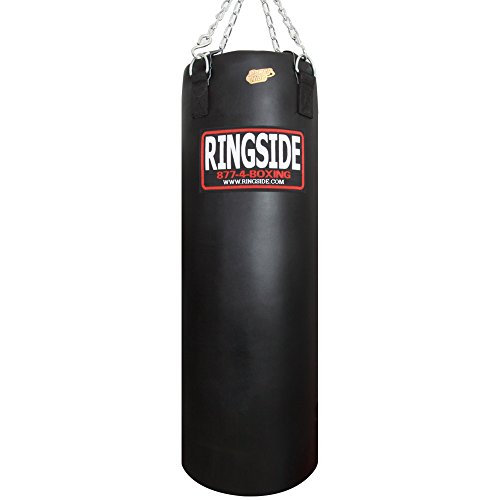 Ringside 100 lb Powerhide Heavy Bag for
- TRAIN BOXING, MMA, MUAY THAI & KICKBOXING: The…
- At 100 lb, this heavy punching bag gives…
- The bag is soft filled for a dense,…
| Product | Key specs | |
|---|---|---|
| Everlast Elite 2 Heavy Bag | Strong PVC exterior resists wear and tear from… Sand & recycled cloth interior provides superior shock… Includes bottom tie-down strap for stability during use | Check price |
| Everlast Elite 2 Heavy Bag Wood Beam | Solid Steel Wood Beam Hanger Built for Heavy Training Realistic Strike Feel | Check price |
| Ringside 100 lb Powerhide Heavy Bag for | TRAIN BOXING, MMA, MUAY THAI & KICKBOXING: The… At 100 lb, this heavy punching bag gives… The bag is soft filled for a dense,… | Check price |
 Mesetast Punching Bag for Adults | 【Quality Materials】The punching bag is made of thick… 【Complete Boxing Equipment】1 x 4ft punching bag(unfilled),1 x… 【Stainless Steel 360° Swivel】The sturdy 360° swivel ensures… | Check price |
As an Amazon Associate we earn from qualifying purchases at no extra cost to you.
Quick picks by training situation
| Situation | Best bag type | Recommended size | Why it fits | Typical price range |
|---|---|---|---|---|
| Small room or apartment | Compact hanging bag or freestanding bag | 40–70 lb | Needs less clearance and produces less swing momentum | $100–$300 |
| Beginner learning boxing fundamentals | Traditional cylindrical canvas or synthetic-leather bag | 70–100 lb | Stable enough for technique without overwhelming the user | $120–$350 |
| Power boxing and heavy combinations | Dense, well-filled hanging heavy bag | 100–150 lb | Resists displacement and supports hard punches | $180–$500 |
| Muay Thai, kickboxing, or knees | Long heavy bag | 100–150 lb, 5–6 ft long | Provides targets from head height to low kicks | $200–$550 |
| Shared household or rented space | Freestanding water- or sand-base bag | 45–120 lb striking body | No ceiling attachment, although the base occupies more floor area | $180–$500 |
How heavy should your bag be?
A common starting point is a bag weighing about half your body weight, but that is only a rough guide. The more important question is whether the bag stays reasonably controlled when you strike it. A powerful punch should make the bag move, but it should not drive a 70 lb bag across the room or cause the mounting hardware to jerk violently.
- 40–70 lb: suitable for light boxing, beginners, children under appropriate supervision, speed-and-combination work, and limited spaces. It will swing more and may feel unstable during hard punches.
- 70–100 lb: the most versatile range for many home boxers. It balances resistance, manageable swing, and installation demands.
- 100–150 lb: better for experienced strikers, heavy punches, body shots, and repeated power rounds. It needs a stronger support structure and more clearance.
- 150 lb or more: generally a specialist choice for very powerful training, multiple users, or commercial-style installations. Verify the building structure before considering it.
Weight alone does not determine resistance. A narrow, tightly packed bag can feel harder than a wider bag with the same listed weight. A long bag also distributes force over a larger surface and is more useful for kicks, while a shorter boxing bag keeps the primary target around chest and head level.
Match the bag to your striking style
Boxing
Choose a traditional cylindrical bag around 3–4 feet long and 70–120 lb. This shape gives useful targets for jabs, crosses, hooks, and uppercuts without wasting space below the waist. A bag with moderate swing is useful for footwork, but a very light bag can turn every combination into a chase.
Muay Thai and kickboxing
Choose a 5–6 foot “banana” or long heavy bag weighing roughly 100–150 lb. Its lower section gives enough surface for low kicks, body kicks, knees, and teeps. A short boxing bag mounted too high is a poor substitute: it encourages awkward low strikes and leaves no realistic target below the ribs.
Power punching
Look for a densely filled bag with reinforced hanging straps, strong stitching, and a weight of at least 100 lb for a stronger adult. A tightly packed textile or sand-and-textile fill usually gives more consistent resistance than a loosely stuffed bag. Do not choose a bag solely because its cover feels hard; excessive hardness can make poor technique uncomfortable and transfers more shock to wrists and elbows.
Mixed martial arts
A rounded or slightly teardrop-shaped bag can accommodate punches, knees, and clinch drills, but it is less ideal for sustained low-kick practice than a long bag. If takedown or ground training is part of the plan, look for a separate grappling dummy rather than forcing a conventional hanging bag to serve both purposes.
Fill material: what changes over time?
| Fill | Feel | Advantages | Ownership concerns |
|---|---|---|---|
| Textile scraps | Moderately firm and forgiving | Good general-purpose resistance; less likely to form a dangerous hard lump | Can settle and develop soft spots; may need redistributing |
| Textile plus sand packets | Dense and stable | Adds weight without making the entire surface rigid | Packets can shift or rupture; inspect the bag if its shape changes |
| Water-filled | Responsive, with fluid impact absorption | Convenient for some freestanding designs; easy to empty before moving | Leaks, temperature changes, and base movement are possible |
| Foam | Uniform and relatively springy | Consistent shape and often clean construction | Can compress permanently in high-impact zones; usually costs more |
For a hanging bag, the cover matters almost as much as the filling. Genuine leather can age well when kept dry but is usually more expensive. Synthetic leather is easier to clean and commonly offers the best value. Canvas is economical and durable against abrasion, but it can feel rough on uncovered skin and may absorb sweat. Whichever cover you choose, inspect the seam construction and strap attachment points before comparing cosmetic features.
Hanging versus freestanding: the space decision
A hanging bag generally swings more naturally and uses floor space efficiently, but the ceiling or wall structure must carry both the bag’s static weight and repeated impact loads. A 100 lb bag does not impose only 100 lb of practical stress when it is repeatedly accelerated and stopped. Mounting into a ceiling joist, structural beam, or properly rated support is substantially safer than attaching hardware to drywall, decorative ceiling material, or an uncertain partition.
Use a hanging bag when you can provide approximately 3 feet of clearance around the bag and can verify the support structure. Allow more room—often 5 feet or more—in the direction of expected swing if you want to move around it freely.
Use a freestanding bag when drilling is impossible or the ceiling cannot be verified. Measure the whole footprint, including the base. A unit with a 24-inch base can require a clear working area of about 7 feet in diameter once stance, punching range, and movement are included. Water bases are easier to empty; sand bases are heavier and usually move less, but they are harder to relocate.
Swing control and mounting hardware
For powerful home workouts, stability comes from three parts: bag weight, suspension length, and the mount. A heavy bag with a long chain can build substantial momentum. A shorter suspension reduces the arc, while a swivel lets the bag rotate and prevents the chain from twisting. A spring or shock-absorbing connector can reduce vibration transmitted to the structure, but it can also add bounce and should be chosen only if its load rating matches the complete setup.
- Use a rated swivel, carabiner, chain, and anchor rather than improvised hardware.
- Check every load rating against the bag’s filled weight and the expected dynamic use.
- Keep the bag low enough for body shots and high enough that its bottom does not strike the floor during movement.
- Stop using the bag if straps fray, stitching opens, metal hardware bends, or the mount creaks under load.
Decision matrix: choose by budget, experience, and frequency
| Budget | Experience | Use frequency | Practical choice |
|---|---|---|---|
| Under $150 | Beginner | 1–2 sessions weekly | 70–100 lb textile-filled bag; reserve money for gloves, wraps, and a properly rated mount |
| $150–$300 | Beginner to intermediate | 2–4 sessions weekly | 100–120 lb synthetic-leather bag or a compact freestanding model |
| $300–$550 | Intermediate to advanced | 3–6 sessions weekly | 100–150 lb dense-fill bag with reinforced suspension and a long format for kickboxing |
| Any budget | Limited space or no suitable ceiling | Occasional to frequent | Freestanding bag, provided the base and complete movement footprint fit safely |
Durability and maintenance realities
The cover is not usually the first component to fail. Seams, hanging straps, chain links, swivels, and the most frequently struck section tend to show wear first. Rotate a symmetrical bag periodically so one panel does not receive every punch. Do not kick a standard boxing bag with bare feet; use suitable footwear or a bag designed for that contact.
Wipe synthetic leather and plastic surfaces after sweaty sessions, then let the bag dry with ventilation around it. Avoid soaking textile or canvas bags, because trapped moisture can encourage odor and deterioration. Inspect the bag weekly if you train several times per week. A useful maintenance schedule is a quick hardware check every session, a seam-and-cover inspection each week, and a full mounting inspection monthly.
Gloves and hand wraps are consumables. Replacing worn wraps and allowing gloves to dry can protect the bag as well as your hands. If the fill settles, do not simply strike the new soft area harder; follow the manufacturer’s instructions for repositioning or refilling it.
Bottom line
For most home boxers, the best heavy bags are 70–100 lb hanging models with textile-based fill and a durable synthetic-leather cover. Choose 100–150 lb and a 5–6 foot long design for powerful boxing, kickboxing, or Muay Thai. Choose a freestanding model when structural mounting is uncertain, and treat installation clearance and rated hardware as part of the purchase—not optional accessories.









