
Best HVAC Nitrogen Regulator Kits for Brazing
The best HVAC nitrogen regulator kit for brazing is a two-stage or high-quality single-stage regulator with a 0–400 psi outlet gauge, a separate low-flow control, a CGA-580 nitrogen connection, and a flexible hose that fits your purge adapters. For most service technicians, a compact 0–400 psi HVAC nitrogen kit with a 0–60 or 0–100 psi flow gauge is the most useful balance of control, portability, and cost.
Quick picks by HVAC job
| Best for | Recommended kit type | Useful specifications | Typical market range |
|---|---|---|---|
| Occasional residential brazing | Compact nitrogen regulator kit | 0–400 psi outlet gauge, 6–10 ft hose, CGA-580 inlet | $50–$110 |
| Frequent service work | Heavy-duty adjustable regulator with flow control | Brass body, metal gauges, 0–400 psi range, replaceable hose | $100–$220 |
| Small tubing and mini-split work | Low-flow purging kit | 0–60 or 0–100 psi flow gauge, 1/4-inch flare hose, compact case | $70–$160 |
| Large commercial piping | High-capacity regulator and manifold setup | High inlet-pressure rating, 0–600 psi outlet gauge, 3/8-inch hose option | $150–$350 |
| Working from a crowded rooftop or ladder | Short, lightweight portable kit | Under 5 lb, protected gauges, 4–6 ft hose, carrying pouch | $60–$150 |
What separates a good brazing kit from a basic nitrogen regulator
Pressure control and flow control are not the same
A regulator reduces cylinder pressure to a usable outlet pressure. A flow-control valve or flow gauge determines how much nitrogen actually enters the refrigeration circuit. Brazing requires a gentle, continuous purge, not a high-pressure blast.
Our top picks
 RX WELD Nitrogen Purge Tool
- 50 PSI Inlet Pressure: Designed to function optimally…
- Easy to Use: Easily prep copper tubes for…
- Function: Helps nitrogen flow smoothly into tubing during…
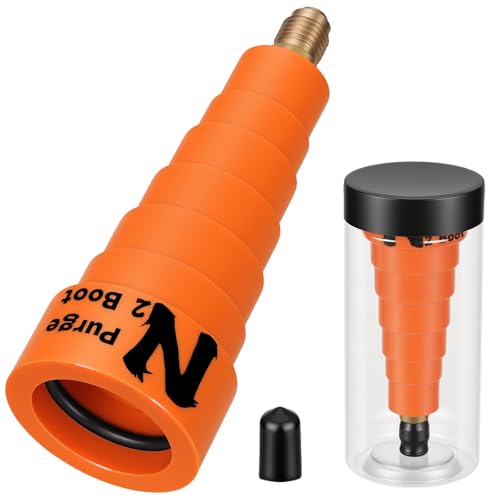 Nitrogen Purge Boot for HVAC Brazing
- Designed for HVAC and refrigeration brazing, this nitrogen…
- This nitrogen purge tool is built with multiple…
- STANDARD 1/4” SAE CONNECTION
 Nitrogen Purge Tool for HVAC Brazing
- Easy to use: Just connect a standard 1/4'…
- Extend the service life of HVAC equipment: Help…
- Precise and affordable: The air inlet pressure is…
| Product | Key specs | |
|---|---|---|
| RX WELD Nitrogen Purge Tool | 50 PSI Inlet Pressure: Designed to function optimally… Easy to Use: Easily prep copper tubes for… Function: Helps nitrogen flow smoothly into tubing during… | Check price |
| Nitrogen Purge Boot for HVAC Brazing | Designed for HVAC and refrigeration brazing, this nitrogen… This nitrogen purge tool is built with multiple… STANDARD 1/4” SAE CONNECTION | Check price |
| Nitrogen Purge Tool for HVAC Brazing | Easy to use: Just connect a standard 1/4'… Extend the service life of HVAC equipment: Help… Precise and affordable: The air inlet pressure is… | Check price |
 Upgraded Nitrogen Purge Tool for HVAC | 【Efficient Nitrogen Flow Control with Upgraded Nitrogen Purge… 【Quick & Easy Mode Switching】 【Durable & Portable Construction】 | Check price |
As an Amazon Associate we earn from qualifying purchases at no extra cost to you.
For most copper HVAC tubing, a practical starting point is approximately 2–5 cubic feet per hour (CFH), although the correct setting depends on tubing size, joint length, leaks, and the amount of air that must be displaced. A regulator that only shows outlet pressure makes this setting difficult to repeat. A kit with a low-range flow gauge is easier to use consistently.
High-pressure capability is still useful for pressure testing, but a 0–400 psi gauge can be difficult to read at the very low pressure used for purging. The strongest all-purpose setup therefore has two indications: a high-pressure outlet gauge and a separate low-flow indicator.
Hose and connector compatibility
Most nitrogen cylinders in North America use a CGA-580 connection. Confirm this before buying, particularly if the kit is imported or marketed for another gas service. On the HVAC side, a 1/4-inch SAE flare hose is common, while 3/8-inch connections may be preferable for larger commercial lines.
- Choose a hose rated for nitrogen pressure and compatible with the regulator’s outlet fitting.
- Look for a 1/4-inch flare fitting or an included adapter for the service port.
- Use a purge tee, access valve, or dedicated fitting that allows nitrogen to enter and exit the piping without pressurizing a closed system.
- Do not assume a propane, oxygen, or general compressed-air regulator has the correct connection or service rating.
- Check whether the hose uses replaceable seals; flare seals and Schrader depressors are common wear items.
Gauge readability matters more than maximum pressure
A large, protected gauge with clear markings is preferable to a tiny gauge with an impressive maximum-pressure number. For brazing, the useful range is concentrated near the low end. Metal cases, rubber boots, and a vertical gauge face help when the cylinder is placed on a rooftop or truck floor.
Pressure gauges are vulnerable to impact and overpressure. If the gauge needle does not return to zero, moves erratically, or fogs internally, replace the gauge or regulator rather than relying on a questionable reading.
Head-to-head: compact kits versus professional regulator setups
Compact kits
Compact kits from HVAC tool brands such as Uniweld, Yellow Jacket, and similar manufacturers are convenient for residential service and occasional brazing. They commonly include a regulator, hose, adapter, and a small storage case. Their advantages are low weight, quick setup, and lower cost.
The trade-off is that the included hose may be short, the gauge may be small, and the flow control may be less precise. A compact kit is a good choice when the technician usually works on 1/4- to 3/8-inch copper and carries the cylinder only short distances.
Heavy-duty regulator assemblies
Professional assemblies using regulators from established welding-gas manufacturers such as Harris or Victor are better suited to daily use, commercial piping, and repeated pressure-testing work. They tend to have sturdier bodies, better-protected gauges, and fittings that tolerate frequent connection and disconnection.
They are heavier and often require a separately purchased hose, purge tee, or adapter. They also make less sense if the kit will be used only a few times per year. A heavy-duty regulator is worth the extra cost when damaged gauges, leaking fittings, or downtime would cost more than the initial price difference.
Decision matrix
| Your situation | Best choice | Why | What to avoid |
|---|---|---|---|
| Budget-conscious homeowner or apprentice | Basic compact kit with flow valve | Enough control for occasional copper brazing | Pressure-only regulator with no practical low-flow adjustment |
| New technician building a service bag | Kit with 0–400 psi pressure gauge and low-range flow gauge | Covers brazing, light purging, and general nitrogen work | Unprotected plastic gauges and nonreplaceable hoses |
| Daily residential service | Compact heavy-duty regulator with 6–10 ft hose | Good reach without excessive cylinder weight | Very short hoses that force the cylinder next to the torch |
| Commercial refrigeration or large pipe | Heavy-duty regulator with larger hose option | Better durability and less restriction at higher flow | Miniature low-capacity kits used outside their intended range |
| Infrequent use and limited storage | Light kit in a sealed pouch or case | Protects fittings while taking little room | Large manifold systems that remain unused and unprotected |
How to set up a nitrogen brazing kit
- Secure the cylinder. Keep it upright and fasten it with a chain or approved strap. Do not leave it loose where it can fall and damage the valve or regulator.
- Inspect the connection. Check the CGA-580 fitting, gasket, hose, and outlet threads. Never force mismatched threads.
- Install the regulator with the adjustment backed out. This reduces the chance of suddenly applying pressure when the cylinder valve is opened.
- Connect the hose to a purge point. Provide an exit path at the far end of the tubing so the circuit is not sealed.
- Open the cylinder valve slowly. Set the outlet pressure only high enough to maintain the required gentle purge.
- Adjust the flow. Begin near 2 CFH for small copper tubing and increase only if the purge is not displacing air adequately. Avoid a strong stream that disturbs the molten brazing alloy.
- Purge before heating and throughout the braze. Continue briefly while the joint cools, then close the cylinder and release trapped pressure from the hose.
As a useful estimate, a 40-cubic-foot cylinder used at 4 CFH has a theoretical runtime of 10 hours. In real work, setup losses, leaks, pressure changes, and purging the hose reduce that figure. If each joint consumes 0.15 cubic feet, the theoretical cylinder capacity is about 267 joints, but actual usage will be lower. This is why leak-free connections and a controllable low flow are more valuable than simply choosing the largest regulator.
Durability and ownership realities
The first parts to wear are usually hose ends, flare seals, Schrader depressors, valve stems, and gauge protectors—not the regulator body. Store the hose without tight kinks, keep caps on unused fittings, and avoid dragging the gauge across concrete or a metal roof.
Inspect the system for leaks with an approved leak-detection method before each major job. Do not use oil or grease on oxygen-service fittings, and do not modify a regulator to fit a different gas connection. Nitrogen cylinders can contain very high pressure; use equipment rated for the cylinder and application.
A common mistake is confusing a pressure-test regulator with a brazing-flow regulator. A regulator capable of 400 or 600 psi may be excellent for testing but awkward for maintaining a repeatable 2–5 CFH purge. Another is buying a kit with a convenient adapter but an unsuitable hose. Confirm the complete flow path—from cylinder connection to purge outlet—before judging the kit by its gauge range alone.
Final buying recommendation
For most HVAC brazing jobs, choose a portable kit with a CGA-580 inlet, a 0–400 psi outlet gauge, a separate low-flow control, a 6–10 ft rated hose, and replaceable fittings. Pick the compact version for residential and mini-split work; choose a heavier Harris-, Victor-, or comparable professional-style regulator assembly when the equipment will be used daily or on larger commercial systems. The best kit is not the one with the highest pressure rating—it is the one that lets you set a stable, visible low flow while matching your cylinder, hose, and purge connections.









