
The best glass mixing bowl set for most kitchens is a nested three- or four-piece borosilicate set with roughly 1.5-, 2.5-, 4-, and 5- to 6-quart bowls, matching lids, a stable rim, and clearly stated microwave, oven, freezer, and dishwasher ratings.
That recommendation is not universal. Soda-lime glass can cost less and is perfectly suitable for ordinary mixing, while borosilicate is the better choice for frequent temperature changes. The right set also depends on whether you mostly whisk dressings, mix cookie dough, proof bread, or prepare large family-size batches.
Our top picks
 Pyrex Essentials
- Set includes 1-qt, 1.5-qt, and 2.5-qt round glass…
- High-quality tempered glass gives you a peace of…
- These glass bowls are freezer, microwave, and dishwasher…
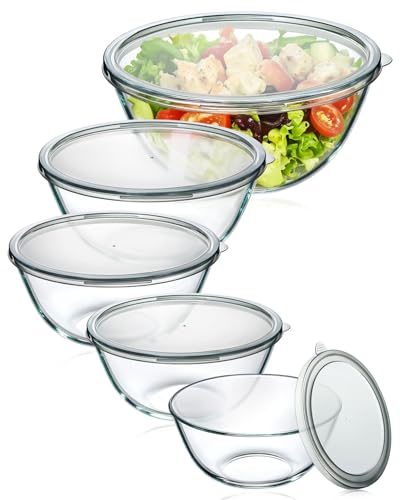 Glass Mixing Bowls with Lids Set of
- Premium Food-Grade Material: The glass mixing bowls are…
- Multi-Size Set: The glass mixing bowls with lids…
- Space-Saving: Our glass nesting bowls and lids nest…
 Anchor Hocking 10 Piece Mixing Bowl Set
- This Anchor Hocking set of mixing bowls contains…
- This set of mixing bowls was designed so…
- Anchor Hocking glass is healthier than plastic and…
| Product | Key specs | |
|---|---|---|
| Pyrex Essentials | Set includes 1-qt, 1.5-qt, and 2.5-qt round glass… High-quality tempered glass gives you a peace of… These glass bowls are freezer, microwave, and dishwasher… | Check price |
| Glass Mixing Bowls with Lids Set of | Premium Food-Grade Material: The glass mixing bowls are… Multi-Size Set: The glass mixing bowls with lids… Space-Saving: Our glass nesting bowls and lids nest… | Check price |
| Anchor Hocking 10 Piece Mixing Bowl Set | This Anchor Hocking set of mixing bowls contains… This set of mixing bowls was designed so… Anchor Hocking glass is healthier than plastic and… | Check price |
 Pyrex Colors Tinted | 3 PACK (FULL SET): Set includes 1.3-qt, 2.3-qt,… Plastic lids are designed to securely keep your… BPA-Free plastic lid is freezer, microwave, and top-rack… | Check price |
As an Amazon Associate we earn from qualifying purchases at no extra cost to you.
Best glass mixing bowl sets by kitchen situation
| Kitchen situation | Best choice | Useful capacity range | What to prioritize |
|---|---|---|---|
| Small kitchen or one- to two-person household | Three-piece nesting set | 1.5, 2.5, and 4 quarts | Compact storage, lighter bowls, pouring rim |
| Frequent everyday cooking | Four-piece borosilicate set | 1.5, 2.5, 4, and 5.5 quarts | Temperature tolerance, dishwasher safety, useful size spread |
| Bread, pastry, and batch cooking | Four- or five-piece heavy-wall set | 2, 3, 4, 5, and 7 quarts | Large working bowl, stable base, refrigerator space |
| Lowest purchase price | Soda-lime glass set | 1.5 to 5 quarts | Thick walls, careful temperature changes, replaceable pieces |
| Food prep and storage in the same container | Set with fitted lids | 1.5 to 6 quarts | Leak-resistant lids, stackable tops, ventilation instructions |
Borosilicate versus soda-lime glass
Borosilicate glass: better for temperature changes
Borosilicate glass contains additives that give it a lower coefficient of thermal expansion than ordinary soda-lime glass. In practical terms, it generally handles a quick change from cold storage to a warm environment better. That makes it appealing for melting butter, warming ingredients in the microwave, or using one bowl for refrigerated and room-temperature preparation.
It is not unbreakable. A borosilicate bowl can still fracture if it is dropped, struck against a sink, placed on a hot burner, or exposed to a severe temperature shock. The manufacturer’s instructions remain more important than the material name alone.
Soda-lime glass: economical and suitable for routine mixing
Soda-lime glass is the common glass used in many household bowls. It is usually less expensive and can be very durable when its walls are thick and its rim is well finished. It works well for whisking eggs, combining dry ingredients, tossing salads, and mixing batters at normal room temperatures.
Its main limitation is thermal shock. Do not pour boiling liquid into a chilled soda-lime bowl or move a cold bowl directly into a hot oven unless the maker explicitly permits it. A set made from thick soda-lime glass may outlast a poorly designed thin borosilicate set in ordinary use, so construction matters as much as the label.
How much capacity do you actually need?
Capacity printed on the packaging is the bowl’s approximate maximum volume, not the amount you should fill while mixing. A bowl filled to the rim leaves no room for whisking, folding, or rising dough. For most recipes, plan to use about 60% to 75% of the stated capacity.
- 1 to 1.5 quarts: dressings, beaten eggs, spice mixtures, and small prep jobs.
- 2 to 3 quarts: pancake batter, frosting, chopped ingredients, and small cookie batches.
- 4 to 5 quarts: cakes, muffins, larger batters, and everyday family cooking.
- 5.5 to 7 quarts: bread dough, double batches, whipped mixtures, and large salads.
For example, a 4-quart bowl has about 16 cups of nominal capacity. At a practical 70% fill level, it provides roughly 11 cups of working space. That is enough for many cake or cookie recipes, but a double batch of bread dough may need a 5.5- or 7-quart bowl because dough expands and requires kneading room.
Features that separate a useful set from a frustrating one
Nesting design
Good nesting is more than putting smaller bowls inside larger ones. Check whether the bowls sit securely without wobbling, whether the rims interlock, and whether the largest bowl leaves enough clearance for cabinet shelves. A four-piece set that occupies the footprint of its largest bowl is usually more useful than four bowls that must be stored separately.
Measure the nested height before buying if cupboard space is tight. A typical nested set may occupy approximately 10 to 14 inches of vertical space, but lids can add several inches or prevent the bowls from nesting completely.
Lids
Lids turn mixing bowls into short-term storage containers, but they are often the first component to wear. Look for flexible, BPA-free plastic or silicone lids with a clearly stated dishwasher rating. A lid that merely rests on the rim is fine for refrigerator storage; it should not be assumed to be leakproof for carrying soup or batter.
Check whether the lids tolerate microwave heating. Many do not, or they require a vent to be opened. Glass may be microwave-safe while the lid is not.
Pour spouts and rims
A pronounced spout is valuable for pancake batter, melted chocolate, sauces, and beaten eggs. It is less important for dough. A rounded, reinforced rim helps prevent drips and gives the bowl a safer grip, while a very thin rim can chip when it contacts a metal sink or another bowl.
Base stability
Glass is heavy, which helps a bowl remain steady, but a completely smooth base can slide on a wet counter. A broad flat base or silicone-covered foot is preferable for whisking. If the set includes silicone sleeves, verify whether they can be removed for cleaning; trapped moisture beneath a sleeve can create an unpleasant odor.
Microwave, oven, freezer, and dishwasher safety
Do not treat “glass” as a complete safety specification. A bowl can be microwave-safe but unsuitable for oven use, or dishwasher-safe but vulnerable to thermal shock when removed from the machine.
- Microwave: use only bowls labeled for microwave heating, and remove or vent the lid as directed.
- Oven: confirm the maximum temperature and whether preheating is required. Never place a glass bowl on a stovetop burner.
- Freezer: leave headspace for expansion and avoid moving a frozen bowl straight into a hot oven or onto a hot surface.
- Dishwasher: place bowls so they cannot strike one another or the racks. Hand-washing lids often extends their life.
Thermal shock is the common mistake: a cold bowl, hot liquid, and a sudden temperature change can be more damaging than normal mixing. Let bowls warm gradually, and inspect them after any impact. Discard a bowl with a crack, deep scratch, or chipped rim rather than continuing to use it.
Chip resistance and long-term ownership
Most damage occurs at the rim, base edge, and contact points where bowls hit metal sinks, faucets, racks, or one another. Thick glass helps, but no glass bowl is chip-proof. A polished, rounded rim is preferable to a sharp, thin edge.
Store the set nested only when the bowls are clean and dry. If the manufacturer supplies separators, use them. Otherwise, a thin cloth or paper towel between bowls can reduce scuffing, although it should not be left damp. Avoid cutting inside a glass bowl and do not use it as a mortar for pounding hard ingredients.
Replacement availability is an underrated buying criterion. A set with four inexpensive lids is less attractive if one cracked lid makes the entire storage system inconvenient. Before purchasing, check whether individual bowls or lids are sold separately and whether the warranty covers breakage during normal use.
What should you spend?
General market pricing usually falls into three tiers. Basic soda-lime sets commonly cost about $20 to $40. Better-made borosilicate or thick-wall sets often cost about $35 to $75. Large sets with multiple lids, silicone bases, or unusually heavy construction can reach roughly $80 to $130.
Paying more is worthwhile when you will use the bowls several times a week, need microwave or freezer flexibility, or want lids for storage. For occasional mixing, a smaller soda-lime set may offer better value. As a simple ownership calculation, a $60 set used twice weekly for three years provides about 312 uses, or approximately 19 cents per use before replacements. A $25 set used only once a month for three years provides about 36 uses, or roughly 69 cents per use.
Bottom line
Choose a three-piece set if storage is the main concern, a four-piece set for the broadest everyday coverage, and a five-piece set only when you regularly make large batches. Choose borosilicate when temperature changes and microwave use matter; choose thick soda-lime glass when routine mixing and price matter more. In either case, prioritize a practical size range, stable bases, rounded chip-resistant rims, useful lids, and safety instructions that cover the exact appliances you plan to use.









