
The best night vision goggles for outdoor use depend on whether you need hands-free navigation, wildlife observation, security, or occasional camping: choose a digital infrared viewer for affordability and recording, or a Gen 2/Gen 3 analog device when low-light performance, low latency, and durability matter most.
Our top picks
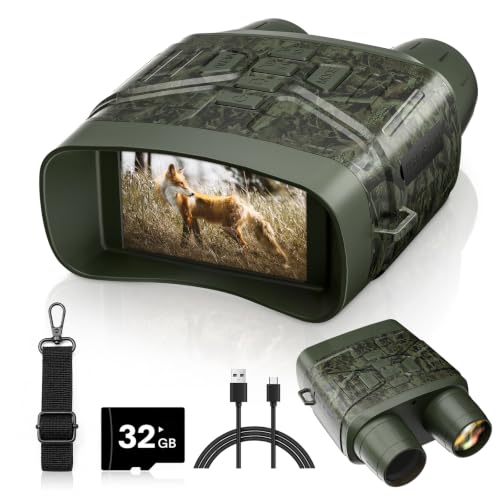 Vtiisamao Night Vision Goggles
- Day and night viewing: Use these night vision…
- 3-inch HD screen and 5X zoom: The large…
- 5000mAh rechargeable battery: The built-in rechargeable battery supports…
 Vtiisamao Night Vision Goggles
- 940nm Invisible IR & Long-Range Viewing: Vtiisamao night…
- 3.99" HD Display & 8X Digital Zoom: The…
- 48MP Photos, 4K Video & Audio Recording: Capture…
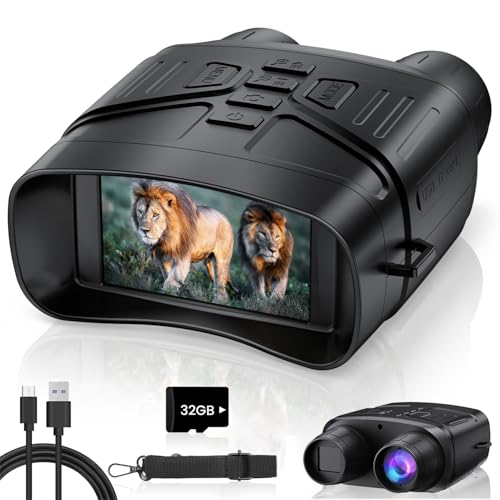 Vtiisamao Night Vision Goggles
- Day and night viewing: Use these night vision…
- 3-inch HD screen and 5X zoom: The large…
- 5000mAh rechargeable battery: The built-in rechargeable battery supports…
| Product | Key specs | |
|---|---|---|
| Vtiisamao Night Vision Goggles | Day and night viewing: Use these night vision… 3-inch HD screen and 5X zoom: The large… 5000mAh rechargeable battery: The built-in rechargeable battery supports… | Check price |
| Vtiisamao Night Vision Goggles | 940nm Invisible IR & Long-Range Viewing: Vtiisamao night… 3.99" HD Display & 8X Digital Zoom: The… 48MP Photos, 4K Video & Audio Recording: Capture… | Check price |
| Vtiisamao Night Vision Goggles | Day and night viewing: Use these night vision… 3-inch HD screen and 5X zoom: The large… 5000mAh rechargeable battery: The built-in rechargeable battery supports… | Check price |
 4K Night Vision Goggles for Adults | High-definition night vision:Designed for camping, hiking, wildlife watching,… Long-distance observation: See distant wildlife, outdoor surroundings, and… Long battery life and large storage: With a… | Check price |
As an Amazon Associate we earn from qualifying purchases at no extra cost to you.
Quick recommendations by outdoor situation
| Situation | Best fit | Useful target specifications | Typical market range |
|---|---|---|---|
| Occasional camping and navigation | Compact digital monocular | 850 nm IR, 200–300 m claimed IR range, 640 × 480 or better sensor, 4–8 hours per charge | $100–$300 |
| Backyard wildlife observation | Digital viewer with adjustable IR and tripod mount | 940 nm IR option, 3–6x optical or hybrid magnification, 8–12° field of view | $200–$600 |
| Frequent hiking or field work | Rugged digital unit or Gen 2 analog monocular | IP65 or better, under 450 g, helmet or head-mount compatibility, 6+ hours of runtime | $400–$2,500 |
| Very dark terrain and professional use | Gen 3 analog monocular or binocular system | High-performance image intensifier, manual gain, 40° field of view, 8+ hours with a quality battery | $2,500–$8,000+ |
These are buying targets rather than guarantees. Manufacturers measure infrared distance, resolution, and weather resistance under different conditions, so compare test methods as well as headline numbers.
Digital versus analog night vision
Digital infrared goggles
Digital night vision uses a CMOS or similar image sensor, processes the signal electronically, and displays it on a screen. Most models need an infrared illuminator in genuinely dark conditions. They are usually less expensive, can record photographs or video, offer adjustable magnification, and may include Wi-Fi, USB-C charging, or a color daytime mode.
The trade-offs are display lag, higher power consumption when the IR emitter is bright, and reduced detail when the image is digitally enlarged. A digital unit rated for “300 meters” may identify a large reflective object at that distance, but it will not necessarily let you recognize a person, animal, or trail marker clearly.
Analog image intensifiers
Analog devices amplify available light through an image-intensifier tube. Gen 2 systems generally offer a substantial improvement over basic digital viewers in dim ambient light, while Gen 3 systems provide the strongest performance in very dark environments. They typically have little noticeable delay and are better suited to moving over uneven ground.
Analog equipment costs much more and commonly records no video. Tubes can have cosmetic blemishes, and some models require careful handling around bright light. A good Gen 2 monocular can be a sensible compromise for frequent outdoor use; Gen 3 is difficult to justify unless low-light performance is central to the task and the budget supports it.
What the key specifications really mean
Infrared wavelength and range
850 nm infrared emitters normally provide more visible illumination to the sensor and therefore a longer useful range. The faint red glow may be noticeable from the front. A 940 nm emitter is much less visible to human eyes but usually produces less illumination for the same power, so its practical range can be shorter.
For a campsite or backyard, adjustable 850 nm IR is often the most useful. For discreet wildlife observation, 940 nm can be preferable. Look for multiple brightness levels rather than a single high-power setting, because excessive IR can wash out nearby objects and consume the battery quickly.
Resolution and image generation
Digital resolution is normally listed in pixels, such as 640 × 480 or 1920 × 1080. More pixels help with detail, but lens quality, sensor sensitivity, compression, and screen resolution also matter. A high-resolution sensor paired with a narrow, dim lens may produce a less useful image than a lower-resolution sensor with better optics.
For analog models, image quality is described using tube generation and resolution in line pairs per millimeter rather than screen pixels. Gen 2 is generally the entry point for serious low-light use; Gen 3 offers greater sensitivity but may include export restrictions or additional purchasing requirements depending on the country.
Field of view and magnification
A wide field of view makes walking safer because it helps you detect branches, rocks, and people near the edges. A narrow field of view can make distant observation easier but feels restrictive while moving. Around 40 degrees is common for analog head-mounted systems, while compact digital viewers may offer a narrower view at higher magnification.
For navigation, favor one-power or low-power optics. For stationary wildlife observation, 3x to 6x magnification can be useful. Digital zoom should be treated as cropping, not as a substitute for optical magnification.
Comfort and mounting matter more than expected
A device that is comfortable for ten minutes can become tiring after an hour. Check the complete mounted weight, including batteries, adapter, counterweight, and cable. A single-eye monocular around 300–450 g is easier to manage than a heavy dual-tube system, but it can create neck fatigue if it sits far in front of the helmet.
- Eye relief: More eye relief helps when wearing glasses, although some users remove glasses and adjust the diopter instead.
- Balance: A rear counterweight may reduce front-heavy strain, but it adds total weight.
- Adjustability: Look for independent left-right and up-down positioning on a head mount.
- Controls: Large, tactile buttons are easier to operate with gloves than a flush touchscreen.
- Safety: Use a breakaway or quick-release mount when moving through brush or near equipment.
For occasional use, a handheld monocular is often more comfortable and less expensive than buying a helmet, mount, and counterweight system. Choose head mounting when both hands must remain available and the device is light enough for repeated use.
Battery life: calculate the realistic runtime
Advertised runtime usually assumes moderate screen brightness and limited IR output. A simple estimate is:
Runtime = battery capacity in watt-hours ÷ average device power draw.
For example, a 3.7-volt, 3,000 mAh battery contains approximately 11.1 watt-hours. If a digital viewer averages 2.2 watts with its display and low IR setting enabled, its theoretical runtime is about five hours. Allowing for cold weather, battery aging, conversion losses, and standby drain, planning on four hours is more realistic.
High-power IR can reduce that figure substantially. For overnight trips, select a device with replaceable batteries or a USB-C power option, and carry a protected spare battery in an inside pocket. Do not leave lithium batteries loose with keys or other metal objects.
Weather resistance and ownership realities
For outdoor use, IP65 means protection from dust and water jets, while IP67 adds temporary immersion protection under defined test conditions. Neither rating means the device should be submerged, operated with an open battery door, or moved directly from freezing air into a warm, humid room.
The parts most likely to cause trouble are battery-door seals, rubber eyecups, charging ports, lens coatings, and head-mount fasteners. After wet use, wipe the housing with a soft cloth, remove moisture from seams, and let the unit dry naturally before sealing it in a case. Clean lenses with a blower first, then a lens-safe cloth; rubbing grit across the glass can create permanent scratches.
Common mistakes include leaving IR enabled in daylight, storing batteries inside the device for months, tightening mount screws until plastic cracks, and judging range from a manufacturer’s maximum figure. Keep the original caps, inspect O-rings, and test every control before a trip.
Legal and ethical considerations
Night vision ownership and use are legal in many places, but rules vary by country, state, and activity. Restrictions may apply to exporting image-intensifier equipment, hunting with artificial light or night vision, observing private property, operating near roads, or using optical equipment while driving. Thermal and night-vision devices can also be regulated differently.
Before buying, check local wildlife, hunting, aviation, and privacy rules. Do not use an IR illuminator to trespass on private spaces or to identify people who reasonably expect privacy. Night vision does not make it safe to cross roads, operate machinery, or handle equipment without ordinary lighting when local rules or safety procedures require illumination.
Bottom line
For most campers and casual observers, the best night vision goggles are a compact digital model with adjustable 850 nm IR, at least 640 × 480 sensor resolution, a wide enough field of view for walking, replaceable or USB-C rechargeable power, and IP65-level protection. Choose a Gen 2 analog monocular when you use night vision frequently in naturally dark terrain, and consider Gen 3 only when its superior low-light performance justifies the cost, care requirements, and legal checks.









