
The best rifle bipods depend on whether you value compact carry, fast leg adjustment, or maximum stability: choose a Harris S-BRM for a proven hunting setup, a Magpul MOE for an affordable lightweight rifle, an Atlas BT46 for versatile field and bench use, or an MDT CKYE-POD when precision adjustment matters more than weight.
Our top picks
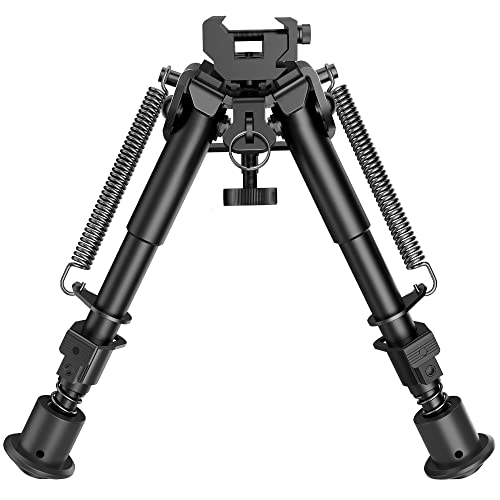 CVLIFE 6-9” Picatinny Bipod Adjustable Spring Return
- Coming with Picatinny adapter, the bipod can be…
- Adjustable leg length with 5 settings and return…
- Made of hardened steel and aluminum, non-rust black…
 CVLIFE 6-9 Inches Bipod Adjustable Super Duty
- Adjustable leg length with 5 settings and return…
- Press the button,the legs can eject fully and…
- Made of hardened steel and aluminum, non-rust black…
 Magpul Rifle Bipod Gun Rest for Hunting
- Made of lightweight Mil-Spec hard anodized 6061 T-6…
- Optimized for rapid one-handed adjustments
- Easily loaded with stabilizing forward tension without fear…
| Product | Key specs | |
|---|---|---|
| CVLIFE 6-9” Picatinny Bipod Adjustable Spring Return | Coming with Picatinny adapter, the bipod can be… Adjustable leg length with 5 settings and return… Made of hardened steel and aluminum, non-rust black… | Check price |
| CVLIFE 6-9 Inches Bipod Adjustable Super Duty | Adjustable leg length with 5 settings and return… Press the button,the legs can eject fully and… Made of hardened steel and aluminum, non-rust black… | Check price |
| Magpul Rifle Bipod Gun Rest for Hunting | Made of lightweight Mil-Spec hard anodized 6061 T-6… Optimized for rapid one-handed adjustments Easily loaded with stabilizing forward tension without fear… | Check price |
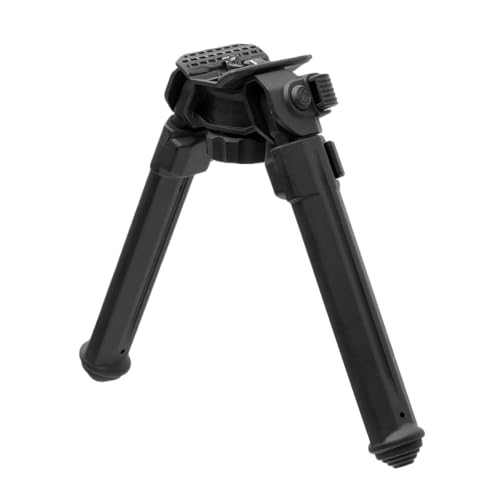 Magpul MOE Bipod for Hunting and Shooting | Utilizes the latest technology in injection molding for… Designed to mount to the popular Uncle Mike's… Non-marring overmolded saddle was made to fit securely… | Check price |
As an Amazon Associate we earn from qualifying purchases at no extra cost to you.
Best Rifle Bipods at a Glance
| Bipod | Typical height range | Approx. weight | Mounting type | Best suited to |
|---|---|---|---|---|
| Harris S-BRM 6–9 | 6–9 in | Approx. 13 oz | Sling swivel stud | Hunting and general prone shooting |
| Magpul MOE Bipod | 7–10 in | Approx. 8 oz | Magpul M-LOK | Lightweight rifles and range use |
| Atlas BT46 V8 | 5.2–9.6 in | Approx. 11 oz | Picatinny rail | Compact, adjustable field setups |
| Accu-Tac BR-4 | Approx. 6–9 in | Approx. 23 oz | Picatinny rail | Heavy rifles and bench shooting |
| MDT CKYE-POD | Varies by model, roughly 9–15 in for a common mid-height version | Approx. 28–32 oz | Picatinny rail or compatible mounting system | Precision shooting and uneven ground |
Weights and dimensions can vary by model, leg configuration, and mounting adapter. Check the manufacturer’s current specification before ordering, particularly if your rifle has a strict weight limit.
Our Top Picks by Shooting Situation
Best all-around hunting bipod: Harris S-BRM 6–9
The Harris S-BRM remains a practical choice for hunters who want a compact bipod with simple, reliable operation. Its 6–9-inch range suits many prone positions and can work from a low bench, while not adding the bulk of a tall precision bipod.
The spring-loaded legs extend independently, and the notched adjustment system is quick once you learn to operate it. The swivel version can compensate for a slightly uneven surface, although it usually needs a separate tension adjustment or lock to prevent unwanted rifle cant. A sling-swivel-stud mount is convenient on traditional hunting stocks, but it is less suitable if the rifle already uses that stud for a sling.
Choose the Harris when low weight, a familiar design, and field repairability matter more than tool-free fine adjustment.
Best lightweight M-LOK option: Magpul MOE Bipod
The Magpul MOE Bipod is a strong match for modern sporting rifles with an M-LOK handguard. It is notably light for a full-size bipod and folds close to the rifle when not in use. Its legs deploy with a push-button mechanism and offer multiple length positions without the more complicated hardware found on large precision models.
Its main limitation is the mounting standard: the MOE version is intended for M-LOK attachment, so it is not a direct fit for a sling stud or a bare stock. The 7–10-inch height is useful for prone shooting and moderate-height benches, but it may be too short for tall grass or a very high firing position.
This is the sensible pick for a shooter who carries the rifle frequently and wants to avoid paying the weight penalty of a competition-style bipod.
Best versatile Picatinny bipod: Atlas BT46 V8
The Atlas BT46 V8 offers a broader range of leg positions than basic hunting bipods. Its legs can be placed at several angles, making it easier to adapt to a steep firing line, a barricade, or uneven ground. The unit folds forward or backward and generally stays compact when carried on a rifle with a Picatinny rail.
It does not use a traditional pan-and-cant mechanism in the same way as every Harris-style model, so users should pay attention to how the rifle contacts the ground. The leg angle and independent extension provide much of its versatility, but the controls take a little practice to use quickly.
The BT46 is a good middle ground for someone who shoots both from a bench and in the field, especially when the rifle already has a Picatinny rail.
Best for a heavy bench rifle: Accu-Tac BR-4
The Accu-Tac BR-4 prioritizes a wide, solid footprint over minimum carry weight. Its heavier construction can make a large rifle feel more planted on a bench or firm range surface. Independent legs and multiple deployment angles are useful when the rifle must be leveled precisely.
The trade-off is clear: at roughly 23 ounces, it weighs substantially more than a lightweight hunting bipod. That difference is easy to calculate. If a rifle is carried for 5 miles, an extra 10 ounces adds about 3.1 pounds of additional carried weight over that distance when expressed as repeated load per mile; in practical terms, the added mass also affects balance and fatigue. For a rifle that travels from a case to a bench, however, the stability can be worth it.
Best for maximum adjustment: MDT CKYE-POD
The MDT CKYE-POD is aimed at precision shooters who need substantial height range, a wide stance, and detailed leg adjustment. Depending on the version, it can accommodate much taller positions than a conventional 6–9-inch hunting bipod. That is useful on uneven terrain, tall grass, and stages where the rifle must be leveled without moving the entire position.
Its size and weight make it less attractive for lightweight hunting rifles. The many adjustment points also create more parts to keep clean and more opportunities to choose the wrong height or leg angle under time pressure. Select it when repeatable setup and terrain adaptability are more important than a minimalist rifle.
Height: Match the Bipod to Your Position
For a low prone position on a flat range, a 5–9-inch bipod is usually the most efficient choice. It keeps the bore closer to the ground and reduces the amount of extension required. A 6–9-inch model is often suitable for hunting from a prepared prone position.
- 5–7 inches: low prone shooting, smooth range surfaces, and compact rifles.
- 6–9 inches: general hunting, prone field positions, and low benches.
- 7–10 inches: rifles with larger magazines, thicker fore-ends, or slightly higher benches.
- 9–15 inches: uneven ground, tall vegetation, kneeling positions, and precision setups.
Measure the rifle rather than choosing by label alone. Place the unloaded rifle in your normal shooting position, measure from the bipod mounting point to the ground, and allow enough clearance for the magazine, handguard, and your preferred sling or bag. The correct bipod should not need to be fully extended for every shot.
Mounting Types: What Fits Your Rifle?
Sling swivel stud
This is common on traditional hunting stocks and is often the simplest retrofit. It works well with Harris-style bipods, but confirm that the stud and stock are strong enough for the bipod’s loading forces. Some rifles have a single stud serving both the bipod and sling, requiring a compatible adapter or alternate sling attachment point.
M-LOK
M-LOK bipods attach directly to compatible slots on a modern handguard. The system keeps the rifle’s underside relatively clean and can be lighter than adding a full-length rail. Check slot spacing and screw length; overtightening can damage the handguard or interfere with the barrel.
Picatinny rail
Picatinny mounts are widely supported and make it easy to move the bipod between rifles equipped with compatible rails. They can add some height and weight, but they offer a secure, standardized interface for field and precision bipods.
Stability Versus Portability: A Practical Decision Matrix
| Your priority | Recommended type | Why | What to accept |
|---|---|---|---|
| Occasional hunting, low budget | 6–9-inch sling-stud bipod | Simple, compact, and widely compatible | Fewer angle and height adjustments |
| Frequent hiking | Lightweight M-LOK or compact Picatinny model | Reduces rifle weight and folded bulk | Narrower stance or less height range |
| Mixed bench and field use | Adjustable 5–10-inch Picatinny bipod | Balances portability with independent leg positions | Higher price than basic hunting models |
| Heavy precision rifle | Wide, rigid 6–9-inch or taller precision bipod | Better planted support and repeatable adjustment | More weight and more parts to maintain |
| Uneven terrain or tall vegetation | 9–15-inch adjustable bipod | Provides clearance and leveling flexibility | Greater folded size and carrying weight |
Setup Mistakes That Reduce Accuracy
A bipod is support equipment, not a substitute for a stable shooting position. Extend both legs evenly when possible, load the bipod forward with consistent pressure, and keep the rifle level. Avoid forcing the rifle sideways against one leg, since that can introduce cant and change point of impact.
On hard benches, rubber feet can prevent sliding. On soft ground, spiked feet may hold better, but they can sink unevenly or damage a shooting surface. If the rifle moves during recoil, first check the surface and body position before assuming the bipod is defective.
Ownership and Maintenance
The parts most likely to wear are leg-lock buttons, springs, pivot hardware, rubber feet, and mounting screws. After use in rain, mud, or dusty conditions, wipe the bipod dry and remove grit from the leg channels. Avoid flooding the mechanism with heavy oil, which can collect dust and make buttons stick. A small amount of manufacturer-approved lubricant on pivots is usually enough.
- Check mounting screws before each range session or hunt.
- Inspect rubber feet for splitting and replace them when they no longer grip.
- Keep sand and mud out of telescoping leg sections.
- Do not use a bipod as a carrying handle or lever.
- Store the rifle and bipod dry, with the legs folded rather than forced against an obstruction.
For most shooters, the best rifle bipods are not the tallest or heaviest models. A 6–9-inch bipod is the efficient default for prone and bench shooting; move to a lightweight M-LOK model when carrying distance matters, an adjustable Picatinny model for mixed use, or a larger precision bipod when terrain and repeatable stability justify the extra bulk.









