
Our Top Picks
 MASTERISH Extra Wide Inflatable Paddle Board 11’6 x11'6x35"x6"138 x 35 x 0.1 Inches25 PoundsCheck on Amazon
 Atoll New 12ft Outrider Inflatable Stand Up PaddleOUTRIDER 12ft120 x 34 x 0.1 inches40 poundsCheck on Amazon


The best paddle board for heavy riders in 2026 is the MASTERISH Extra Wide Inflatable Paddle Board, an 11’6″ × 35″ × 6″ platform rated to 450 LB — the widest deck and highest stated capacity in this roundup, at a mid-range price tier. It suits paddlers roughly 200–320 lb who want a stable, gear-tolerant board without paying premium-tier money. If your budget stretches further and you want more waterline for touring, fishing and long days, the Atoll New 12ft Outrider is the strongest premium choice: 12 feet of length, an extra-wide beam and a hull shaped to carry a rider plus equipment. If you would rather unbox one complete kit and go, the TIGERXBANG 11′ × 34″ × 6″ is the simplest starting point. Everything below is ranked on the six numbers that actually decide whether a board works for a larger paddler: stated weight capacity, width, thickness, rigidity, deck length and carry weight.
Top 3 Picks
Best Overall: MASTERISH Extra Wide 11’6″ × 35″ × 6″
A 35-inch beam and a 450 LB stated capacity put this board at the top of the heavy-rider category, and it does it at a mid-range price tier rather than a premium one. The 11’6″ length keeps enough waterline for decent glide while the extra width buys the stability most riders over 220 lb need. It is the default recommendation unless you specifically want a shorter, faster-turning board or a full premium package.
Best Premium: Atoll New 12ft Outrider
Twelve feet of length, an extra-wide beam and a hull intended for touring, fishing and gear loads make this the pick for riders who paddle distance or carry coolers, rod holders and dry bags. The longer waterline tracks straighter and glides further per stroke, which matters most when the paddler is heavy and every stroke costs more energy. It is a premium-tier purchase aimed at people who will use it often.
Best Complete Kit: TIGERXBANG 11′ × 34″ × 6″
This board arrives with a full accessory set — pump, paddle, backpack, leash and fins — so there is no second shopping trip before your first session. At 34 inches wide and 6 inches thick it sits between the 33-inch all-rounders and the 35-inch maximum-stability decks. It suits first-time heavy riders who want one box, one decision and a board that will not feel twitchy on day one.
Quick Comparison
| Product | Best for | Stated size | Stated capacity | Rigidity / thickness class | Price tier |
|---|---|---|---|---|---|
| Wetarjoyfre Inflatable Paddle Board | All-round adult paddling with a sturdier build | 11′ × 33″ × 6″ | Not stated in the listing name; 33″ × 6″ boards typically claim 250–350 LB | 6″ drop-stitch, high-pressure class | Premium |
| MASTERISH Extra Wide | Heavy riders who need maximum stated capacity | 11’6″ × 35″ × 6″ | 450 LB | 6″ drop-stitch, extra-wide deck | Mid-range |
| TIGERXBANG Inflatable SUP | A complete kit straight out of the box | 11′ × 34″ × 6″ | Not stated in the listing name; 34″ × 6″ boards typically claim 300–400 LB | 6″ drop-stitch, high-pressure class | Premium |
| Atoll New 12ft Outrider | Touring, fishing and gear-heavy loads | 12′ × extra-wide beam × 6″ class | Not stated in the listing name; 12′ extra-wide boards typically claim 350–450 LB | 6″ drop-stitch, touring hull | Premium |
| Overmont Carbon Fiber Paddle | Reducing swing weight on long distances | Adjustable 69″–85″ | Accessory — no board capacity | Carbon fiber shaft and blade | Mid-range |
| Atoll New Cove 11ft | A shorter, quicker-turning all-rounder | 11′ × wide beam × 6″ class | Not stated in the listing name | 6″ drop-stitch, all-round hull | Premium |
| Karltion SUP Paddle | A cheap, packable travel paddle | 3-piece, adjustable | Accessory — no board capacity | Aluminum alloy shaft | Budget |
| Frebuta Kayak Paddle | Sit-down paddling and kayak conversion | 70″–96″ telescopic | Accessory — no board capacity | Aluminum shaft, kayak blades, drip rings | Budget |
| YVLEEN SUP Paddle | A packable spare that floats | 4-piece, adjustable | Accessory — no board capacity | Aluminum shaft, floating design | Mid-range |
| RAVE Sports SUP Paddle | A budget all-round paddle with a firm lock | Adjustable, floats | Accessory — no board capacity | Lightweight shaft, no-twist handle lock | Budget |
| LIOOBO Paddle Holder Clips | Securing a spare paddle on deck | 4 clips per pack | Accessory — no board capacity | PVC oarlock mounts, black | Budget |
| Luxshiny Kayak Paddle Leash | Keeping a paddle attached to the board | 4 leashes per pack | Accessory — no board capacity | Elastic rope safety strap, black | Budget |
How We Chose
This roundup is built from published product specifications, category norms and load arithmetic rather than from field sessions — we do not claim to have paddled, owned or measured any of these items. The first filter is stated weight capacity: a board only makes this list if its listed rating can carry a realistic rider-plus-gear load at 60–70% of maximum, which is the working band where a board still floats high, tracks straight and resists flex. The second filter is geometry — width of 33 inches or more, thickness of 6 inches, and deck length of at least 11 feet for the boards aimed at larger paddlers. The third is rigidity class, judged by drop-stitch thickness, rail construction and the recommended inflation pressure a listing states. Fourth, we checked the accessory bundle, because a board sold without a pump, paddle, leash and fins adds real cost later. Fifth, we mapped each item to a use case — flat-water all-round, touring and fishing, first-kit simplicity, or the paddle and accessory upgrades that make a heavy rider’s setup work — and noted the natural upgrade path from each. Budget-tier paddles and fittings are included deliberately, since the total cost of a heavy-rider setup rarely stops at the board.
1. Wetarjoyfre 11’×33″×6″ Inflatable Paddle Board – Best for All-Round Adult Paddling With a Sturdier Build
As an Amazon Associate we earn from qualifying purchases at no extra cost to you.

The Wetarjoyfre board sits in the middle of the heavy-rider width range at 33 inches, which is the number most paddlers between 180 and 260 lb should start from. It is an 11-foot, 6-inch-thick inflatable in the premium price tier, and in this category a premium tier usually signals a denser drop-stitch core, additional rail layers and a more complete accessory bundle than entry-level boards. If you paddle mostly flat water, want a board that feels firm underfoot, and do not need the absolute maximum deck width, this is the most balanced option in the roundup.
Who it suits: adults in the 180–260 lb range, paddlers who mix flat-water cruising with occasional light chop, and anyone who wants a board that doubles as a casual platform for sitting, kneeling or carrying a small cooler. The 11-foot length is the sweet spot for all-round use — long enough to track reasonably well, short enough to turn without a fight. The 6-inch thickness is the non-negotiable part for a heavier rider: it provides the volume that keeps the deck above the waterline and the stiffness that stops the hull from bowing under a load.
Key specs as stated in the listing:
- Size: 11′ × 33″ × 6″
- Construction class: high-pressure drop-stitch inflatable with layered PVC rails
- Inflation class: 12–15 PSI (typical for this build class)
- Typical accessory bundle at this tier: hand pump, 3-piece adjustable paddle, backpack, coil leash, removable fin
- Packed weight class: roughly 24–30 lb including the bag, before the pump and paddle
The strengths here are balance and firmness. A 33-inch deck is wide enough that a 250 lb rider can stand with feet shoulder-width apart and still have rail clearance, but narrow enough that the stroke does not require reaching awkwardly across a wide deck — a real issue on 35-inch boards for paddlers with shorter arms or shoulder concerns. The premium build class also tends to mean better valve hardware and a stiffer rail seam, which are the two places cheap inflatables fail first.
Pros
- Balanced 33-inch width suits a wide range of rider sizes rather than one extreme
- 6-inch thickness gives the volume and rigidity a heavier paddler needs
- Premium-tier construction class, typically with stronger rails and hardware
- 11-foot deck length leaves room for a dry bag or small cooler at the nose
- All-round hull works for lakes, bays and calm coastal water
Cons
- No stated capacity in the listing name, so heavier riders must confirm the rating before buying
- Narrower than the 35-inch MASTERISH, so it gives up a little stability in chop
- Premium tier costs more than the mid-range options without offering more stated capacity
- Carry weight is in the same class as every 6-inch board — this is not a light package
Compared with the nearest alternative in this list, the TIGERXBANG 11′ × 34″ × 6″, the Wetarjoyfre trades one inch of width for what is generally a more refined build class. The TIGERXBANG gives you more deck stability and a complete accessory set out of the box; the Wetarjoyfre appeals to riders who would rather buy a firmer, better-finished board and choose their own paddle separately. Against the MASTERISH, the difference is clearer: the MASTERISH states 450 LB and 35 inches, so a rider above roughly 280 lb should take the MASTERISH and treat the Wetarjoyfre as the choice for the 180–260 lb band.
2. MASTERISH Extra Wide 11’6″ × 35″ × 6″ – Best for Heavy Riders Who Need Maximum Stated Capacity

The MASTERISH is the only board in this roundup that states a 450 LB weight capacity in its listing name, and it pairs that with the widest deck here at 35 inches. For a heavy rider, those two numbers are the whole argument: capacity determines whether the board floats you and your gear high enough to paddle efficiently, and width determines whether you can stand up in the first place and stay up when a boat wake rolls through. At a mid-range price tier, it delivers the highest capacity-per-cost in this list.
Who it suits: riders from roughly 200 lb up to the 300–320 lb range, paddlers who carry gear, and anyone who has tried a narrower board and found it too tippy. It also suits bigger-framed paddlers who simply want more deck to move around on — standing, sitting, kneeling, or shifting position to stretch. The 11’6″ length adds half a foot of waterline over an 11-foot board, which slightly improves glide and tracking without making the board hard to turn.
Key specs as stated in the listing:
- Size: 11’6″ × 35″ × 6″
- Stated maximum weight capacity: 450 LB
- Construction class: extra-wide, high-pressure drop-stitch inflatable
- Deck class: wide EVA traction pad with cargo area at the nose
- Typical packed weight class: 26–32 lb with bag, before pump and paddle
Run the load arithmetic before you commit, because this is where the 450 LB figure earns its keep. A 260 lb rider plus 20 lb of gear, water and a cooler totals 280 lb — about 62% of the stated maximum, which sits neatly inside the 60–70% working band. At that ratio the board still rides high, the rails stay clear of the water and the hull resists flex. A 300 lb rider with 25 lb of gear lands at 325 lb, or 72% of maximum, which is still workable but is where you start to notice slower acceleration and a wetter deck. Above roughly 340 lb total, the board is still within its rating but you are paddling a submerged platform rather than a planing one.
Pros
- 450 LB stated capacity — the highest in this roundup and the clearest fit for riders over 250 lb
- 35-inch beam gives the most stable standing platform of any board here
- 11’6″ length adds glide without hurting manoeuvrability much
- Mid-range price tier makes it the best capacity-per-cost option in the list
- Extra deck area is genuinely useful for gear, sitting and re-mounting after a fall
Cons
- 35 inches wide means a longer reach over the rail; shorter-armed paddlers may feel it in the shoulders
- Wide, long boards are slower to turn than 10’6″–11′ all-rounders
- Mid-range tier typically means a more basic accessory bundle than the premium boards
- Carry weight is at the top of the class — a 30 lb bag is a real walk from the car
Against the nearest alternative, the Atoll New 12ft Outrider, the choice comes down to price tier and mission. The Atoll gives you an extra six inches of length, a touring-oriented hull and a premium build for longer days and fishing setups; the MASTERISH gives you the highest stated capacity here at a mid-range price. If you mostly paddle an hour or two on a lake and want maximum stability per pound spent, the MASTERISH wins. If you are rigging a fishing platform or planning multi-hour tours, the Atoll’s extra waterline is worth the premium. Compared with the Wetarjoyfre, the MASTERISH simply has more of everything that matters to a heavy rider — two extra inches of width and a published capacity figure.
3. TIGERXBANG 11′ × 34″ × 6″ Inflatable SUP – Best for a Complete Kit Straight Out of the Box

The TIGERXBANG lands at 34 inches wide, which is the practical middle ground between an all-round 33-inch deck and a maximum-stability 35-inch one. It is sold as a complete package — the listing name specifies “with Complete Accessories,” and in this category that means the pump, paddle, backpack, leash and fins are in the box. For a first-time heavy rider, that removes the most common mistake in the category: buying a board and then discovering the pump, paddle and leash are separate purchases.
Who it suits: first-time buyers over 200 lb who want one decision and one delivery, paddlers who want a stable board without going to the full 35-inch width, and households where the board will be shared between riders of different sizes. The 6-inch thickness keeps the volume and rigidity in the right class, and the 11-foot length is the standard all-round dimension that works on lakes, calm bays and slow rivers.
Key specs as stated in the listing:
- Size: 11′ × 34″ × 6″
- Construction class: high-pressure drop-stitch inflatable with reinforced rails
- Included accessories: complete set — pump, adjustable paddle, backpack, leash and removable fins
- Inflation class: 12–15 PSI
- Typical packed weight class: 25–31 lb with bag
The main strength is completeness plus geometry. A 34-inch deck gives a 230–260 lb rider noticeably more margin than a 33-inch board when the water is choppy, and it does so without the shoulder strain that a 35-inch deck can create over a two-hour session. The premium price tier is largely explained by the accessory bundle: a decent dual-action pump and a usable paddle are worth real money, and the backpack matters more than people expect, because a 6-inch board plus pump and paddle is not something you carry under one arm.
Pros
- 34-inch width is a genuine compromise between stability and stroke comfort
- Complete accessory kit means no hidden second purchase
- 6-inch thickness provides the volume heavier riders need
- 11-foot length is versatile across flat water and light chop
- Good fit for shared use between riders of different weights
Cons
- No stated weight capacity in the listing name — confirm the rating before buying
- Premium tier pricing for a board that is not the widest here
- Bundled paddles are usually aluminum and heavier than a carbon upgrade
- 34 inches still gives up a little stability to the 35-inch MASTERISH in boat wake
The nearest alternative is the Wetarjoyfre at 11′ × 33″ × 6″. Both are premium-tier, 11-foot, 6-inch boards; the TIGERXBANG buys you an extra inch of width and a complete kit, while the Wetarjoyfre’s appeal is a more refined build class and a narrower deck that is easier on the shoulders over long sessions. If you are buying your first board and want everything in one box, take the TIGERXBANG. If you already own a good paddle and pump, the Wetarjoyfre’s narrower, stiffer-feeling platform may suit you better. Against the MASTERISH, the trade is simple: the TIGERXBANG is more complete, the MASTERISH is wider with a published 450 LB capacity.
4. Atoll New 12ft Outrider – Best for Touring, Fishing and Gear-Heavy Loads

The Outrider is the longest board in this roundup at 12 feet, and it is explicitly positioned for fishing, touring and general use — the listing name names all three. Length is the spec that heavy riders underrate. A 12-foot hull has more waterline than an 11-foot one, which means it tracks straighter, glides further per stroke and holds a line in crosswind with less corrective paddling. For a heavier paddler, whose every stroke costs more energy, that efficiency compounds over a two- or three-hour session.
Who it suits: riders who paddle distance, anyone rigging a board for fishing with a crate, rod holders and a cooler, and paddlers who carry camera gear, camping kit or a passenger’s worth of equipment. The extra-wide beam in the listing name, combined with a 6-inch thickness class, is what allows that load to sit on deck without the rails dragging. It also suits heavier riders who simply prefer a longer, more planted feel over a short, playful one.
Key specs as stated in the listing:
- Length: 12 ft
- Beam: extra-wide (touring/fishing class)
- Thickness class: 6-inch drop-stitch
- Intended use: fishing, touring and all-round paddling
- Construction class: high-pressure inflatable, premium tier
The load math is where a 12-foot board separates itself. Take a 250 lb rider with 40 lb of fishing gear, a cooler and a battery — 290 lb total. On a board rated in the 400–450 LB class, that is roughly 65–72% of maximum, right at the top of the comfortable band. Because the Outrider spreads that load over a longer, wider hull, the deck stays higher and the trim stays level, so you are not constantly shifting weight to keep the nose up. On a shorter board, the same load would push the stern down and make the board drag.
Pros
- 12-foot length delivers the best glide and tracking in this roundup
- Extra-wide beam plus 6-inch thickness handles rider-plus-gear loads
- Purpose-built for fishing and touring setups, not just casual paddling
- Premium construction class, typically with stronger rails and fittings
- Long waterline is more efficient for heavy paddlers over distance
Cons
- Premium price tier — the most expensive way to get on the water here
- 12 feet is the hardest board in this list to turn and to store
- Longer boards catch more wind at the nose when paddling into a headwind
- Packed weight is at the heavy end of the class for carrying to the water
Compared with the Atoll New Cove 11ft, the Outrider is the distance and gear board while the Cove is the shorter, quicker all-rounder. If your sessions are two hours of cruising on a lake and you store the board in a small space, the Cove is easier to live with. If you are mounting rod holders, carrying a cooler, or paddling a mile or more each way, the Outrider’s extra foot of length is worth the premium. Against the MASTERISH, the Outrider wins on glide and gear capacity while the MASTERISH wins on stated capacity and price — 450 LB at a mid-range tier is hard to argue with if maximum load is the priority.
5. Overmont Carbon Fiber Paddle, Adjustable 69″–85″ – Best for Reducing Swing Weight on Long Distances

Once you are standing on a board that supports your weight, the paddle becomes the next limiting factor. A heavy rider moves more water per stroke, and every extra ounce in the shaft is an ounce you lift and swing several thousand times in a session. The Overmont carbon fiber paddle is adjustable from 69 to 85 inches, which covers most adult riders on a 6-inch-thick inflatable, and it is the lightest paddle class in this roundup.
Who it suits: paddlers who already own a board and want to upgrade from the aluminum paddle that came in the box, anyone doing two-hour-plus sessions, and heavier riders who notice shoulder or forearm fatigue late in a paddle. It is also the right choice for a rider who wants one paddle that adjusts between standing, kneeling and sitting positions without tools.
Key specs as stated in the listing:
- Adjustment range: 69″ to 85″
- Material: carbon fiber
- Type: SUP paddle, adjustable length
- Price tier: mid-range
- Best paired with: 6-inch-thick boards, where the standing height adds roughly 4–6 inches to required paddle length
Here is the sizing arithmetic that makes the 69–85 inch range matter. The common starting formula for all-round paddling is rider height plus 8 to 10 inches. A 5’10” rider is 70 inches tall, so the baseline is 78 to 80 inches. On a 6-inch-thick inflatable you stand several inches higher than on a solid board, so add roughly 4 to 6 inches, landing at 82 to 86 inches. That puts a 5’10” paddler right at the top of the Overmont’s range — which is exactly where an adjustable paddle should sit, not in the middle. A 6’2″ rider at 74 inches needs 86 to 90 inches for comfortable touring, which is beyond this paddle’s maximum; that rider should look at a longer adjustable or fixed-length carbon paddle.
Pros
- Carbon fiber construction reduces swing weight noticeably over aluminum
- 69–85 inch range covers most adult riders on thick inflatables
- Adjustable length works for standing, kneeling and seated paddling
- Less fatigue on long sessions, which matters more the heavier the paddler
- Mid-range tier rather than premium carbon pricing
Cons
- 85-inch maximum is short for very tall riders on 6-inch boards
- Carbon requires more care than aluminum — avoid levering it off the bottom or dropping it on rock
- No stated board capacity because it is an accessory, not a board
- Costs more than the budget aluminum paddles in this list
Against the nearest alternative, the RAVE Sports SUP paddle, the Overmont is the performance upgrade: lighter, stiffer and less tiring, at a higher tier. Against the YVLEEN 4-piece aluminum paddle, the Overmont trades packability for stiffness — the YVLEEN breaks down smaller for travel, but a multi-joint aluminum shaft flexes more under a powerful heavy-rider stroke, and flex eats the energy you put into each pull. If you paddle locally and often, the Overmont is the better long-term buy; if the paddle has to fly in a suitcase, the YVLEEN’s four-piece design wins.
6. Atoll New Cove 11ft – Best for Riders Who Want a Shorter, Quicker All-Round Board

The Cove is Atoll’s 11-foot all-round board, sold as a complete package with a paddle, backpack and accessories included. It sits at the shorter end of the boards in this roundup, which makes it the most manoeuvrable of the group and the easiest to store. For a heavy rider who paddles smaller bodies of water — a lake, a sheltered bay, a slow river — that shorter length is a feature rather than a compromise.
Who it suits: riders in the 180–250 lb range who want a board that turns easily, anyone paddling confined water where long straight runs are rare, and paddlers with limited storage space. It also suits riders who want a premium build but do not need a 12-foot touring hull. The wide beam and 6-inch thickness class keep the volume and stability in the right range for adult riders.
Key specs as stated in the listing:
- Length: 11 ft
- Beam: wide all-round class
- Thickness class: 6-inch drop-stitch
- Included: paddle, backpack and accessories
- Construction class: premium tier inflatable
The trade-off between 11 and 12 feet is worth spelling out in numbers. Over a one-mile paddle, a 12-foot board typically requires fewer strokes to cover the same distance because it glides further between pulls. An 11-foot board needs more strokes but turns in a noticeably tighter arc — useful when you are negotiating a marina, a narrow channel or a crowded swimming area. For a heavy rider, that means the Cove is the better choice for short, technical paddles and the Outrider is the better choice for long, straight ones.
Pros
- 11-foot length turns more easily than any 12-foot board here
- Wide beam and 6-inch thickness keep it stable for adult riders
- Complete package with paddle, backpack and accessories included
- Premium build class, typically with better rails and hardware
- Easier to store and transport than a 12-foot hull
Cons
- Less glide and tracking than the 12-foot Outrider over distance
- Premium price tier for a board with no stated capacity figure in the listing name
- Shorter waterline means more corrective strokes in crosswind
- Not the right pick if you plan to mount fishing gear or carry heavy loads
Against the nearest alternative, the Atoll New 12ft Outrider, the Cove is the everyday board and the Outrider is the expedition board. Buy the Cove if your paddling is local, your storage is tight and you value easy turning. Buy the Outrider if you carry gear or paddle distance. Compared with the MASTERISH, the Cove offers a premium build and a complete kit, while the MASTERISH offers two more inches of width, a published 450 LB capacity and a lower price tier — so a rider over 250 lb should weigh that capacity figure heavily.
7. Karltion SUP Paddle, 3-Piece Adjustable Aluminum – Best Budget Travel Paddle

The Karltion paddle is a three-piece adjustable SUP paddle with an aluminum alloy shaft, designed to break down small enough to travel. Three pieces is the practical minimum for a paddle that fits inside a board backpack or a checked bag; two-piece paddles are stiffer but bulkier, and four-piece paddles pack smaller but add another joint that can flex. For a heavy rider, the three-piece format is a reasonable compromise, though any aluminum shaft will flex more under a powerful stroke than carbon.
Who it suits: paddlers on a tight budget, anyone who needs a spare paddle to keep in the car or the board bag, and riders who travel by air and cannot carry a full-length paddle. It is also a sensible second paddle when a friend or family member joins a session on your board.
Key specs as stated in the listing:
- Format: 3-piece, breaks down for transport
- Material: aluminum alloy shaft
- Adjustment: adjustable length for standing and seated paddling
- Price tier: budget
- Best paired with: budget and mid-range boards where the included paddle is a placeholder
The value case is straightforward: at the budget tier, this paddle costs a fraction of a carbon one and does the same basic job. Aluminum is also more forgiving than carbon — you can push off the bottom, drop it on gravel and leave it in a hot car without the same anxiety. The trade is weight and flex. A heavier paddler puts more load through the shaft, and a flexing aluminum shaft absorbs some of that energy instead of transferring it to the blade, which is why long-distance paddlers eventually move to carbon.
Pros
- Budget tier — the cheapest way to add a usable spare paddle
- Three-piece design packs into a board bag or suitcase
- Aluminum alloy is durable and tolerant of rough handling
- Adjustable length suits different riders and paddling positions
- Good option as a travel or backup paddle rather than a primary one
Cons
- Aluminum flexes more than carbon under a heavy rider’s stroke
- Heavier swing weight than a carbon paddle over a long session
- Extra joint in the shaft can develop play with heavy use
- Not the paddle to choose if you paddle long distances every week
Against the nearest alternative, the YVLEEN 4-piece aluminum paddle, the Karltion’s three-piece build has one fewer joint, which generally means a slightly stiffer feel, while the YVLEEN packs smaller and floats. Against the Overmont carbon fiber paddle, the gap is performance: the Overmont is lighter and stiffer and will feel better after an hour, but it costs more and needs more care. Buy the Karltion as a travel or backup paddle; buy the Overmont as your everyday paddle.
8. Frebuta Kayak Paddle, 70″–96″ Telescopic – Best for Sit-Down Paddling and Kayak Conversion

The Frebuta paddle is a telescopic kayak paddle that adjusts from 70 to 96 inches, supplied with a paddle leash and drip rings. Its role in a heavy-rider setup is specific: many inflatable SUPs in this roundup have D-rings and fittings for a kayak seat, and once you add a seat you need a double-bladed paddle rather than a single-bladed SUP paddle. Sitting also changes the physics in your favour — a seated paddler has a lower centre of gravity, which is a genuine advantage for a heavier rider on choppy water or in a stiff wind.
Who it suits: riders who convert their inflatable SUP into a sit-down craft with a kayak seat, paddlers who want a backup propulsion option on a fishing or touring setup, and anyone who finds standing for long periods tiring. The 70–96 inch range is wide enough to cover seated paddling for most adult heights.
Key specs as stated in the listing:
- Adjustment range: 70″ to 96″ telescopic
- Type: kayak paddle with double blades
- Included: paddle leash and drip rings
- Price tier: budget
- Best paired with: any board in this list that accepts a kayak seat
The drip rings are a small detail that matters more than they sound. Without them, water runs down the shaft and onto your lap and deck, which is uncomfortable in cool conditions and makes the deck slippery. The included leash is the other practical addition — a kayak paddle is easy to lose over the side when you are reaching for a fish or a camera, and a leash turns a lost paddle into a retrieved one.
Pros
- Wide 70–96 inch telescopic range fits most adult riders seated
- Turns a stand-up board into a sit-down craft with a kayak seat
- Includes drip rings and a paddle leash — two accessories often bought separately
- Seated paddling lowers your centre of gravity, which helps in chop
- Budget tier, so it is a cheap way to add a second paddling mode
Cons
- Double-bladed kayak paddles are not the right tool for standing paddling
- Budget-tier aluminum build flexes under hard strokes
- Telescopic joints need periodic cleaning to stay tight
- Not a substitute for a proper SUP paddle if you mainly stand
Against the nearest alternative, the Karltion 3-piece SUP paddle, the Frebuta serves a completely different purpose — one is for standing, the other for sitting. Many heavy riders end up owning both, using the SUP paddle for calm mornings and the kayak paddle when the wind picks up or when they are fishing. Against the YVLEEN 4-piece paddle, the Frebuta has a longer adjustment range, which makes it the better fit for taller riders who want to paddle seated.
9. YVLEEN SUP Paddle, 4-Piece Adjustable Aluminum, Floating – Best Packable Spare That Floats

The YVLEEN paddle is a four-piece adjustable aluminum SUP paddle that also converts to a kayak paddle and floats if you drop it. Four pieces is the most packable format available, which makes it the paddle to own if your board lives in a backpack and travels by car, train or plane. The floating design is a practical safety feature: a dropped paddle that sinks is a paddle you paddle home with your hands.
Who it suits: travellers, paddlers with limited storage, and anyone who wants a spare paddle that lives permanently in the board bag. It also suits riders who want one paddle that does double duty as a SUP paddle and a kayak paddle, which is useful on boards set up to accept a seat.
Key specs as stated in the listing:
- Format: 4-piece, adjustable
- Material: aluminum
- Features: floating design; converts between SUP and kayak use
- Price tier: mid-range
- Best paired with: travel setups and boards stored in a backpack
The packability is the headline. A four-piece paddle fits inside most SUP backpacks alongside the deflated board, which means the whole kit travels as one bag. The floating design is worth more than it sounds for a heavy rider, because heavier paddlers tend to sit lower and reach further over the rail, which increases the chance of a dropped paddle. On the other hand, every extra joint is a potential source of flex and wobble, and four joints is the most you can add before stiffness suffers noticeably.
Pros
- Four-piece design packs down smaller than any other paddle here
- Floats if dropped, which prevents a long swim or a lost paddle
- Converts between SUP and kayak configurations
- Mid-range tier with a good balance of price and features
- Ideal as a permanent spare in the board bag
Cons
- Four joints mean more flex than a two- or three-piece paddle
- Aluminum shaft is heavier than carbon over a long session
- Joint clamps need rinsing and drying to stay secure
- Not the stiffest option for a powerful heavy-rider stroke
Against the nearest alternative, the Karltion 3-piece paddle, the YVLEEN packs smaller and floats but has one more joint and a higher price tier. If your priority is the smallest possible packed size and drop protection, the YVLEEN is the better buy. If you want the stiffest cheap paddle and do not need it to fit in a suitcase, the Karltion wins. Against the RAVE Sports paddle, the YVLEEN is the travel option while the RAVE is the everyday budget paddle.
10. RAVE Sports SUP Paddle – Best Budget All-Round Paddle With a Firm Lock
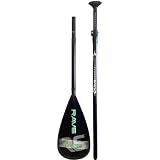
The RAVE Sports SUP paddle is an adjustable, lightweight paddle that floats and uses a no-twist handle lock. That last detail is the one that matters most in practice: on cheap adjustable paddles, the handle rotates slightly under load, so the blade angle drifts mid-stroke and you lose power on every pull. A no-twist lock keeps the blade aligned with the shaft, which is exactly what a heavier paddler needs, because more force goes through the handle.
Who it suits: paddlers who want a dependable everyday paddle at a budget tier, riders replacing a broken or lost paddle without upgrading to carbon, and anyone who wants a second paddle so a friend can join a session. It is a straightforward, no-frills choice that covers the basics well.
Key specs as stated in the listing:
- Type: adjustable SUP paddle
- Features: floats; no-twist handle lock
- Build class: lightweight shaft
- Price tier: budget
- Best paired with: any board in this list as a first or spare paddle
The floating design and the lock together









