
Our Top Picks


The best PCR thermal cycler for most molecular biology labs in 2026 is the ULTRAVEN GTC-96E, a mid-range 96-well-class instrument that pairs gradient thermal cycling with real-time fluorescence detection, so a single benchtop box covers both end-point and quantitative workflows. It suits a working lab that runs primer optimisation, standard amplification and the occasional qPCR assay without dedicating a separate instrument to each. If your budget is tight, the ULTRAVEN MTC-16 is the most sensible compact entry point for small-batch and teaching work. If you need the tightest gradient resolution and the smallest temperature error on the block, the stonylab Gradient PCR Thermal Cycler, with its 42 °C gradient range, six independent temperature zones and ±0.2 °C stated accuracy, is the premium pick. Everyone else sits between those three: the choice comes down to block format, well count, gradient control, ramp rate, how the instrument is programmed and how it will be serviced five years from now.
Top 3 Picks
Best overall: ULTRAVEN GTC-96E
A 96-well-class gradient cycler with real-time PCR capability built in, which means one instrument for optimisation, routine amplification and quantification. The mid-range tier keeps it reachable for a core lab or a shared departmental bench, and the combination of gradient control with fluorescence detection removes the usual argument about which machine to book. It is the pick for a lab that wants to stop moving plates between two instruments.
Best budget: ULTRAVEN MTC-16
A 16-well compact cycler built for fast, single-protocol runs, field work and teaching benches. It will not run a 96-well plate and it will not do quantitative detection, but for a handful of tubes, a quick colony screen or a classroom demonstration it covers the essentials at the lowest tier. Its small footprint is a genuine advantage on a crowded bench.
Best premium: stonylab Gradient PCR Thermal Cycler
Six independent temperature zones and a 42 °C gradient range give this instrument the finest annealing-temperature resolution in this roundup, and the ±0.2 °C stated accuracy is the kind of figure you want when you are chasing a stubborn primer pair or running a protocol where a degree of drift matters. Premium tier, aimed at labs where optimisation time is the real cost.
Quick Comparison
| Product | Best for | Key specs | Price tier |
|---|---|---|---|
| ULTRAVEN GTC-96E | Gradient cycling plus real-time detection in one box | 96-well class; gradient block; real-time fluorescence detection; on-board protocol storage | Mid-range |
| ULTRAVEN MTC-16 | Field, teaching and small-batch PCR | 16 × 0.2 mL class block; compact footprint; fast single-protocol runs | Budget |
| GOYOJO Gradient Thermo Cycler | High-throughput gradient work in a busy core lab | 96-well class gradient block; full-size chassis; touchscreen programming typical of the class | Premium |
| Biologix EdvoCycler 2 (48 × 0.2 mL) | Mid-size labs wanting a modern touchscreen at 48-well scale | 48 × 0.2 mL block; 7-inch colour HD touchscreen; strip and plate compatible | Mid-range |
| Edvotek EdvoCycler 2 | Teaching labs running 8-tube strips | 48 × 0.2 mL block; 8-tube strip compatible; education-oriented protocol set | Budget |
| Eppendorf 5331 Mastercycler Gradient | Labs that want proven gradient engineering and spares support | Gradient block; 115 V, 50/60 Hz; silver-block Mastercycler lineage | Mid-range |
| CryoKing EdvoCycler Jr. | Personal benches and very small reaction counts | 16 × 0.2 mL block; 7-inch colour HD touchscreen | Budget |
| stonylab Gradient PCR Thermal Cycler | Fine gradient resolution and tight accuracy | 42 °C gradient range; 6 independent temperature zones; ±0.2 °C stated accuracy | Premium |
| MJ Research PTC-100 | Tight budgets and legacy protocol compatibility | 60-well block; 100–240 V, 50/60 Hz; legacy programmable platform | Budget |
| ESCO Swift MiniPro | Small-batch PCR with a compact footprint | 24 × 0.2 mL block; 110 VAC | Mid-range |
| GOWE PCR Thermal Cycler | A 96-well workhorse with premium build | 96 × 0.2 mL block; full-size chassis; gradient-capable class | Premium |
| stonylab Gradient PCR Bundle | Start-to-finish setup with consumables included | Gradient cycler plus 8-strip 0.2 mL PCR tubes in one bundle | Premium |
How We Chose
This roundup is built from published product listings, manufacturer specification sheets and well-established facts about thermal cycler engineering, not from bench testing. We did not run any of these instruments, and no claim here should be read as a measurement we took ourselves. Selection rested on four things. First, specification substance: block format, well count, stated temperature accuracy and uniformity, gradient capability, heated-lid behaviour, power requirements and how the instrument is programmed. Second, category fit: whether a machine does one job unusually well — teaching, field use, quantitative detection, high-throughput gradient work — rather than trying to cover everything. Third, use-case realism: a 16-well cycler is not a lesser 96-well cycler, it is a different tool for a different workload, and we scored it that way. Fourth, upgrade path and ownership: whether consumables, lid gaskets, Peltier modules and calibration services will still be available in five years, and whether the vendor or a third party supports the platform. Where a listing gives an exact figure — a 48 × 0.2 mL block, a 7-inch touchscreen, a 42 °C gradient range, a 60-well block, 100–240 V input — we use it. Where it does not, we describe the spec class rather than inventing a number, and we flag what a buyer should confirm with the vendor before ordering.
1. ULTRAVEN GTC-96E – Best for gradient cycling and real-time detection in one instrument
As an Amazon Associate we earn from qualifying purchases at no extra cost to you.
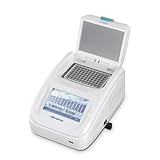
This is the instrument to consider first if your lab does both conventional end-point PCR and quantitative work, and you are tired of scheduling two machines. The listing describes it as a gradient thermal cycler and a real-time PCR system, and the GTC-96E designation points to a 96-well format class. In practical terms that means a plate-scale block, gradient annealing control across the block, and fluorescence optics for detection during cycling — the combination that lets you optimise a primer pair and then run the same assay quantitatively without changing benches.
Who it suits
A core molecular biology lab, a small diagnostics-adjacent research group, or a teaching-and-research department that runs a mixed workload: colony screens in the morning, a SYBR-based expression panel in the afternoon. It also suits a lab that currently outsources quantitative work because the in-house cycler is end-point only. It is less suited to a lab that runs fewer than a handful of reactions a week, where the real-time optics are capability you pay for and never use.
Key specs
| Block format | 96-well class, per the GTC-96E designation |
|---|---|
| Gradient control | Yes — gradient annealing across the block |
| Detection | Real-time fluorescence optics, end-point PCR also supported |
| Programming | On-board protocol storage; graphical editing typical of the class |
| Heated lid | Heated lid standard in this class; confirm adjustable temperature range |
| Consumables | 0.2 mL tubes, 8-tube strips, 96-well plates |
| Price tier | Mid-range |
Strengths
The single strongest argument is consolidation. Two instruments means two calibration schedules, two service contracts, two footprints on a bench that probably has neither. Combining gradient cycling with real-time detection also shortens the optimisation loop: you can run a gradient plate, read the amplification curves, and pick the annealing temperature from data rather than from an end-point gel. For labs that run dye-based quantification, that is a meaningful change in how fast an assay gets validated.
The 96-well format is the other strength. It is the format the rest of the molecular biology ecosystem assumes: standard plates, standard seals, standard multichannel workflows. A 48-well or 16-well instrument forces you into strips and manual tube handling, which is fine at low volume and painful at scale.
Pros
- One instrument for gradient optimisation and quantitative detection
- 96-well format matches standard plates, seals and multichannel pipetting
- Gradient control shortens primer and probe optimisation
- Mid-range tier keeps plate-scale real-time capability within reach
- Consolidation reduces bench footprint and service overhead
Cons
- Real-time optics are wasted spend if you only ever run end-point PCR
- You pay for capability you must also learn to use — optics calibration, dye selection, baseline settings
- Plate-scale runs consume more reagent per experiment than strip-based runs
- Confirm filter channels against the dyes you actually use before ordering
Compared with the nearest alternative
Against the GOYOJO Gradient Thermo Cycler, the GTC-96E trades some of the premium chassis and full-size gradient block of a dedicated high-throughput machine for integrated detection. If your bottleneck is plates per day and you already own a separate real-time instrument, GOYOJO is the more focused tool. Against the GOWE 96 × 0.2 mL cycler, the difference is again detection: GOWE is a premium end-point workhorse, the GTC-96E is a combined platform at a lower tier. If quantitative work is on your five-year roadmap, buy the combined instrument now rather than adding a second box later.
2. ULTRAVEN MTC-16 – Best for field, teaching and small-batch PCR

The MTC-16 is the smallest serious option in this roundup: a compact, fast, field-ready mini thermal cycler built around a 16 × 0.2 mL class block. It does one thing — heat and cool a small number of tubes through a programmed protocol — and it does it in a chassis you can carry. That is not a limitation to apologise for; it is a design decision that fits a specific workload extremely well.
Who it suits
Teaching laboratories running a class of students through a single protocol. Field biologists doing colony PCR, genotyping or species identification away from a main lab. A researcher who needs a personal cycler on their own bench for quick screens rather than booking time on the departmental 96-well machine. Anyone whose typical run is six to sixteen tubes and whose typical wait time is fifteen to sixty minutes.
Key specs
- 16 × 0.2 mL class block — sized for individual tubes and short strips, not plates
- Compact, transportable chassis aimed at bench-side and field use
- Fast, simple protocol execution; short runs are the design target
- Mains powered; check the voltage and plug type for your region before ordering
- Price tier: budget
Strengths
Speed to result is the point. A small block has less thermal mass to move, so a 16-tube run reaches temperature quickly and finishes sooner than a loaded 96-well block doing the same protocol. For a lab where the cycler is a step in a longer workflow — extract, amplify, run a gel, move on — that matters more than throughput.
The second strength is access. A cycler that lives on your own bench and takes thirty seconds to start removes the scheduling friction that quietly slows small experiments. Multiply that across a semester of teaching practicals or a field season, and the budget-tier price looks less like a compromise and more like the correct allocation of money.
Pros
- Lowest tier entry point into reliable programmable cycling
- Small thermal mass means fast ramps and short overall run times
- Compact footprint suits crowded benches and mobile setups
- Simple enough for students and rotating staff to operate correctly
- Ideal match for workflows that never exceed a dozen tubes
Cons
- No 96-well plate support, so it cannot absorb a scale-up
- Gradient capability is limited or absent at this tier — optimisation means running separate tubes
- No real-time detection
- Low throughput becomes a bottleneck the moment a project expands
Compared with the nearest alternative
The obvious head-to-head is with the CryoKing EdvoCycler Jr., also a 16 × 0.2 mL instrument, but with a 7-inch colour HD touchscreen. The Jr. wins on interface and on teaching usability — a large graphical screen makes protocol editing and demonstration easier in front of a class. The MTC-16 wins on portability and field readiness, which is the reason it exists. Against the ESCO Swift MiniPro at 24 × 0.2 mL, the MTC-16 gives up eight wells and some of the mid-range build quality in exchange for a lower tier and a smaller chassis. If your runs are capped at sixteen tubes and you value speed and mobility, the MTC-16 is the better fit; if you routinely run twenty-plus tubes, step up to the Swift MiniPro.
3. GOYOJO Gradient Thermo Cycler – Best for high-throughput gradient work in a core lab

GOYOJO’s gradient thermal cycler is a full-size, premium-tier machine aimed squarely at the lab whose bottleneck is plates per day. It is a 96-well class gradient instrument in a conventional benchtop chassis, sold as a hot item in the laboratory PCR category. Where the mini cyclers trade capability for size, this one trades size for capability.
Who it suits
A shared core facility, a high-throughput genotyping service, or a research group running multiple 96-well plates daily. It suits labs where the cycler runs unattended for long stretches and where a queue of protocols — some with gradients, some without — has to move through a single instrument. It is overkill for a bench that runs twelve tubes twice a week.
Key specs
| Block format | 96-well class gradient block |
|---|---|
| Gradient control | Yes — column-wise gradient across the block |
| Chassis | Full-size benchtop; plan bench depth and clearance around vents |
| Programming | Touchscreen or keypad interface typical of the premium class; multi-protocol storage |
| Heated lid | Heated lid standard; confirm pressure settings for plates versus strips |
| Consumables | 0.2 mL tubes, 8-tube strips, 96-well plates, plate seals |
| Price tier | Premium |
Strengths
Gradient control at plate scale is the headline. Being able to run twelve annealing temperatures across a single 96-well plate turns primer optimisation from a week of sequential runs into an afternoon. In a lab that optimises often — new primer sets, new templates, new master mixes — that capability pays for itself in reagents alone.
The premium chassis usually brings better thermal engineering with it: a heavier block, tighter control electronics, and a lid designed to press consistently across a full plate. Consistency across all 96 positions matters more than peak performance on any single well, because a plate that amplifies unevenly produces data you have to throw away.
Pros
- Plate-scale gradient control collapses optimisation timelines
- 96-well format matches standard plates, seals and multichannel pipetting
- Premium chassis typically means heavier block and more stable thermal control
- Suits unattended, multi-protocol, queue-driven workloads
- Upgrade headroom: one instrument can absorb a doubling of throughput
Cons
- Premium tier pricing for capability a low-volume lab will never use
- Large footprint and meaningful power draw — check circuit capacity
- No real-time detection; quantitative work needs a separate instrument
- Full-size blocks take longer to ramp than mini cyclers, so short runs feel slower
Compared with the nearest alternative
Versus the GOWE 96 × 0.2 mL cycler, both are premium 96-well platforms and the choice often comes down to interface preference, local service availability and gradient behaviour rather than headline specs. Versus the ULTRAVEN GTC-96E, GOYOJO is the purer thermal cycler: no optics, no dye calibration, more of the money in the block and lid. If you already have a real-time instrument and need raw plate throughput with gradient control, GOYOJO is the more focused buy. If you do not, the GTC-96E does more jobs for less.
4. Biologix EdvoCycler 2 (48 × 0.2 mL) – Best for mid-size labs wanting a modern touchscreen at 48-well scale

The Biologix EdvoCycler 2 sits in an underrated sweet spot: a 48 × 0.2 mL block with a 7-inch colour HD touchscreen, in the mid-range tier. It is twice the capacity of a 24-well instrument without the footprint, power draw and reagent commitment of a 96-well plate machine.
Who it suits
A research group that runs twenty to forty reactions at a time — enough that strip-by-strip handling on a 16-well machine has become tedious, not enough to justify filling 96-well plates. Also a good fit for teaching-and-research departments that want one instrument serving both student practicals and staff projects, and for labs that want a modern graphical interface rather than a keypad and a two-line display.
Key specs
- 48 × 0.2 mL block — accepts individual tubes, 8-tube strips and compatible formats
- 7-inch colour HD touchscreen for protocol editing and run monitoring
- Case of 1; sold as a standalone benchtop unit
- Mains powered; confirm voltage configuration for your region
- Price tier: mid-range
Strengths
The screen is not a gimmick. A 7-inch colour touchscreen changes how a lab interacts with a cycler: protocols become editable on the instrument rather than through a manual and a row of buttons, run progress is legible from across the bench, and error states are readable rather than cryptic. In teaching settings that is worth real money, because it reduces the number of failed runs caused by mis-keyed parameters.
The 48-well format is the practical strength. It matches an 8-tube strip workflow exactly — six strips fill the block — which means you can load what you need without committing a full plate. Reagent consumption per experiment stays lower than a 96-well protocol, and the block still ramps faster than a full-size plate block because there is less mass to move.
Pros
- 48-well capacity is a genuine middle ground between mini and plate-scale
- 7-inch colour HD touchscreen improves usability and reduces programming errors
- 8-tube strip workflow maps cleanly onto the block
- Smaller thermal mass than 96-well instruments, so short runs finish sooner
- Mid-range tier for a modern interface and mid-size block
Cons
- No gradient control at this tier, so annealing optimisation is sequential
- No real-time detection
- 48-well capacity caps you if a project scales to plates
- Less third-party consumable flexibility than the universal 96-well format
Compared with the nearest alternative
Against the Edvotek EdvoCycler 2 — same 48 × 0.2 mL format, same strip compatibility, lower tier — the Biologix version is the one to pick when you want the touchscreen interface and a slightly more polished instrument, and the Edvotek is the one to pick when budget dominates and the workflow is classroom-standard. Against the CryoKing EdvoCycler Jr., the Biologix gives you three times the wells for a step up in tier; the Jr. remains the better personal-bench instrument. If your reaction count is growing past twenty, the 48-well Biologix is the natural next step rather than buying a second 16-well unit.
5. Edvotek Inc EdvoCycler 2 Thermal Cycler – Best for teaching labs running 8-tube strips

The Edvotek EdvoCycler 2 is the education-oriented member of the 48-well family: a 48 × 0.2 mL block designed around 0.2 mL PCR tubes and 8-tube strip compatibility, at the budget tier. Edvotek is a long-established supplier to teaching laboratories, and this instrument reflects that audience.
Who it suits
University and college teaching labs running standard molecular biology practicals. A department that needs several cyclers rather than one, and therefore cares about unit cost more than peak specification. Also a small research group whose protocols are simple, well established, and do not need gradient optimisation or quantitative detection.
Key specs
- 48 × 0.2 mL block
- Compatible with 0.2 mL PCR tubes and 8-tube strips
- Sold as a case of 1
- Education-focused protocol support typical of the Edvotek line
- Mains powered; confirm voltage configuration
- Price tier: budget
Strengths
Cost per teaching position is the real metric in a classroom, and this instrument optimises for it. A 48-well block with strip compatibility means a practical class can load six strips and demonstrate a full amplification from denaturation to extension without the cost of a plate-scale machine. Six strips of eight reactions is a sensible class size, and the block format matches how students actually pipette.
Standardisation is the second strength. When the whole teaching lab runs the same instrument, troubleshooting becomes trivial — a protocol that worked at one bench works at every bench, and the demonstrator only has to know one interface. That consistency is worth more in a teaching context than any individual specification.
Pros
- Budget tier makes multiple units feasible for a teaching lab
- 48 × 0.2 mL block with 8-tube strip compatibility matches classroom workflows
- Consistent platform across benches simplifies training and troubleshooting
- Capacity is generous for the price — six strips per run
- Simple operation reduces the risk of parameter errors by students
Cons
- No gradient control, so optimisation is manual and sequential
- No real-time detection
- Interface is functional rather than modern — no large colour touchscreen at this tier
- Not the instrument to buy if your protocols will become more demanding
Compared with the nearest alternative
The direct comparison is with the Biologix EdvoCycler 2, which shares the 48 × 0.2 mL format but adds a 7-inch colour HD touchscreen and sits one tier higher. Choose the Biologix when you want the better interface and can spend the extra; choose the Edvotek when you are buying for a classroom, want several units, and would rather put the difference into reagents. Against the CryoKing EdvoCycler Jr. at 16 wells, the Edvotek offers three times the capacity for a similar tier — the Jr.’s touchscreen is nicer, but in a class of twenty students the extra wells matter more than the screen.
6. Eppendorf 5331 Mastercycler Gradient – Best for labs that want proven gradient engineering and long-term spares support

The Eppendorf 5331 Mastercycler Gradient is the instrument in this list with the deepest engineering pedigree. Eppendorf’s Mastercycler line is well known for its silver-block design and for gradient control that laboratories have relied on for decades, and the 5331 is specified at 115 V, 50/60 Hz. It sits in the mid-range tier and is aimed at labs that value reproducibility and serviceability over novelty.
Who it suits
A laboratory that needs gradient optimisation as a routine, everyday capability rather than an occasional convenience. A core facility that has to defend its results in publications or audits and prefers a platform with a long documented history. A lab that values the availability of service, calibration and spare parts — the practical reality that a cycler is only as good as the support behind it.
Key specs
| Block design | Silver block, a hallmark of the Mastercycler line |
|---|---|
| Gradient control | Yes — gradient across the block for annealing optimisation |
| Power | 115 V, 50/60 Hz |
| Format | 0.2 mL tube and strip compatible; confirm plate support for your exact configuration |
| Programming | Stored protocols and gradient setup on the instrument |
| Price tier | Mid-range |
Strengths
The silver block is not marketing. Silver conducts heat better than aluminium, which is why the design shows up in instruments built for tight uniformity — the block reaches temperature faster and holds a more even profile across positions. For reactions that are sensitive to a degree or two of variation, that shows up as more consistent band intensities and fewer wells that amplify weakly.
Gradient control across the block is the workflow strength: run one plate, read twelve annealing temperatures, pick the winner. And the brand’s service network is a real asset in a shared facility, where downtime has a cost measured in other people’s experiments.
Pros
- Silver block design associated with fast ramping and tight uniformity
- Gradient control for efficient annealing optimisation
- Long-established platform with documented performance history
- Strong service, calibration and spares ecosystem
- 115 V, 50/60 Hz specification is straightforward for North American labs
Cons
- No real-time fluorescence detection
- Interface is functional rather than modern — no large colour touchscreen
- 115 V specification means a voltage transformer or a different configuration elsewhere
- Mid-range tier pricing for a machine without detection capability
Compared with the nearest alternative
Against the stonylab Gradient PCR Thermal Cycler, the trade is resolution versus pedigree. stonylab offers six independent temperature zones, a 42 °C gradient range and ±0.2 °C stated accuracy — better raw gradient numbers on paper. Eppendorf offers a silver block, decades of published use and a service network you can call. If your lab needs documented reproducibility and easy servicing, the Mastercycler is the safer purchase; if you need the finest annealing resolution and are comfortable with a less established support chain, stonylab wins on specification. Against the Biologix EdvoCycler 2, the Eppendorf adds gradient control and block engineering, and gives up the 7-inch touchscreen.
7. CryoKing EdvoCycler Jr. Thermal Cycler – Best for personal benches and very small reaction counts

The CryoKing EdvoCycler Jr. is a 16 × 0.2 mL cycler with a 7-inch colour HD touchscreen, sold as a case of one at the budget tier. It is the smallest instrument here that still gives you a genuinely modern interface, which is an unusual and useful combination.
Who it suits
An individual researcher who wants a cycler on their own bench and runs a handful of tubes at a time. A teaching lab that wants students to interact with a large, legible screen while learning protocol design. A small lab that needs one reliable instrument for routine genotyping, colony PCR or screening, and does not want to fight for time on a shared machine.
Key specs
- 16 × 0.2 mL block
- 7-inch colour HD touchscreen
- Case of 1
- Mains powered; confirm voltage configuration for your region
- Price tier: budget
Strengths
The touchscreen is the differentiator at this tier. Most budget 16-well instruments give you a keypad and a small display; the Jr. gives you the same class of interface found on much more expensive machines. That means faster protocol entry, clearer run monitoring, and a much shorter learning curve for anyone new to the bench.
Size is the second strength. A 16-well block occupies very little bench space, ramps quickly because there is little mass to heat, and suits workflows where you are running two to twelve reactions and want the answer in under an hour. For a personal cycler, that is exactly the right specification.
Pros
- 7-inch colour HD touchscreen at a budget tier — rare combination
- Very small footprint suits personal benches
- Fast ramps on a small block
- Low entry price makes a dedicated personal cycler affordable
- Easy to teach on because the interface is legible
Cons
- 16 wells only — no plate capability and no scale-up path
- No gradient control at this tier
- No real-time detection
- Low thermal capacity means it cannot absorb a growing project
Compared with the nearest alternative
Against the ULTRAVEN MTC-16, the two are direct competitors at 16 wells and the budget tier. The Jr. wins on interface — the 7-inch touchscreen is the better teaching and daily-use experience. The MTC-16 wins on portability and field readiness, and on being built for compactness as a primary design goal. Against the Biologix EdvoCycler 2, the Jr. gives up 32 wells and a step in build quality in exchange for a much lower tier. If you are buying one instrument for a bench and your runs will never exceed sixteen tubes, the Jr. is the better daily companion; if you expect growth, buy the 48-well Biologix once rather than the Jr. twice.
8. stonylab Gradient PCR Thermal Cycler – Best for fine gradient resolution and tight temperature accuracy

This is the specification leader of the roundup on the two numbers that matter most for optimisation: a 42 °C gradient range, six independent temperature zones, and ±0.2 °C stated temperature accuracy. It is a premium-tier instrument aimed at labs where annealing optimisation is a recurring, time-consuming problem.
Who it suits
Labs working with difficult templates: high-GC sequences, primer sets with mismatches, multiplex reactions where several primer pairs have to anneal at once. Also labs that run many new primer designs per month and want to resolve optimum annealing temperature in as few runs as possible. It is a poor fit for a lab whose protocols are all settled and identical week to week.
Key specs
| Gradient range | 42 °C |
|---|---|
| Temperature zones | 6 independent zones |
| Temperature accuracy | ±0.2 °C stated |
| Format | 0.2 mL tube and strip compatible; confirm plate support for your configuration |
| Programming | On-board gradient and protocol setup |
| Price tier | Premium |
Strengths
The gradient mathematics are the real story. A 42 °C span across a twelve-column block gives a step of about 3.8 °C per column (42 ÷ 11). Six independent zones let you shape the profile rather than accepting a single linear ramp — useful when the optimal temperatures for two primer pairs in a multiplex are far apart, because you can hold different regions of the block at genuinely different setpoints rather than one averaged slope. And ±0.2 °C stated accuracy means the temperature you program is close to the temperature the sample sees, which is exactly what you need when a one-degree shift changes your yield.
In practice this instrument shortens the loop between “this primer set does not work” and “this primer set works at 61.5 °C”. For a lab designing primers weekly, that is the whole value proposition.
Pros
- 42 °C gradient range — the widest in this roundup
- Six independent temperature zones allow non-linear optimisation profiles
- ±0.2 °C stated accuracy for reproducible annealing
- Premium build aimed at demanding optimisation work
- Reduces the number of runs needed to find an optimum
Cons
- Premium tier pricing for capability routine protocols do not use
- No real-time detection
- Gradient capability is wasted spend if your assays are already validated
- Confirm consumable compatibility and service arrangements with the vendor
Compared with the nearest alternative
Against the Eppendorf 5331 Mastercycler Gradient, stonylab wins on the numbers — wider gradient span, six zones, tighter stated accuracy — while Eppendorf wins on block engineering tradition, documented history and service depth. If a published protocol has to be reproducible across sites and audited, the Eppendorf platform is the conservative choice. If you are optimising aggressively and want the finest resolution available, stonylab is the specification pick. Against the GOYOJO gradient cycler, stonylab is the optimisation specialist and GOYOJO is the throughput machine; they solve different bottlenecks.
9. MJ Research PTC-100 PCR Programmable Thermal Controller – Best for tight budgets and legacy protocol compatibility

The MJ Research PTC-100 is a 60-well programmable thermal controller specified at 100–240 V, 50/60 Hz. It is a legacy platform — MJ Research instruments date from an era when a thermal cycler was a programmable heating block with a keypad, and the PTC-100 is one of the most recognisable examples. It appears in this roundup at the budget tier because units circulate widely on the secondary and refurbished market.
Who it suits
A lab with a genuinely constrained budget that needs a functioning programmable cycler now. A teaching lab that wants an extra instrument for simple, well-characterised protocols. A group that has inherited protocols written for a PTC-100 and wants to keep running them without rewriting. It is not the instrument to build a new, growing research programme around.
Key specs
| Block format | 60-well |
|---|---|
| Power | 100–240 V, 50/60 Hz — wide input range suits multiple regions |
| Control | Programmable thermal controller with stored protocols |
| Gradient | Not a gradient instrument — this is a fixed-profile programmable block |
| Platform status | Legacy; verify condition, service history and spare availability before purchase |
| Price tier | Budget |
Strengths
The wide 100–240 V input is a practical advantage — one unit works across regions without a transformer. The 60-well block is an unusual size that sits between strip-scale and plate-scale, and for labs whose protocols were written around it, that exact format is a reason to keep one running. The programming model is simple and, once learned, extremely predictable.
The price is the main strength. At the budget tier, a PTC-100 gets a teaching lab or a cash-strapped group into programmable cycling for a fraction of a new instrument. For straightforward protocols — a standard two-step or three-step amplification with a fixed annealing temperature — a legacy block with a calibrated thermistor does the job.
Pros
- Budget tier pricing on a proven, widely used legacy platform
- Wide 100–240 V input range works across regions
- 60-well format suits workflows already built around it
- Simple, predictable programming model
- Common enough that documentation and community knowledge are easy to find
Cons
- No gradient control — optimisation requires sequential runs
- No real-time detection
- Legacy platform: spares, lid gaskets and service may be hard to source
- Calibration history on a used unit is unknown unless documented
- Older electronics and Peltier modules are the likely failure points
Compared with the nearest alternative
Against the CryoKing EdvoCycler Jr., the comparison is legacy versus modern. The Jr. gives you a 16-well block and a 7-inch touchscreen at a similar tier, with a current support chain; the PTC-100 gives you 60 wells and a wide voltage range, with the risk that comes with an ageing platform. If your protocols are simple and your budget is the binding constraint, the PTC-100 is defensible. If you need something that will still be serviceable in five years, buy the newer budget instrument. Against the ESCO Swift MiniPro at 24 wells, the PTC-100 offers more wells but far less certainty.
10. ESCO Swift MiniPro Thermal Cycler – Best for small-batch PCR with a compact footprint

The ESCO Swift MiniPro is a 24 × 0.2 mL thermal cycler specified at 110 VAC, in the mid-range tier. ESCO is an established laboratory equipment manufacturer, and the Swift MiniPro is designed as a compact benchtop instrument for labs that need more than a 16-well personal cycler but do not want to commit to plate-scale runs.
Who it suits
A small research group running fifteen to twenty-four reactions at a time. A lab that wants a dedicated cycler for a specific assay rather than queueing for the shared 96-well machine. A clinical-adjacent or applied lab where bench space is tight and the instrument has to fit a defined footprint. Also a good fit as a second cycler for a lab whose main instrument is constantly booked.
Key specs
- 24 × 0.2 mL block
- 110 VAC power specification
- Compact benchtop chassis designed for small footprint
- 0.2 mL tube and strip compatible
- Price tier: mid-range
Strengths
The 24-well block is the practical centre of this instrument. It holds three 8-tube strips, which maps neatly onto a standard workflow: one strip for a negative control series, one for samples, one for a replicate set. That is a more natural fit for real experiments than a 16-well block, which forces you to choose between controls and samples.
Compactness is the second strength. A 24-well cycler takes noticeably less bench depth than a 96-well instrument and draws less power, which matters in a lab where every instrument competes for the same circuit. And the mid-range build quality usually brings a better heated lid and more stable thermal control than the budget tier, which translates into more consistent results across the block.
Pros
- 24 wells hold three full 8-tube strips — a natural experimental layout
- Compact footprint suits space-constrained benches
- Mid-range build quality typically means a better heated lid and more stable control
- Lower power draw than plate-scale instruments
- Good second-cycler option for labs with a booked-out main instrument
Cons
- No gradient control at this tier
- No real-time detection
- 24 wells still caps a scaling project
- 110 VAC specification suits North America; other regions need the appropriate configuration
Compared with the nearest alternative
Against the Biologix EdvoCycler 2 at 48 wells, the Swift MiniPro gives up half the capacity and the 7-inch touchscreen, but takes less bench space and costs less to run. If your reaction count is genuinely under twenty-four, the smaller instrument is the smarter buy. Against the ULTRAVEN MTC-16 at 16 wells, the Swift MiniPro adds eight wells and a step in build quality, which is exactly the upgrade you make when a 16-well block starts forcing you to split runs. If you are choosing between them, count the tubes in your last ten experiments — if the maximum is over sixteen, buy the ESCO.
11. GOWE PCR Thermal Cycler 96 × 0.2 mL – Best for a premium 96-well workhorse

The GOWE PCR Thermal Cycler is a 96 × 0.2 mL instrument at the premium tier: a conventional full-size plate-scale block with the capacity to carry a laboratory’s routine amplification load. It is the straightforward choice for a lab that needs throughput and reliability rather than a specialist capability.
Who it suits
A research group or service lab running multiple 96-well plates per week. A core facility that needs a dependable primary cycler and already owns separate instruments for gradient optimisation and quantitative detection. A lab that wants the maximum number of reactions per run in a single, well-understood format.
Key specs
| Block format | 96 × 0.2 mL |
|---|---|
| Capacity | One full 96-well plate, or 12 eight-tube strips |
| Gradient | Gradient-capable class; confirm the exact span for your configuration |
| Chassis | Full-size benchtop; allow clearance for vents and lid travel |
| Power | Confirm voltage and circuit capacity — plate-scale cyclers draw meaningful current |
| Price tier | Premium |
Strengths
Capacity per run is the argument. A 96 × 0.2 mL block accepts a full plate or twelve 8-tube strips, which means one instrument can carry a lab’s entire routine amplification load for a week if the protocols are settled. For a service lab, that reduces the number of instruments needed, the number of calibration events, and the amount of bench space consumed.
The format is also the most interoperable in molecular biology. Standard 96-well plates, standard plate seals, standard multichannel pipetting and standard plate readers all assume it. Choosing a 96-well cycler is choosing to stop worrying about consumable compatibility.
Pros
- 96 × 0.2 mL capacity handles full plates or twelve 8-tube strips
- Universal consumable format — plates, seals and strips all fit
- Premium build aimed at sustained, routine use
- One instrument can carry a lab’s routine amplification load
- Straightforward scaling: capacity is not the constraint
Cons
- Premium tier pricing for a single-capability instrument
- No real-time detection
- Large footprint and higher power draw
- Full-size block takes longer to ramp, so short runs are slower than on a mini cycler
- Gradient specification should be confirmed rather than assumed
Compared with the nearest alternative
Against the GOYOJO Gradient Thermo Cycler, both are premium 96-well platforms, and the decision usually rests on gradient behaviour, interface and local service rather than capacity.









