
Key takeaways
- Compatible with Sony E mount cameras
- Perfect for nature & event photography
- Large f/1.4 aperture for superb lowlight performance
For most full-frame shooters, the best Sigma lens to own first is the 24-70mm f/2.8 DG DN II Art — it covers portraits, landscapes and everyday video at a constant f/2.8 while weighing about 745 g. If you shoot APS-C, the 18-50mm f/2.8 DC DN Contemporary delivers the same practical range for roughly a third of the price, and wildlife photographers should be looking at the 150-600mm f/5-6.3 DG DN OS Sports. Everything below maps those picks to your mount, your sensor size and the aperture you actually need.
Our top picks
 Sigma 16mm f/1.4 DC DN Contemporary Lens
- Compatible with Sony E mount cameras
- Perfect for nature & event photography
- Large f/1.4 aperture for superb lowlight performance
 Sigma 30mm F1.4 Contemporary DC DN Lens
- mount
- With nine rounded aperture blades, a stepping ring…
- Perfect paring of high performance and pricing, Contemporary…
 Sigma 16-300mm F3.5-6.7 DC OS Contemporary Lens
- Wide-angle, super-telephoto and close-up photography all in one…
- High-speed autofocus and image stabilization for effortless shooting…
- Uncompromising optical quality that redefines the standard for…
| Product | Key specs | |
|---|---|---|
| Sigma 16mm f/1.4 DC DN Contemporary Lens | Compatible with Sony E mount cameras Perfect for nature & event photography Large f/1.4 aperture for superb lowlight performance | Check price |
| Sigma 30mm F1.4 Contemporary DC DN Lens | mount With nine rounded aperture blades, a stepping ring… Perfect paring of high performance and pricing, Contemporary… | Check price |
| Sigma 16-300mm F3.5-6.7 DC OS Contemporary Lens | Wide-angle, super-telephoto and close-up photography all in one… High-speed autofocus and image stabilization for effortless shooting… Uncompromising optical quality that redefines the standard for… | Check price |
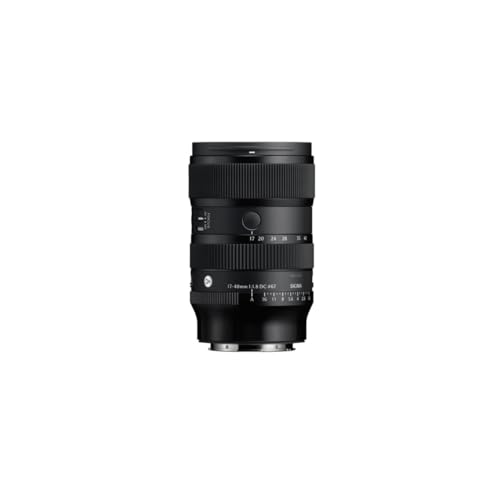 Sigma 17-40mm F1.8 DC | Bright F1.8 constant aperture zoom lens for low-light… Art-series optics deliver sharp detail and professional image… Designed for Sony E-mount APS-C cameras, ideal for… | Check price |
As an Amazon Associate we earn from qualifying purchases at no extra cost to you.
Quick comparison: the Sigma lenses worth shortlisting
| Lens | Best for | Key specs (manufacturer figures) | Typical price range |
|---|---|---|---|
| 24-70mm f/2.8 DG DN II Art | Best overall / hybrid | Full frame, constant f/2.8, ~745 g, 82 mm filter thread | $1,100–$1,400 |
| 85mm f/1.4 DG DN Art | Portraits | Full frame, f/1.4, ~625 g, 77 mm filter thread | $1,000–$1,300 |
| 14-24mm f/2.8 DG DN Art | Landscapes and astro | Full frame, f/2.8, ~795 g, rear filter holder (no front thread) | $1,200–$1,500 |
| 150-600mm f/5-6.3 DG DN OS Sports | Wildlife on a budget | Full frame, ~2,100 g, 95 mm filter, optical stabilisation | $1,300–$1,600 |
| 500mm f/5.6 DG DN OS Sports | Wildlife with weight limits | Full frame prime, ~1,370 g, 95 mm filter, teleconverter support | $2,800–$3,200 |
| 28-105mm f/2.8 DG DN Art | Video | Full frame, constant f/2.8, ~995 g, 82 mm filter, de-clickable aperture ring | $1,400–$1,700 |
| 35mm f/1.4 DG DN Art | Low light and documentary | Full frame, f/1.4, ~640 g, 67 mm filter thread | $800–$1,000 |
| 18-50mm f/2.8 DC DN Contemporary | Best budget all-rounder | APS-C only, f/2.8, ~290 g, 55 mm filter thread | $450–$600 |
| 56mm f/1.4 DC DN Contemporary | Budget portraits | APS-C only, f/1.4, ~280 g, 55 mm filter thread | $350–$500 |
Best overall: Sigma 24-70mm f/2.8 DG DN II Art
This is the lens that answers the most questions at once. A constant f/2.8 across 24mm to 70mm covers group shots, environmental portraits, interiors and most event work, and the second-generation Art version trimmed the weight to roughly 745 g — light enough to hang on a strap all day, heavy enough to feel deliberate. Per the manufacturer’s spec sheet it uses an 82 mm filter thread, which is the practical tax you pay for that aperture at that focal range.
Who it suits: full-frame hybrid shooters who want one lens for 70–80% of their work and don’t want to swap during a shoot.
Main trade-off: it’s a compromise everywhere rather than a specialist anywhere. An 85mm f/1.4 will out-render it for portraits, and a 14-24mm will beat it for wide landscapes. If you know your niche, buy the specialist instead.
Best for portraits: Sigma 85mm f/1.4 DG DN Art
85mm is the classic portrait focal length because it compresses features gently without flattening them the way a 135mm can in tight rooms, and f/1.4 gives you the separation that makes the subject pop. The DG DN version is about 625 g — noticeably lighter than the DSLR-era Art it replaced — and takes 77 mm filters, a common size that keeps polariser and ND costs reasonable.
Who it suits: anyone shooting people, weddings or headshots on full frame, especially in available light.
Main trade-off: at f/1.4 the depth of field is thin enough that a slight lean from your subject moves the eye out of focus. Budget for a second, wider lens — the 35mm f/1.4 DG DN Art pairs with it naturally — because 85mm is unusable for group shots indoors.
Best for landscapes: Sigma 14-24mm f/2.8 DG DN Art
For wide landscapes and night skies, 14mm at f/2.8 is the combination that matters: the wide end gets the foreground-to-horizon composition, and the fast aperture keeps exposure times short enough that stars stay points rather than trails. The lens weighs roughly 795 g and, notably, has no front filter thread — it takes rear-format filters in a holder at the mount instead.
Who it suits: landscape and astro shooters who want one wide zoom to do both, rather than a slow f/4 wide plus a separate fast prime.
Main trade-off: that rear-filter design. If you already own a set of 82 mm or 100 mm square front filters, they won’t fit. Also, 14mm is unforgiving — a 24mm shot cropped slightly is often easier than a 14mm shot that includes your own shadow.
Best for wildlife: Sigma 150-600mm f/5-6.3 DG DN OS Sports
The reach-per-dollar argument is hard to beat: 600mm on full frame, roughly 900mm equivalent on a 1.5x APS-C body, optical stabilisation, and a price that sits well under a first-party 500mm or 600mm prime. It weighs about 2,100 g and takes 95 mm filters, and the Sports line is the one Sigma builds for dust and splash resistance.
Who it suits: bird and mammal shooters who need maximum reach on a mid-range budget and usually work from a tripod or monopod.
Main trade-off: f/6.3 at 600mm is slow. In shade or at dawn you’ll be pushing ISO, and the autofocus has less light to work with than a prime. The lighter alternative — the 500mm f/5.6 DG DN OS Sports at about 1,370 g — costs roughly double but is a prime, gains a third of a stop, and is far easier to handhold for long periods. It also accepts Sigma’s teleconverters, which the 150-600mm does not.
Best for video: Sigma 28-105mm f/2.8 DG DN Art
This is the rare zoom designed with video shooters in mind rather than adapted for them. It holds f/2.8 all the way to 105mm, has a de-clickable aperture ring so you can change exposure silently mid-shot, and is built to suppress focus breathing — the zoom effect you get when pulling focus, which is distracting in footage and invisible in stills.
Who it suits: solo video creators and documentary shooters who want one lens on a gimbal or shoulder rig.
Main trade-off: at about 995 g it’s heavy for gimbal work, and 28mm isn’t especially wide on a full-frame body. If you vlog to camera, you may want the 24-70mm II instead for the extra four millimetres.
Best for low light: Sigma 35mm f/1.4 DG DN Art
The maths here is the whole argument. Moving from f/2.8 to f/1.4 is two full stops, which is four times as much light. In practice that means shooting at ISO 1600 instead of ISO 6400 at the same shutter speed — the difference between a clean file and a noisy one in a dim room. At about 640 g with a 67 mm thread, the 35mm f/1.4 is also the most carryable of Sigma’s fast full-frame primes.
Who it suits: street, documentary, event and night photographers who work in bad light and can’t use a flash.
Main trade-off: 35mm is a “nothing and everything” focal length. It’s wide enough to include context and not wide enough to be dramatic. If you want night skies rather than night streets, the 20mm f/1.4 DG DN Art is the better fast option.
Best budget picks: Sigma 18-50mm f/2.8 and 56mm f/1.4 DC DN Contemporary
If you shoot APS-C — Sony E, Fujifilm X, L-Mount or select Canon RF bodies — the DC DN line is where Sigma’s value reputation was built. The 18-50mm f/2.8 weighs about 290 g, which makes it smaller than most kit zooms while being a stop faster, and the 56mm f/1.4 is the classic budget portrait lens at around 280 g.
The calculation worth doing: multiply focal length by your sensor’s crop factor. The 18-50mm becomes roughly 27-75mm on a 1.5x body and about 29-80mm on a 1.6x Canon body. The 56mm f/1.4 becomes an 84mm f/2.1 equivalent — the same angle of view and similar background separation as an 85mm f/2 on full frame, for a fraction of the money and weight.
Main trade-off: DC DN lenses only cover APS-C sensors. Mount one on a full-frame body and the camera drops into crop mode, throwing away roughly half your megapixels. Buy deliberately, not accidentally.
How to choose: focal length, mount and aperture, in numbers
Start with the subject, not the spec sheet. Rough working ranges on full frame: 14-24mm for landscapes and interiors, 24-35mm for street and environmental portraits, 50-85mm for people, 100mm+ for macro and compression, 400-600mm for wildlife and sport. On APS-C, divide those numbers by 1.5 to get the focal lengths printed on the barrel.
Then check the mount. Sigma’s mirrorless naming is consistent and worth learning: DG DN means full-frame mirrorless, DC DN means APS-C mirrorless, and the older DG HSM designation means DSLR-era glass. Availability varies by model — the full-frame Art and Sports lenses are built primarily for Sony E and L-Mount, with a growing but not universal set of Canon RF versions, and DC DN lenses appear across Sony E, Fujifilm X, L-Mount and select RF bodies. Sigma does not currently list native Nikon Z versions for most of these lenses, so Z shooters should confirm compatibility before buying rather than assuming it.
Finally, decide how much aperture you’re willing to carry. Each stop doubles the light and typically adds weight and cost: a 24-70mm f/2.8 is around 745 g, while an f/4 equivalent is often 400-500 g. Two stops of aperture (f/1.4 versus f/2.8) can replace a tripod indoors. One stop rarely changes your shooting, so don’t pay for it.
Decision matrix: your situation, your lens
| Your situation | What matters most | Suggested Sigma lens |
|---|---|---|
| APS-C beginner, under $600 total | Weight, price, one-lens range | 18-50mm f/2.8 DC DN Contemporary |
| Full-frame hybrid shooter, one lens | Constant aperture, autofocus speed | 24-70mm f/2.8 DG DN II Art |
| Portrait specialist, studio or outdoor | Background separation at working distance | 85mm f/1.4 DG DN Art |
| Landscape and night sky | Wide angle plus fast aperture | 14-24mm f/2.8 DG DN Art |
| Wildlife, mostly tripod work, tight budget | Reach per dollar | 150-600mm f/5-6.3 DG DN OS Sports |
| Wildlife, hiking long distances | Weight, prime sharpness, teleconverters | 500mm f/5.6 DG DN OS Sports |
| Solo video, gimbal or shoulder rig | Focus breathing, silent aperture control | 28-105mm f/2.8 DG DN Art |
| Low-light street and documentary | Two extra stops, small footprint | 35mm f/1.4 DG DN Art |
| Close-up and product work | 1:1 magnification, flat field | 105mm f/2.8 DG DN Macro Art |
Ownership realities: what wears and what to budget for
Lenses outlive camera bodies, so it’s worth knowing where the money goes after purchase. The parts that fail first are rarely optical: the rubber zoom and focus rings, the lens hood bayonet, and the tripod collar on telephotos. Hoods and caps are the genuine consumables — budget a small annual allowance, because a replacement hood for a 95 mm telephoto is not the $15 item it is for a 55 mm prime.
Filters scale with diameter in a way that surprises people. A 67 mm circular polariser is an inexpensive accessory; a 95 mm one can cost several times as much, and a full 95 mm neutral-density set can approach the price of a used APS-C body. If you plan to shoot landscapes with a 150-600mm, factor that in. Sigma’s 14-24mm sidesteps the problem entirely with its rear filter holder, but rear-format filters are a smaller and more specialist market.
Weather sealing is not uniform across the range. The Art and Sports lines are the ones described as dust- and splash-resistant, with sealing at the mount and a water- and oil-repellent coating on the front element; the compact DC DN Contemporary lenses are more lightly protected. None of them are waterproof, and the most common way to kill a lens is still salt spray followed by a wipe with a dry cloth — rinse the front element with clean water first, then dry it.
Firmware is the other ownership chore. Sony E-mount lenses generally update through the camera body, L-Mount lenses update through the body or Sigma’s UD-11 dock, and older DSLR-era lenses use the USB Dock. Third-party autofocus behaviour can shift with body firmware, so if a lens starts hunting after a camera update, check for a lens update before assuming the lens is at fault. Common mistakes worth avoiding: buying a DC DN lens for a full-frame body, putting a cheap filter in front of a $1,000 lens, and assuming a heavy black lens is weather-sealed just because it looks professional.
Frequently Asked Questions
Are Sigma lenses compatible with Sony, Canon, Nikon and Fujifilm cameras?
It depends on the lens and the mount. Sigma’s mirrorless lenses are made in Sony E and L-Mount as the primary options, with a growing number available in Canon RF and Fujifilm X mounts — mostly the APS-C DC DN models plus select full-frame Art lenses. Sigma does not currently list native Nikon Z versions for most of these lenses, so Nikon shooters should verify availability before buying. Always confirm the exact mount on the manufacturer’s product page.
What is the difference between DG DN and DC DN?
DG DN lenses are designed for full-frame mirrorless sensors, while DC DN lenses are designed for APS-C sensors only. Both use the “DN” suffix to indicate a mirrorless-specific optical design with a short flange distance. If you mount a DC DN lens on a full-frame camera, the body will normally switch to crop mode and you’ll lose a large share of your resolution.
Is f/1.4 worth the extra cost over f/2.8?
It’s worth it if you regularly shoot in genuinely low light or need very shallow depth of field. Two stops is a fourfold increase in light, which can take you from ISO 6400 to ISO 1600 at the same shutter speed. It’s not worth it if you mostly shoot stopped down to f/4 or f/5.6 for landscapes, where the extra aperture only adds weight and cost.
Which Sigma lens is best for wildlife on a tight budget?
The 150-600mm f/5-6.3 DG DN OS Sports gives the most reach per dollar, with 600mm on full frame and roughly 900mm equivalent on a 1.5x APS-C body. Its main limitation is the slow f/6.3 maximum aperture at the long end, which pushes ISO up in poor light. The 100-400mm f/5-6.3 DG DN OS Contemporary is a lighter, cheaper alternative if 400mm is enough reach.
Do Sigma lenses work with teleconverters?
Only some of them. Sigma’s teleconverters are listed as compatible with select Sports-series lenses, such as the 500mm f/5.6 DG DN OS Sports and the 70-200mm f/2.8 DG DN OS Sports, and compatibility is mount-specific. The 150-600mm f/5-6.3 DG DN OS Sports does not accept them. Adding a 1.4x converter also costs you one stop of light, turning f/5.6 into f/8.
Are Sigma Art lenses weather-sealed?
Sigma describes its Art and Sports lenses as dust- and splash-resistant, with sealing at the mount and a water- and oil-repellent coating on the front element. That protects against rain and dust during normal use, but it is not the same as waterproofing and does not cover submersion. The compact DC DN Contemporary lenses carry lighter sealing, so treat them as fair-weather tools.









