
Best Camera Remote Shutters for Long Exposure: Choose by Connection, Not Hype
The best camera remote shutter for long exposure is a wired locking release if you need dependable bulb-mode control; choose an intervalometer for timed exposures and repeat sequences, infrared for inexpensive line-of-sight shooting, or Bluetooth when your camera supports a compatible app or remote and you want to work from farther away. The deciding factors are whether the release can hold the shutter open, how reliably it communicates with your specific camera, and how much control you need over exposure time.
Quick picks by situation
| Your situation | Best fit | Why | Check before buying |
|---|---|---|---|
| One long exposure, lowest fuss | Wired locking remote | No radio signal or line-of-sight requirement; a physical lock can hold the button down in bulb mode. | Connector, pinout, and bulb-mode support for your exact camera. |
| Timed exposures or a night-sky sequence | Wired intervalometer | Programs exposure length, delay, interval, and number of frames. | Minimum interval, maximum exposure duration, and whether it supports bulb timing. |
| Occasional use from in front of the camera | Infrared remote | Usually compact and inexpensive, with no cable to tug the camera. | Whether the camera has an IR receiver and whether the remote must face it. |
| Wireless control without a dedicated receiver | Bluetooth remote or camera app | Can avoid a cable and may offer remote triggering through the camera’s supported system. | Exact camera-generation compatibility, range, and bulb support in the app or remote. |
What matters most for long exposures
Bulb-mode stability
In bulb mode, the shutter stays open while the release is held or locked, or for a duration set by a compatible timer. A wired release with a mechanical lock is the simplest option for an exposure whose end time you will judge by eye. For a precisely timed exposure, an intervalometer can trigger and release automatically—but only if it supports bulb timing with your camera. A basic remote may trigger the shutter without being able to keep it open.
Our top picks
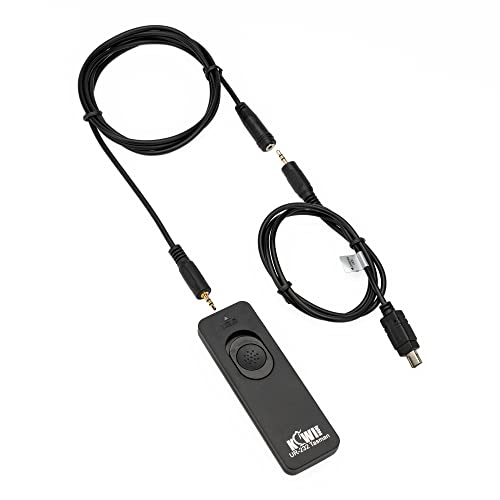 Kiwifotos MC-DC2 Remote Switch Shutter Release Cord
- Control autofocus and shutter triggering, Capture images without…
- Ideal for bulb exposures, super telephoto shots and…
- Handy for taking pictures of subjects that are…
 Kiwifotos RS-60E3 Remote Switch Shutter Release for
- Control autofocus and shutter triggering, Capture images without…
- Ideal for bulb exposures, super telephoto shots and…
- Handy for taking pictures of subjects that are…
 JJC Wireless Infrared Shutter Release Remote for
- The wireless remote is for select Nikon cameras…
- Range extents to approximately up to 68ft
- It’s a wireless shutter release capable of instantly…
| Product | Key specs | |
|---|---|---|
| Kiwifotos MC-DC2 Remote Switch Shutter Release Cord | Control autofocus and shutter triggering, Capture images without… Ideal for bulb exposures, super telephoto shots and… Handy for taking pictures of subjects that are… | Check price |
| Kiwifotos RS-60E3 Remote Switch Shutter Release for | Control autofocus and shutter triggering, Capture images without… Ideal for bulb exposures, super telephoto shots and… Handy for taking pictures of subjects that are… | Check price |
| JJC Wireless Infrared Shutter Release Remote for | The wireless remote is for select Nikon cameras… Range extents to approximately up to 68ft It’s a wireless shutter release capable of instantly… | Check price |
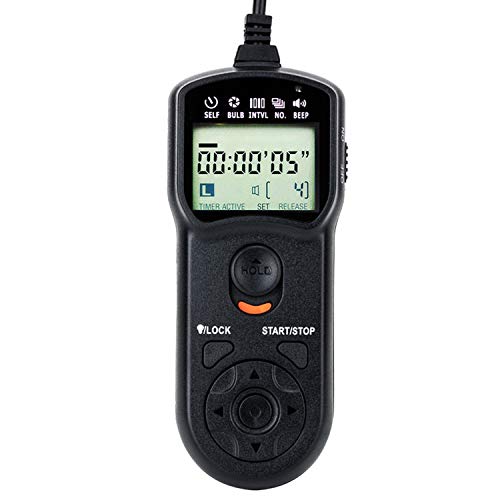 JJC Intervalometer Timer Remote for Canon EOS | Compact Size:12.1x4x2.1cm, 90cm/2.95ft long wired remote controller, powered… Self-timer, interval timer, long-exposure timer and exposure-count setting… Take Photos without Camera Shake and great for… | Check price |
As an Amazon Associate we earn from qualifying purchases at no extra cost to you.
For exposures longer than the camera’s built-in timed-shutter limit, confirm how the release behaves at the intended duration. Some camera and remote combinations require the camera to be set to bulb; others use a dedicated timed-bulb function. Don’t assume that a remote’s “long exposure” wording means it can control every bulb exposure length.
Range and the actual shooting position
A cable’s practical range is its physical length, often around 0.5–1 m for compact releases, though longer cables are available. Infrared remotes need a clear path to the camera’s receiver and can be unreliable if you are behind the camera, outdoors in bright conditions, or pointing at the wrong side. Bluetooth range depends on the camera, remote, obstacles, and interference; advertised maximums are not a guarantee through walls or across a busy location. If you need to trigger from a sheltered spot, verify the working range for the particular camera and accessory rather than choosing by connection label alone.
Compatibility is model-specific
Camera brands often use different remote sockets, and even cameras from the same brand may not share one. Wireless options can be just as particular: an infrared receiver may be absent, Bluetooth features may differ by generation, and app support can vary. Match the accessory to the camera’s full model name, not just the brand. For third-party wired releases, check connector shape and compatibility documentation; similar-looking plugs are not proof of a correct pinout.
Connection types compared
| Type | Typical useful range | Bulb control | Power and trade-offs |
|---|---|---|---|
| Wired locking release | About 0.5–1 m for common short cables; longer versions vary. | Often holds the shutter open mechanically; verify camera support. | Usually needs no battery. Cable can snag, pull, or transfer movement if left taut. |
| Wired intervalometer | Limited by its cable, commonly around 0.5–1 m. | Can automate timed bulb exposures when explicitly supported. | Often uses a small replaceable battery. More controls, but more settings to configure. |
| Infrared | Often a few metres in clear line of sight; varies by camera and remote. | Frequently limited to trigger functions; bulb holding or timing is not universal. | Small battery-powered remote. Easy to misplace and sensitive to positioning. |
| Bluetooth or camera app | Often several metres in practical use; device and conditions matter. | Varies widely; timed bulb control must be confirmed for the camera and app. | Wireless convenience, but depends on charged devices, pairing, and supported software. |
These are practical category-level expectations, not promises for every model. Treat the camera manual and accessory compatibility list as the final authority.
How to choose without overbuying
- Choose wired locking if you mostly make single exposures, want minimal setup, or need a dependable physical hold in bulb mode.
- Choose an intervalometer if you routinely make repeated exposures, star trails, or time-lapse sequences. Confirm it can set the exposure duration and interval you need; some units impose minimum intervals or limits on total frames.
- Choose infrared if your camera has an IR receiver and you only need a simple trigger from in front of the camera. It is a poor match for an obscured receiver or a location where you need to stand behind a wall or shelter.
- Choose Bluetooth if your camera’s app or a compatible remote offers the exact release and bulb controls you need. It is especially appealing when you want to avoid a cable, but less attractive if pairing or app support is uncertain.
As a budget guide, basic wired and infrared releases often sit in the lower general market-price range, while programmable intervalometers and brand-specific wireless accessories tend to cost more. Higher price does not guarantee better bulb compatibility. Spend first on the right camera connection and functions, then on convenience.
Setup that reduces blur and missed exposures
- Confirm the connection and mode. Check the accessory against the exact camera model, then set bulb mode or the required remote-release setting.
- Secure the camera. Mount it on a stable tripod and keep the release cable slack. A cable stretched tight can tug the camera as you press the button.
- Test before the important exposure. Make a short test to confirm that the remote starts and ends exposure as expected. For an intervalometer, test the delay, exposure length, interval, and frame count.
- Lock or program deliberately. On a mechanical release, engage the lock only after the shutter has opened and unlock it when the exposure should end. With a timer, check whether the entered duration is in seconds and whether the camera itself needs bulb mode.
- Keep a fallback. Carry a spare battery for electronic remotes, and know whether the camera’s self-timer or built-in interval function can cover a basic trigger if the accessory fails.
Ownership details that affect reliability
With wired releases, the cable and connector are the vulnerable parts: repeated sharp bends, yanking, and storage wrapped tightly around the controller can cause intermittent connections. Coil the cable loosely and unplug it by the connector housing, not by pulling the wire. Keep connectors capped or in a clean compartment; grit or moisture can interfere with the connection.
Wireless remotes avoid cable strain but introduce battery and pairing issues. Replace weak batteries before a planned night shoot, and test pairing at home rather than in the dark. Infrared remotes are easy to leave behind, so a small tether or dedicated pocket can help. Intervalometers have more controls to bump accidentally; check their settings whenever you change cameras or reset a sequence.
For most long-exposure photographers, a simple compatible wired lock is the best value for occasional bulb exposures. If you need exact repeatable timing, buy an intervalometer whose bulb behavior is documented for your camera. Go wireless for convenience only when the camera’s receiver, range, and exposure controls match how you actually shoot.









