
The best alkaline reverse osmosis systems in 2026 pair a standard RO membrane with a remineralization stage that adds calcium and magnesium back, typically lifting pH from an acidic 5.5–6.5 up to 7.5–9 — and the right pick depends on whether you rent or own, how much cabinet space you have, and how much wastewater you’re willing to accept.
Our top picks
 iSpring RCC7AK-BN NSF Certified
- The top-mounted fastener allows for easy countertop installation…
- The patent-pending natural mineral AK stage delivers spring…
- SEE WHAT’S CAUGHT
 iSpring RCC7AK-BLK
- This advanced 6-stage RO system restores natural alkalinity…
- Reduces up to 99% of over 1,000 harmful…
- Features a transparent first-stage filter housing for quick…
 iSpring RCC7AK-UV
- This under-sink reverse osmosis water filter is tested…
- Built-in LED UV stage provides an extra layer…
- Built with individually layered filter cartridges instead of…
| Product | Key specs | |
|---|---|---|
| iSpring RCC7AK-BN NSF Certified | The top-mounted fastener allows for easy countertop installation… The patent-pending natural mineral AK stage delivers spring… SEE WHAT’S CAUGHT | Check price |
| iSpring RCC7AK-BLK | This advanced 6-stage RO system restores natural alkalinity… Reduces up to 99% of over 1,000 harmful… Features a transparent first-stage filter housing for quick… | Check price |
| iSpring RCC7AK-UV | This under-sink reverse osmosis water filter is tested… Built-in LED UV stage provides an extra layer… Built with individually layered filter cartridges instead of… | Check price |
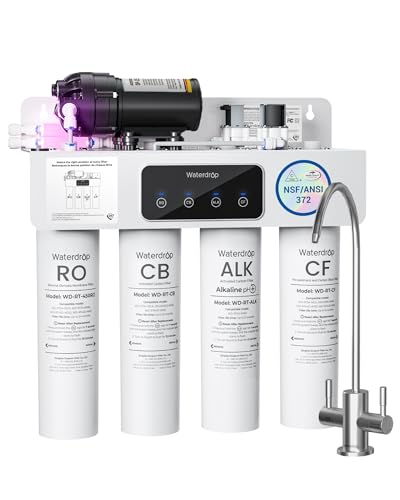 | [Dual Water Flow]: The WD-T4-A RO system offers… [10-Stage Filtration with RO Membrane]: This system reduces… [450GPD Flow & 2:1 Pure to Drain]: With… | Check price |
As an Amazon Associate we earn from qualifying purchases at no extra cost to you.
What “alkaline” actually means in an RO system
Reverse osmosis strips water down so aggressively that the output is slightly acidic and flat-tasting. Two methods fix this:
- Mineral cartridge (remineralization): a post-filter containing calcite, maifan stone, or a blend of calcium and magnesium media. Water flows through and picks up trace minerals. This is the most common approach — found in the iSpring RCC7AK, APEC RO-PH90, and AquaTru.
- Electrolysis/ionization: powered plates alter the water’s oxidation-reduction potential and split it into alkaline and acidic streams. Rare in countertop RO units; more common in standalone ionizers. Higher cost, more failure points.
For most buyers, a mineral cartridge achieves the goal — better taste and a pH above neutral — without adding electrical components under the sink. Note that alkaline water is a taste and preference category; there’s no need to overpay for extreme pH numbers, and anyone with kidney conditions or on mineral-restricted diets should ask a doctor before changing water mineral intake.
Head-to-head spec comparison
| System | Type | Stages | Flow / Output | Wastewater Ratio | Remineralization | Est. Annual Filter Cost |
|---|---|---|---|---|---|---|
| iSpring RCC7AK | Under-sink, tank | 6 | 75 GPD (~0.05 GPM at faucet) | ~1:2 to 1:3 | Calcite + mineral cartridge | $50–80 |
| APEC RO-PH90 | Under-sink, tank | 6 | 90 GPD | ~1:3 | Calcium carbonate cartridge, US-made filters | $60–100 |
| Waterdrop G3P600 | Under-sink, tankless | 8 (incl. UV) | 600 GPD (~0.42 GPM) | 2:1 (purified:drain) | Optional mineral add-on | $100–150 |
| Frizzlife PD600-TAM3 | Under-sink, tankless | 7 | 600 GPD | 1.5:1 | Built-in TAM3 alkaline stage | $80–120 |
| AquaTru Classic | Countertop | 4 (incl. VOC + alkaline options) | ~0.7 gal per ~12 min cycle | ~4:1 | Alkaline VOC filter variant | $80–120 |
| Bluevua RO100ROPOT | Countertop | 5 | ~1L carafe per ~7 min | 2:1 | Remineralization stage | $60–90 |
Prices across the category run roughly $150–250 for tank-based under-sink units, $300–500 for tankless high-flow systems, and $300–450 for countertop models.
The numbers that actually change daily life
Wastewater ratio is the biggest hidden variable
Traditional tank systems drain 2–3 gallons for every gallon purified. A family using 4 gallons of RO water daily sends 8–12 gallons down the drain — 3,000–4,500 gallons per year. Tankless systems like the Waterdrop G3P600 invert this to roughly 2:1 in your favor, cutting annual waste to around 700 gallons. If you’re on a metered water bill or drought-conscious, the tankless premium often pays back within two to three years.
Flow rate decides whether you wait
Tank systems store 2.8–4 gallons, so the faucet delivers decent pressure until the tank empties, then slows to a trickle while it refills (a 75 GPD membrane needs ~45 minutes to refill a gallon). Tankless 600 GPD units deliver ~0.4 GPM continuously — a liter in about 8 seconds — but pull rated flow only with adequate inlet pressure (typically 40+ PSI).
Countertop vs. under-sink
- Countertop (AquaTru, Bluevua): zero plumbing, ideal for renters and dorms. Trade-offs: you manually fill a feed tank, dispensed water sits in a carafe, and units occupy ~14″×14″ of counter space. Output suits 1–3 people.
- Under-sink tankless (Waterdrop, Frizzlife): best water-to-waste ratio and flow, but needs a dedicated faucet hole (or drilled countertop), a drain saddle connection, and usually a power outlet under the sink.
- Under-sink tank (iSpring, APEC): cheapest entry, no electricity required, works on low pressure down to ~40 PSI. Needs the most cabinet space for the tank.
Decision matrix: match your situation
| Your situation | Best fit | Why |
|---|---|---|
| Renter, no plumbing access | Bluevua RO100ROPOT or AquaTru | No installation; take it when you move |
| Homeowner, 3+ people, daily cooking | Waterdrop G3P600 or Frizzlife PD600 | 600 GPD keeps up with pots and kettles; low waste |
| Budget under $250, have cabinet space | iSpring RCC7AK | Cheap filters ($50–80/yr), universal 10″ cartridges |
| Well water / high sediment | APEC RO-PH90 | Robust pre-filters; US-sourced media; add a permeate pump if pressure is low |
| Low water pressure (<40 PSI) | Tank system + booster pump | Tankless units need mains pressure to hit rated flow |
Five-year cost of ownership: a worked example
Compare an iSpring RCC7AK (~$200) against a Waterdrop G3P600 (~$450) for a household using 3 gallons/day:
- Filters over 5 years: iSpring ≈ $300–400; Waterdrop ≈ $500–700 (membrane lasts ~2 yrs, $80–100 each).
- Water waste over 5 years: iSpring at 1:3 wastes ~16,000 gal (~$60–130 depending on local rates); Waterdrop at 2:1 wastes ~2,700 gal (~$10–25).
- Total 5-year cost: iSpring ≈ $560–730; Waterdrop ≈ $960–1,175.
The budget tank system stays cheaper overall despite its waste. Tankless pays off on convenience and space, not strictly dollars — unless your water/sewer rates are unusually high.
Ownership realities listings won’t tell you
- Alkaline cartridges die faster than other filters. Mineral media is consumed as it dissolves — expect 6–12 months, and the pH benefit fades gradually, so a cheap pH test strip tells you when it’s spent better than the calendar does.
- Countertop units need weekly tank cleaning. The feed reservoir grows biofilm if you let water sit; rinse it, don’t just top it up.
- First leaks come from fittings, not filters. Push-connect joints under the sink loosen with temperature swings; check them monthly for the first year. A leak detector puck ($10–15) is cheap insurance.
- Skip the “alkaline” upsell if you already eat minerals. Remineralization adds maybe 20–50 ppm of calcium/magnesium — meaningful for taste, minor nutritionally. If budget is tight, a plain RO plus good food covers the same ground.
- Drain saddle placement matters. Mount it above the P-trap and away from the dishwasher knockout, or you’ll hear gurgling forever.
FAQ
Is alkaline RO water better for health?
The mineral stage primarily improves taste and raises pH for palatability. Evidence for health benefits beyond hydration is limited — treat it as a preference feature, and consult a healthcare professional if you have specific dietary or medical concerns.
Can I add an alkaline stage to an existing RO system?
Yes. Universal inline remineralization cartridges ($20–40) connect to standard 1/4″ tubing after the membrane and before the faucet on most under-sink systems.
How often do RO membranes need replacing?
Every 2–3 years under normal city-water conditions; pre-filters every 6–12 months. Hard or sediment-heavy water shortens all of these.









