
Key takeaways
- Best for most bedrooms and living rooms: BEHR PREMIUM PLUS Interior Ceiling Paint. Its flat finish helps disguise minor surface unevenness, and the paint is designed for ceiling application with reduced splatter. It’s a practical choice for routine repainting over a sound, previously painted ceiling.
- Best for a large room: Benjamin Moore Waterborne Ceiling Paint. Its flat finish and ceiling-focused formulation suit broad, uninterrupted areas where roller marks and lap lines are especially visible. Work in manageable sections and keep a wet edge.
- Best for a budget-conscious repaint: Glidden Ceiling Paint. A straightforward flat ceiling paint can be a sensible value for clean, previously painted ceilings. Check the specific product label for coverage and application guidance, since formulas and package sizes vary.
- Best for a bathroom: Benjamin Moore Aura Bath & Spa. This is a matte interior finish designed for high-humidity areas. It is a better fit than ordinary flat ceiling paint where moisture is a recurring concern, but ventilation and a dry substrate still matter.
- Best for water stains: Zinsser B-I-N Shellac-Base Primer, followed by ceiling paint. B-I-N is a stain-blocking primer, not a finish coat. Use it to isolate suitable stains, allow it to dry as directed, then apply the chosen ceiling paint.
Best Ceiling Paints for Bright, Even Results
The best ceiling paint for most dry rooms is a flat, low-splatter interior ceiling paint; choose a dedicated stain-blocking primer first for water marks, and a moisture-resistant formula for bathrooms. The right pick depends less on a “bright white” label than on sheen, coverage, open time, and whether the surface is clean, stained, textured, or humid.
Top picks by situation
- Best for most bedrooms and living rooms: BEHR PREMIUM PLUS Interior Ceiling Paint. Its flat finish helps disguise minor surface unevenness, and the paint is designed for ceiling application with reduced splatter. It’s a practical choice for routine repainting over a sound, previously painted ceiling.
- Best for a large room: Benjamin Moore Waterborne Ceiling Paint. Its flat finish and ceiling-focused formulation suit broad, uninterrupted areas where roller marks and lap lines are especially visible. Work in manageable sections and keep a wet edge.
- Best for a budget-conscious repaint: Glidden Ceiling Paint. A straightforward flat ceiling paint can be a sensible value for clean, previously painted ceilings. Check the specific product label for coverage and application guidance, since formulas and package sizes vary.
- Best for a bathroom: Benjamin Moore Aura Bath & Spa. This is a matte interior finish designed for high-humidity areas. It is a better fit than ordinary flat ceiling paint where moisture is a recurring concern, but ventilation and a dry substrate still matter.
- Best for water stains: Zinsser B-I-N Shellac-Base Primer, followed by ceiling paint. B-I-N is a stain-blocking primer, not a finish coat. Use it to isolate suitable stains, allow it to dry as directed, then apply the chosen ceiling paint.
Compare the options before you buy
Coverage below is an approximate planning figure, not a guarantee. Porous, textured, patched, or strongly contrasting surfaces can require more paint or an extra coat. Check the current label for the exact product and container size you’re buying.
Our top picks
 Glidden 1 qt. White Flat Ceiling Interior
- Ready-mixed, grab-n-go white ceiling paint
- Excellent hide to brighten a ceiling that has…
- Durable flat finish that minimizes surface imperfections
 Zinsser Covers Up Ceiling Paint & Primer
- Vertical aerosol for overhead professional projects
- Quick cure for water stains
- Flat white finish matches most ceiling tiles
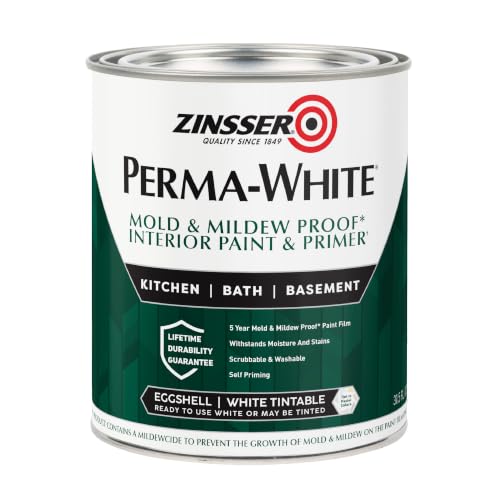 Zinsser 02774 PERMA-WHITE Mold & Mildew Proof
- Self-Priming formula - requires no sanding
- Mold & Mildew-Proof paint film - guaranteed for…
- Resists dirt and moisture on film coating
| Product | Key specs | |
|---|---|---|
| Glidden 1 qt. White Flat Ceiling Interior | Ready-mixed, grab-n-go white ceiling paint Excellent hide to brighten a ceiling that has… Durable flat finish that minimizes surface imperfections | Check price |
| Zinsser Covers Up Ceiling Paint & Primer | Vertical aerosol for overhead professional projects Quick cure for water stains Flat white finish matches most ceiling tiles | Check price |
| Zinsser 02774 PERMA-WHITE Mold & Mildew Proof | Self-Priming formula - requires no sanding Mold & Mildew-Proof paint film - guaranteed for… Resists dirt and moisture on film coating | Check price |
 Glidden Grab-N-Go Pink to White Ceiling paint | Never miss a spot- goes on pink and… Paint & primer all-in-one Flat sheen hides surface imperfections | Check price |
As an Amazon Associate we earn from qualifying purchases at no extra cost to you.
| Product | Best use | Finish or role | Planning coverage per gallon | Drying / recoating guidance |
|---|---|---|---|---|
| BEHR PREMIUM PLUS Interior Ceiling Paint | Routine repaint in a dry room | Flat ceiling paint | About 350–400 sq. ft. | Follow the can; temperature, humidity, and airflow affect drying |
| Benjamin Moore Waterborne Ceiling Paint | Large, visible ceiling areas | Flat ceiling paint | About 350–400 sq. ft. | Follow the product label for recoat time |
| Glidden Ceiling Paint | Value-focused repaint | Flat ceiling paint | About 300–400 sq. ft. | Use the current label; allow extra time in humid conditions |
| Benjamin Moore Aura Bath & Spa | Bathroom or other humid room | Matte, moisture-oriented interior paint | About 350–400 sq. ft. | Use label directions and ventilate the room while it cures |
| Zinsser B-I-N Shellac-Base Primer | Isolating stains before topcoat | Primer; not a finish sheen | About 300–400 sq. ft. | Check the can for its specific dry and recoat schedule |
These are approximate ranges for estimating materials, not manufacturer guarantees for every surface. Product formulations, available sizes, and label instructions may change, so verify the current can before starting.
Choose by room, surface, and priority
| Your situation | What to prioritize | A suitable approach |
|---|---|---|
| Bedroom with a clean, smooth ceiling | Flat sheen and easy application | Use a dedicated flat ceiling paint such as BEHR PREMIUM PLUS. |
| Large living room or open-plan space | Uniform appearance and enough working time | Consider Benjamin Moore Waterborne Ceiling Paint; paint continuously from one edge to the other. |
| Bathroom with recurring humidity | Moisture suitability and ventilation | Choose a product labeled for high-humidity areas, such as Aura Bath & Spa, and use an effective exhaust fan. |
| Yellow or brown water mark | Stain blocking—not simply extra topcoat | Find and fix the leak, let the surface dry, spot-prime with a compatible stain blocker, then paint. |
| Textured or porous ceiling | Absorption and roller technique | Plan for more material; test a small area and follow paint-maker guidance for the texture. |
How sheen and technique affect the result
Flat is usually the safest ceiling sheen. It reflects less light than satin or semi-gloss, so small ridges, patches, and roller inconsistencies are less conspicuous. A matte finish can be a useful compromise in a bathroom when the product is specifically intended for humid spaces. Glossier finishes are easier to wipe, but they can spotlight imperfections and are rarely the first choice for a typical bedroom ceiling.
Coverage numbers also need context. A 12-by-15-foot room has 180 square feet of ceiling. At a nominal 350 square feet per gallon, one gallon appears sufficient for one coat. For two coats, the basic estimate is 360 square feet, so one gallon is just short before accounting for waste, texture, or absorption. Buying a little extra from the same batch can prevent a color mismatch if touch-ups are needed.
On a big ceiling, low splatter and even coverage depend on setup as much as the can. Use a roller cover suited to the ceiling texture, load it evenly, and avoid pressing hard to squeeze out the last paint. Overloading a roller causes drips; rolling too dry can leave thin, uneven bands. Keep a wet edge and finish each section with light, parallel strokes in the same direction.
Stains, drying, and bathroom realities
Paint alone rarely hides an active leak or a persistent water stain reliably. Repair the source first, then let the ceiling dry fully. For water, smoke, or other stubborn discoloration, use a primer labeled for that stain type and confirm it is suitable for the existing surface and topcoat. Painting over damp material can trap moisture and lead to peeling or recurring marks.
“Dry to the touch” is not the same as fully cured. Recoat times vary by product and conditions; cool temperatures, poor airflow, and high humidity slow drying. In a bathroom, keep the room ventilated and avoid heavy moisture until the label’s guidance allows normal use. No paint compensates for a ceiling that stays damp because the fan is ineffective or the source of moisture has not been corrected.
Preparation and ownership tips
- Cover floors and fixtures, and use eye protection; ceiling work sends drips and fine splatter downward.
- Remove dust and cobwebs before painting. Grease or residue can interfere with adhesion, especially near kitchens and vents.
- Patch and sand repairs, then spot-prime them. Fresh compound can absorb paint differently and show through a flat finish.
- Use the same paint batch across a continuous ceiling when possible. Keep a labeled, tightly sealed remainder for future repairs.
- Clean tools promptly according to the label. Dried paint on roller covers and brushes is harder to remove and can leave debris in the next coat.
For most dry rooms, start with a flat ceiling paint and base the quantity on two coats if the surface is patched, textured, or changing color substantially. Switch to a humidity-suited matte product in a bathroom, and treat stains with an appropriate primer rather than expecting a white topcoat to do the job.









