Key takeaways
- 6,6,8 String Acoustic Electric Double Neck Guitar, Harp…
- 4 Band EQ with 9 Volt Battery
- Width: 17"
The best harp guitars for most players are custom or specialist-built instruments with a six-string guitar neck, three to six sympathetic sub-bass strings, a 24.75- to 25.5-inch main scale, and a rigid case sized for the extended bass horn; the right choice depends more on sub-bass layout and handling than on the number of strings alone.
Our top picks
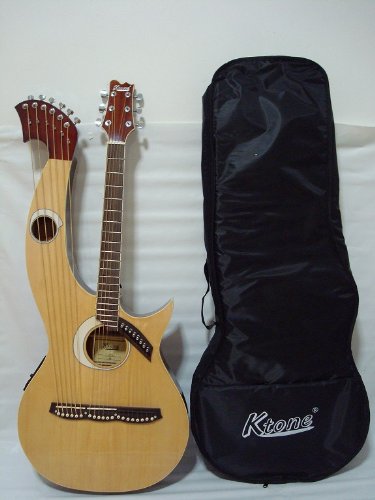 Ktone Harp Guitar
- 6,6,8 String Acoustic Electric Double Neck Guitar, Harp…
- 4 Band EQ with 9 Volt Battery
- Width: 17"


As an Amazon Associate we earn from qualifying purchases at no extra cost to you.
Best harp guitars by playing situation
| Player or situation | Best design choice | Useful target specifications | Why it fits |
|---|---|---|---|
| First harp-guitar owner | Six main strings plus three sub-basses | 24.75–25.5 in main scale; 3–4 in nut extension; 8–11 lb | Provides extra low notes without making the instrument excessively wide or heavy |
| Fingerstyle player needing a large bass range | Six main strings plus five or six sub-basses | 25–25.5 in main scale; 9–14 lb; individual sub-bass bridges | Offers more orchestral range, but requires more precise right-hand choreography |
| Small room or frequent transport | Compact harp attachment or chambered bass horn | Body length under 42 in; depth under 5 in; removable or fitted support hardware | Reduces storage and handling problems compared with a large traditional body |
| Performer using amplification | Separate pickup systems for main and sub-bass strings | Two-channel output or blend control; passive under-saddle or bridge sensors | Allows the low strings to be balanced without overpowering the guitar register |
| Collector or historical-style player | Dyer- or Knutsen-inspired raised-wing design | Often 4–6 sub-basses; spruce top; 12–16 in lower bout | Captures the visual and acoustic character of early twentieth-century harp guitars |
What makes a harp guitar different?
A harp guitar combines a conventional fretted guitar neck with one or more unfretted sub-bass strings. The main strings are played and fretted in the usual way. The sub-basses usually sit beside the neck, outside the main fingerboard, and are plucked as open notes. They extend the instrument downward without requiring an unusually long fretted neck.
There is no single standard harp-guitar format. Historical instruments by makers such as C. F. Martin, W. J. Dyer & Bro., and Chris J. Knutsen used several body and bridge arrangements. Modern specialist builders, including Mike Doolin, may offer custom layouts rather than a fixed mass-market model range. That means two instruments both described as “six-string, four-sub-bass harp guitars” can feel and sound very different.
Body designs: raised wing versus extended lower bout
Raised-wing designs
The raised-wing design adds a second soundboard section or elevated side structure beside the main neck. Sub-bass strings cross this area and terminate at a separate bridge. The arrangement gives the player a clear visual boundary between the fretted guitar and the harp register, and it often produces strong low-end projection.
Its disadvantages are size and leverage. The raised section can catch against a chair, arm, or case lining, while the extra mass may pull the instrument away from the torso. A fitted support or strap system is often more important than it first appears.
Extended lower-bout designs
Some harp guitars use a broad lower bout or side extension that houses the sub-bass bridge. These can feel more like large jumbos and may be easier to support on the leg. The trade-off is a wider body footprint and, sometimes, less separation between the main and sub-bass strings.
For seated playing, compare the point where the bass horn contacts your thigh. A design that looks elegant on a stand can become tiring if its extension forces your picking hand too far from the main soundhole.
Sub-bass layouts and tuning
Three sub-basses are usually the most approachable configuration. A common descending arrangement might use C, B, and A below the guitar’s low E, although exact tuning depends on scale length, string gauge, and the builder’s intended repertoire. Four or more sub-basses may extend toward F, E, or lower, but very low notes need adequate string length and a top and bridge designed to handle their tension.
Sub-bass strings are commonly tuned diatonically or chromatically. A chromatic layout gives more independent notes, while a diatonic layout can make common bass patterns easier to execute. Before buying, ask for the actual open-string pitches rather than relying on labels such as “extended bass” or “orchestral range.”
Individual sub-bass bridges are preferable when the strings use different gauges or tunings. They allow more precise compensation and make replacing one damaged string less disruptive. A shared bridge can work well, but it provides fewer adjustment options if one string intonates poorly.
Scale length, woods, and acoustic response
The main guitar scale is normally close to familiar acoustic-guitar dimensions. A 24.75-inch scale feels slightly softer and bends more easily; a 25.4- or 25.5-inch scale provides more tension, headroom, and definition. For sub-basses, scale lengths commonly fall between 25 and 30 inches. Longer sub-bass scales improve clarity and reduce flabby response, but they increase the instrument’s overall reach.
Spruce remains the most versatile soundboard material. Sitka spruce tends to offer broad headroom and a familiar acoustic balance, while Engelmann spruce can respond quickly to a lighter touch. Cedar often emphasizes immediate warmth but may compress sooner under a forceful attack. These are tendencies, not guarantees: bracing, bridge placement, air volume, and construction quality matter at least as much as the species.
Rosewood backs and sides commonly produce deep overtones and strong sustain, which can suit solo arrangements with open sub-basses. Mahogany usually emphasizes a drier, more focused midrange and can make complex bass lines easier to distinguish. Maple can deliver a clearer, quicker attack, useful when the low strings otherwise blur into the main guitar voice.
Tuning stability is a design issue, not just a tuner issue
Harp guitars put unusual demands on tuning stability because the sub-bass strings pull asymmetrically on the top and bridge. Look for a rigid neck joint, a well-supported sub-bass bridge, accurate tuner posts, and a nut or string guide that does not bind. Geared tuners on the sub-basses are usually more practical than friction pegs, particularly for low-tension strings.
New strings may require several tuning cycles as they stretch. Tune gradually from below the target pitch, then let the instrument rest before making a final adjustment. Avoid repeatedly tuning far above the intended pitch to “seat” a string; that adds unnecessary stress to the bridge and soundboard.
Temperature and humidity remain important. A wooden harp guitar is best kept around 40–55 percent relative humidity. Excess dryness can cause fret sprout, top sink, bridge lifting, or cracks; excessive humidity can raise the action and soften the response. Because harp guitars have more exposed structure, a compact hygrometer inside the case is a worthwhile purchase.
Playability: what to check before buying
- Picking clearance: Confirm that your thumb can reach the sub-basses without colliding with the main bridge or soundhole.
- Neck width: A nut width around 1.75–1.9 inches is common for fingerstyle, but wider is not automatically better if it strains your fretting hand.
- Action: Main-string action around 2.0–2.8 mm at the twelfth fret is a reasonable starting range, subject to playing style and builder setup.
- Sub-bass access: The lowest string should be reachable without lifting your shoulder or twisting your wrist.
- Balance: Test the instrument seated and standing. A neck that dives or a bass horn that tips the guitar outward will become tiring during long performances.
- Noise control: Listen for sympathetic rattles from unused sub-basses. Soft temporary dampers can help, but persistent buzzing may indicate a setup problem.
Case requirements and ownership costs
A standard dreadnought case rarely fits a harp guitar. Measure the full length, widest body point, depth, and the projection of the bass horn, then add clearance for padding. A typical specialist case may be 44–52 inches long, 18–24 inches wide, and 7–12 inches deep. Weight can range from roughly 12 to 25 pounds depending on whether the case is plywood, fiberglass, or molded composite.
Expect specialist cases to cost roughly $400–$1,500, with custom flight-ready versions higher. Do not substitute a soft gig bag unless the builder specifically approves it. The extended wing and multiple bridges need protection from impact, and a loose case can allow the instrument to shift during transport.
Strings are another recurring expense. A main set may cost approximately $15–$35, while a complete harp-guitar set with several sub-basses can cost $30–$90 or more. If you change strings four times a year, a $60 set costs about $15 per month of ownership before setup labor. Budget for an occasional professional setup, especially after changing sub-bass gauges or tuning.
Best buying decision by budget
At the lower end of the specialist market, roughly $1,500–$3,000, prioritize a stable three-sub-bass design, a usable case, and a documented setup over decorative appointments. Around $3,000–$7,000, you can usually compare more carefully among woods, scale lengths, pickup options, and custom tuning layouts. Above that range, much of the price reflects individual construction, historical accuracy, ornamentation, and the builder’s waitlist rather than a simple increase in volume.
The safest choice for a first purchase is a moderately sized six-plus-three instrument with a 24.75- to 25.5-inch main scale, three sub-basses, separate adjustable bridge hardware, and a fitted hard case. Choose five or six sub-basses only when you already know the repertoire and can explain which additional notes you will use. More strings add range, but they also add weight, tuning time, case size, and opportunities for unwanted sympathetic noise.
FAQ
Are harp guitars difficult to learn?
The fretted neck is familiar to an acoustic guitarist, but the sub-basses require a separate right-hand map. Start with simple alternating patterns and damp unused low strings until your hand learns the spacing.
Can a harp guitar use ordinary guitar strings?
The main strings usually can, if the builder specifies the gauges. Sub-basses should use strings selected for their scale length and target pitch. Installing random heavy strings can overload the bridge or change the top’s response.
Should I buy an acoustic pickup?
For occasional amplification, a carefully installed bridge or under-saddle system may be adequate. For performances where the sub-basses must remain balanced, a separate pickup or dual-channel system is easier to control than one sensor serving every string.