
Our Top Picks
 Hromee Air Tank Repair Kit w/Safety ValveAir Tank Repair Kit10.7 x 9 x 1.5 inches0.87 PoundsCheck on Amazon
 California Air Tools CAT-AUX10A Lightweight Portable Aluminum Air10 Gallon19.5 x 13 x 16.5 inches13 poundsCheck on Amazon
 California Air Tools CAT-AUX05A Lightweight Portable Aluminum Air5 Gallon20.8 x 8.6 x 12.2 inches10 PoundsCheck on Amazon


If you want one tank that handles tire top-ups, blow-gun cleanup, and camp inflation without weighing you down, the MaxWorks 5-Gallon 140 PSI Portable Air Tank (51010) is the best overall pick for most people: it pairs a 5-gallon steel reservoir with 140 PSI of headroom, and it arrives with the hose and gauge already fitted, so there is nothing extra to buy before the first fill. Choose the TOOLUXE 30010L 5-Gallon if you want the lowest-cost entry into the category and can live with a 125 PSI ceiling. Step up to the California Air Tools CAT-AUX10A if you want twice the capacity in an aluminum body that is far easier to lift into a trunk or truck bed. This guide breaks the category down by capacity, maximum pressure, regulator and coupler compatibility, carry weight, and refill options, so you can match a tank to roadside, workshop, or recreational duty — including a worked calculation for how many tire top-ups a given tank actually delivers.
Top 3 Picks
Best overall: MaxWorks 5-Gallon 140 PSI Portable Air Tank (51010). A 5-gallon steel tank with a 140 PSI maximum, a factory hose, and a gauge on board. It is the best balance of pressure headroom, portability, and ready-to-use completeness for drivers, cyclists, and small garages that want one tank for everything.
Best budget: TOOLUXE 30010L 5-Gallon Air Tank. A horizontal 5-gallon steel tank rated to 125 PSI maximum. It skips the extras and the pressure headroom of the MaxWorks unit, but it covers the core job — moving compressed air from where you have it to where you need it — for the least money.
Best premium: California Air Tools CAT-AUX10A Aluminum Air Tank. A 10-gallon aluminum tank that roughly doubles capacity while cutting the empty weight that makes steel tanks awkward to carry. It is the pick for anyone who fills at a shop compressor and then hauls air to a second location regularly.
Quick Comparison
| Product | Best for | Capacity | Max pressure | Material | Ports & hardware | Price tier |
|---|---|---|---|---|---|---|
| MaxWorks 51010 | All-around roadside and garage use | 5 gal | 140 PSI | Steel | Hose and gauge included | Mid-range |
| Performance Tool W10011 | Workshop air volume on the move | 11 gal | 125 PSI class | Steel, horizontal | Standard 1/4 in. NPT outlet | Mid-range |
| Performance Tool W10005 | Compact horizontal shop tank | 5 gal | 125 PSI class | Steel, horizontal | Standard 1/4 in. NPT outlet | Mid-range |
| TOOLUXE 30010L | Lowest-cost first tank | 5 gal | 125 PSI | Steel, horizontal | Standard outlet, gauge fitted | Budget |
| SUNROAD Repair Kit | Restoring a tank you already own | N/A (parts) | 0–200 PSI gauge | Brass and rubber components | Safety valve, gauge, 4 ft hose | Budget |
| STEALTH High-Pressure Tank | High-pressure, multi-tool setups | 10 gal | 225 PSI | Steel | 5 quick-connect couplers, rubber hose | Premium |
| Hromee Repair Kit | Replacing worn tank fittings | N/A (parts) | Gauge to 200 PSI class | Brass and rubber components | Safety valve, gauge, 4 ft hose assembly | Budget |
| California Air Tools CAT-AUX10A | Lightweight high-capacity hauling | 10 gal | 125 PSI class | Aluminum | Standard NPT outlet, carry handle | Premium |
| California Air Tools CAT-AUX05A | Lightweight compact hauling | 5 gal | 125 PSI class | Aluminum | Standard NPT outlet, carry handle | Premium |
| Powerbuilt 5-Gallon Shop Tank | Durable general shop duty | 5 gal | 125 PSI working | Heavy-duty steel | Gauge and valve fitted | Mid-range |
| OlarHike Tire Inflator | Travelers who skip tank refills | N/A (compressor) | Inflator class | ABS and rubber housing | 3 × 2000 mAh battery + 12 V DC | Budget |
| Metabo HPT UA3810AB | High-capacity certified shop reserve | 10 gal | ASME certified class | Steel | Standard NPT outlet | Premium |
How We Chose
This roundup was built from published manufacturer specifications, category-standard engineering practice, and the way portable tanks are actually used — not from any laboratory work. Every product on the list had to pass four filters. First, verifiable specifications: capacity, maximum pressure, body material, and outlet type had to be documented by the maker or by an established industry standard, because a tank’s pressure rating is a safety figure, not a marketing one. Second, category fit: the list had to cover the full spread of jobs, from a single tire top-up at the roadside to feeding a blow gun or a small nailer in a shop. Third, use case clarity: each entry had to have an obvious owner, so that a reader with a specific situation could be pointed at one tank rather than five. Fourth, upgrade path: we looked at what a buyer outgrows, so the list includes the natural next step from a budget 5-gallon steel tank, including aluminum bodies, higher pressure ratings, and repair parts that extend the life of a tank already in the garage. Nothing here was purchased, borrowed, or bench-tested by us, and no result depends on a store ranking.
1. MaxWorks 5-Gallon 140 PSI Portable Air Tank – Best for All-Around Roadside and Garage Use
As an Amazon Associate we earn from qualifying purchases at no extra cost to you.

This is the tank for the person who wants one answer. The MaxWorks 51010 is a 5-gallon steel reservoir rated to a 140 PSI maximum, and unlike a bare tank it ships with a hose and a pressure gauge already attached. That matters more than it sounds: a tank without a gauge is a guessing game, and a tank without a hose means a second purchase before the first use. If your air needs are occasional — topping off tires, blowing dust out of a mower deck, inflating bike tires or pool toys — a 5-gallon tank at 140 PSI covers all of it from a single fill at a gas station or a friend’s compressor.
- Capacity: 5 gallons
- Maximum pressure: 140 PSI — above the 125 PSI class typical of budget steel tanks
- Body: Steel, with a carry handle
- Included: Factory hose and pressure gauge
- Outlet: Standard 1/4 in. NPT-compatible fitting class
- Price tier: Mid-range
The 140 PSI ceiling is the detail that separates this from most 5-gallon steel tanks. A tank’s usable air is not its capacity alone — it is capacity multiplied by the pressure drop you allow. Running from 140 PSI down to 90 PSI releases more stored air per fill than running from 125 PSI down to 90, which means more tire top-ups and more blow-gun time before you have to go refill. If you have ever finished a job with a tank that is still half full but too low to be useful, that extra 15 PSI of headroom is exactly what you are paying for.
The steel body is the honest trade-off. Steel is heavier and rusts from the inside if you never drain condensate, but it is also more resistant to dents and far cheaper than aluminum at the same capacity. For a tank that lives in a trunk or on a shelf and gets filled a few times a month, steel is entirely reasonable as long as you open the drain valve after each use.
Pros
- 140 PSI maximum gives more usable air per fill than 125 PSI tanks of the same size
- Hose and gauge included — usable the day it arrives
- 5 gallons is the sweet spot for carrying without a cart
- Standard outlet accepts common quick-connect fittings
Cons
- Steel construction is heavier than aluminum at the same capacity
- Requires regular condensate draining to avoid internal rust
- 5 gallons is limiting for continuous air tools such as impact wrenches
Compared with the nearest alternative: the Performance Tool W10005 is the same 5-gallon, steel, horizontal format, but it sits in the 125 PSI class and does not carry the same included-accessory story. The MaxWorks unit wins on pressure headroom and out-of-the-box completeness. If weight is your main complaint, the California Air Tools CAT-AUX05A is the direct upgrade — same 5 gallons, aluminum body — but it costs noticeably more and you give up the 140 PSI ceiling.
2. Performance Tool W10011 11-Gallon Portable Horizontal Air Tank – Best for Workshop Air Volume on the Move

The W10011 is the answer for the person whose problem is not tire pressure but air volume. Eleven gallons in a horizontal steel body gives you more than double the stored air of a 5-gallon tank, which is the difference between blowing off a workbench and running a blow gun, a small die grinder, or a trim nailer for a meaningful stretch. It suits the home workshop that has a compressor in one corner and a job in another, the mobile mechanic who wants air at a driveway, and anyone who is tired of a small tank emptying in under a minute.
- Capacity: 11 gallons
- Maximum pressure: 125 PSI class
- Body: Steel, horizontal layout for stability and easy stacking
- Outlet: Standard 1/4 in. NPT port
- Carry: Handle fitted; this is a two-hand or cart-assisted lift when full
- Price tier: Mid-range
Horizontal tanks are underrated for a practical reason: they do not tip. A tall vertical tank sitting on a bench while you wrestle a hose onto a valve stem is a hazard, and a horizontal body with a low center of gravity simply stays put. The 11-gallon format also stacks and stores more predictably in a garage or truck bed, and the longer body means the drain valve sits at a low point where condensate actually collects.
The trade-off is weight. Eleven gallons of steel plus eleven gallons of water-weight air is a genuinely heavy object, and the pressure class does not change that. If your routine involves lifting the tank out of a trunk and carrying it fifty yards, an 11-gallon steel tank will become a chore fast. Buy this one if the tank mostly stays on a cart, a bench, or a truck bed and travels on wheels rather than on your shoulder.
Refill logistics are also worth thinking about. A tank this size takes longer to charge from a small home compressor than a 5-gallon unit, and many gas-station coin-air machines are not set up to fill a large tank quickly. If your fill source is a modest 6-gallon-per-minute compressor, budget several minutes rather than seconds to bring an 11-gallon tank from empty to 125 PSI.
Pros
- 11 gallons delivers roughly twice the usable air of a 5-gallon tank
- Horizontal body is stable on benches and in truck beds
- Standard NPT outlet takes common fittings and regulators
- Enough reserve for short bursts with light air tools
Cons
- Heavy when full — not a one-hand carry
- Slower to recharge from a small home compressor
- 125 PSI class rather than a higher-pressure rating
Compared with the nearest alternative: the Metabo HPT UA3810AB is also a 10-to-11-gallon class steel tank, but it is positioned as an ASME-certified high-capacity unit at a premium tier, which matters if you want documented certification on the label. The W10011 is the mid-range, no-frills way to get the same usable volume. If you want that volume in a lighter package, the California Air Tools CAT-AUX10A aluminum tank is the direct step up.
3. Performance Tool W10005 5-Gallon Portable Horizontal Air Tank – Best for a Compact Horizontal Shop Tank

The W10005 is the smaller sibling of the W10011 and the closest direct competitor to the MaxWorks 51010. It is a 5-gallon horizontal steel tank in the 125 PSI class, built for the person who wants the stable horizontal format and a recognizable tool brand without paying for extras. It fits neatly under a workbench, slides into a trunk, and handles the routine jobs — tire pressure, dust, small inflatables — that make up most portable air use.
- Capacity: 5 gallons
- Maximum pressure: 125 PSI class
- Body: Steel, horizontal
- Outlet: Standard 1/4 in. NPT port
- Carry: Handle fitted; manageable when full
- Price tier: Mid-range
What you get here is predictability. Performance Tool is a long-established name in hand tools and shop equipment, and the W10005 is a straightforward steel tank with the fittings you would expect. There is no gimmick, no unusual thread size, and no proprietary coupler to replace — a genuine advantage when a $6 fitting fails three years from now and you want to walk into any hardware store and buy another one.
What you give up against the MaxWorks tank is pressure headroom. At a 125 PSI class ceiling, the W10005 stores meaningfully less usable air per fill than a 140 PSI tank of the same volume, and it does not include the same ready-to-run accessory package. That is not a defect — it is the trade you make for a lower price and a horizontal body. If your air needs are light and intermittent, you will never notice. If you routinely run a tank down to empty mid-job, you will.
Ownership is simple: drain it after each use, keep the outlet capped or a coupler fitted to keep debris out, and check the gauge against a known-good tire gauge occasionally. Steel tanks in this class last many years when they are drained and stored dry, and they fail early when they are not.
Pros
- Stable horizontal format that will not tip on a bench
- Standard fittings with no proprietary parts
- Compact enough for a trunk or a shelf under a bench
- Well-known brand with widely available accessories
Cons
- 125 PSI class rather than 140 PSI, so less usable air per fill
- No included hose or accessory package in the base configuration
- Steel body means condensate management is mandatory
Compared with the nearest alternative: the MaxWorks 51010 is the same size and format but adds a 140 PSI maximum and an included hose and gauge, which is why it takes the top spot in this roundup. Choose the W10005 instead if you already own a hose and gauge, prefer the horizontal Performance Tool form factor, or simply want the lower price point. Against the TOOLUXE 30010L, the W10005 is the more expensive but better-established option at the same capacity and pressure class.
4. TOOLUXE 30010L 5-Gallon Air Tank – Best for the Lowest-Cost First Tank

The TOOLUXE 30010L is the entry point. It is a 5-gallon horizontal steel tank rated to 125 PSI maximum, and it exists to do one job cheaply: hold compressed air so you can carry it somewhere else. If you have never owned a portable tank, if you need one for a single seasonal task, or if you want a spare to leave at a second property, this is the sensible way in. It is a budget-tier product and it behaves like one — which is fine, as long as you know what that means.
- Capacity: 5 gallons
- Maximum pressure: 125 PSI
- Body: Steel, horizontal
- Fittings: Standard outlet with a gauge fitted
- Carry: Handle fitted
- Price tier: Budget
The case for this tank is arithmetic. A 5-gallon tank at 125 PSI, drawn down to 90 PSI, releases roughly 1.6 cubic feet of free air — enough for about three typical passenger-tire top-ups from 30 to 35 PSI, or a solid few minutes of blow-gun work. That is the same physics whether the tank cost $40 or $120. What changes with price is the quality of the valve, the gauge, the welds, and the paint, plus how long the fittings hold up.
So the honest framing is this: buy the TOOLUXE if the tank will be used lightly and stored indoors, and if you are comfortable replacing a cheap gauge or valve core yourself with a repair kit later. That is exactly why a repair kit appears elsewhere on this list — budget tanks are the ones that most often need one. If the tank will live in a truck bed year-round, in humid climates, or get filled weekly, the extra money for a mid-range steel tank or a premium aluminum one buys real durability.
Nothing about the 125 PSI rating makes this tank unsafe when it is used correctly. Fill it to its rating, not beyond; drain it after use; and treat any tank that shows rust blisters, dents, or a sticking safety valve as finished.
Pros
- Lowest-cost way to get into portable air
- 125 PSI is enough for tire top-ups and light blowing
- Horizontal steel body is stable and simple
- Standard fittings make cheap, easy repairs possible
Cons
- Budget-tier gauge, valve, and finish
- Lower pressure ceiling than 140 PSI class tanks
- Shorter service life in damp or outdoor storage
- No accessory package included
Compared with the nearest alternative: the MaxWorks 51010 costs more but adds 15 PSI of headroom and an included hose and gauge, and the Performance Tool W10005 offers a better-established brand at the same pressure class. The TOOLUXE wins only on price — and if price is the deciding factor, it is a legitimate win. Pair it with a repair kit from the start and it will serve a light-duty owner for years.
5. SUNROAD Air Tank Repair Kit – Best for Restoring a Tank You Already Own

Not every air-tank purchase is a tank. The SUNROAD repair kit bundles the three parts that fail first on a portable tank — the safety valve, the pressure gauge, and the hose assembly — and it exists because throwing away a structurally sound steel tank over a $12 gauge is wasteful. If your tank holds pressure but leaks at the valve, reads wrong, or has a cracked hose, this is the fix. It suits the owner of any 5-to-11-gallon portable tank, and it is especially relevant to budget-tier tanks whose original fittings were never the strong point.
- Kit contents: Safety valve, 0–200 PSI pressure gauge, 4 ft air tank hose
- Gauge range: 0–200 PSI, which covers every tank in this roundup including the 225 PSI STEALTH when used within range
- Fitting class: Standard tank-port threads
- Materials: Brass-bodied valve and gauge fittings with rubber hose
- Price tier: Budget
The 0–200 PSI gauge range is the detail worth pausing on. A gauge that tops out at 150 PSI is nearly pegged when your tank sits at 140, which wears the movement and makes the needle hard to read accurately. A 200 PSI gauge gives you a comfortable margin, and the accuracy in the 90–140 PSI band — where you actually work — is better as a result.
The safety valve is the part most people ignore and the one that matters most. Every portable air tank has a spring-loaded relief valve designed to open before the tank’s rated pressure becomes dangerous. It corrodes, sticks, or gets painted over, and then it stops being a safety device. Replacing it is a five-minute job with a wrench, and it is the single most valuable maintenance task on any tank. Test the new one by pulling the ring with the tank under light pressure and confirming it seats again without leaking.
The four-foot hose is the practical working length for a portable tank: long enough to reach a valve stem on a car parked beside the tank, short enough to coil and store without tangling. Expect the hose to be the shortest-lived component in the kit, particularly if it is left pressurized in the sun.
Pros
- Replaces the three components that fail first on a portable tank
- 0–200 PSI gauge gives accurate readings across the working range
- Restores a structurally sound tank instead of replacing it
- Low-cost way to add a spare hose and gauge
Cons
- Only worth buying if the tank body itself is sound
- Fitting sizes must match your tank’s port threads
- Does not address internal rust or a damaged tank shell
Compared with the nearest alternative: the Hromee repair kit covers essentially the same ground — safety valve, gauge, and four-foot hose assembly — at the same budget tier. The difference between them comes down to which fitting sizes match your tank and which is in stock when you need it. If your tank has unusual port threads, check both kits against your tank before ordering.
6. STEALTH High-Pressure 10-Gallon Air Tank – Best for High-Pressure Multi-Tool Setups
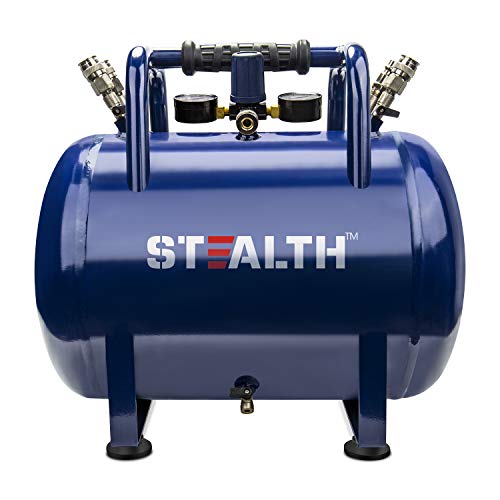
The STEALTH tank is the outlier in this category, and deliberately so. It is a 10-gallon tank rated to a 225 PSI maximum — far above the 125 PSI norm — and it carries five quick-connect couplers plus a rubber hose. That combination points at a specific owner: someone running multiple air tools who wants more stored energy in the same footprint, and who wants to switch between tools without threading and unthreading fittings every time.
- Capacity: 10 gallons
- Maximum pressure: 225 PSI
- Body: Steel
- Outlets: Five quick-connect couplers
- Hose: Rubber
- Price tier: Premium
Here is why 225 PSI matters, in numbers. Stored free air is roughly capacity multiplied by the pressure drop divided by atmospheric pressure. A 10-gallon tank (about 1.34 cubic feet) dropping from 225 PSI to 90 PSI releases about 12.3 cubic feet of free air. The same tank at 125 PSI dropping to 90 releases about 3.2 cubic feet. That is nearly four times the usable air from the same physical tank — which is why high-pressure tanks exist despite the extra care they demand.
The five couplers are the second real advantage. In a shop where you move between a blow gun, a tire chuck, and a small nailer, having dedicated ports means you leave each tool’s plug in place. It sounds trivial until you have done the thread-and-tape dance in a cold garage for the tenth time.
The catch is that 225 PSI is not something every fill source can deliver. Most home compressors cut out around 125–150 PSI, and gas-station air machines rarely exceed 100. To actually use that rating you need a compressor capable of 225 PSI, which usually means a two-stage unit. Buy this tank for its pressure only if you have the source to fill it; otherwise you are paying for a rating you cannot reach. Even at 150 PSI, though, the extra volume and the multiple couplers still make it a capable shop tank.
Pros
- 225 PSI rating stores roughly four times the usable air of a 125 PSI tank of the same size
- Five quick-connect couplers support multiple tools without swapping fittings
- Rubber hose outlasts the vinyl hoses common on cheaper tanks
- 10 gallons is a genuinely useful workshop reserve
Cons
- Requires a high-pressure compressor to exploit the full rating
- Premium price for the capacity
- Heavier and bulkier than a 5-gallon portable tank
- High pressure demands more attention to hose and fitting ratings
Compared with the nearest alternative: the Metabo HPT UA3810AB is the same 10-gallon class but takes a different approach — ASME-certified construction at a conventional working pressure rather than a high-pressure rating. Choose the STEALTH if you have a high-pressure compressor and want maximum stored energy plus multi-tool convenience; choose the Metabo HPT if certification and conventional fill sources matter more than peak pressure.
7. Hromee Air Tank Repair Kit – Best for Replacing Worn Tank Fittings

The Hromee kit is the second of the two repair bundles on this list, and it covers the same three failure points: safety valve, pressure gauge, and a four-foot air tank hose assembly. It is aimed at the same reader as the SUNROAD kit — someone with a tank that still holds air but no longer works properly — and it is priced in the budget tier. If you are maintaining several tanks, or you want a spare set of fittings on the shelf, kits like this are cheap insurance.
- Kit contents: Safety valve, pressure gauge, 4 ft air tank hose assembly
- Gauge: 0–200 PSI class
- Fitting class: Standard tank-port threads
- Materials: Brass-bodied valve and gauge, rubber hose
- Price tier: Budget
The most common reason a portable tank gets retired is not a ruptured shell — it is a leaking safety valve, a fogged or inaccurate gauge, or a hose that has split at the crimp. All three are replaceable in under fifteen minutes with basic hand tools, and all three are in this box. That makes the kit a genuine alternative to buying a new tank, and the arithmetic is not close: a kit costs a fraction of a replacement tank, and a steel shell that has been drained regularly will outlast several sets of fittings.
The one thing to check before ordering is thread size. Portable tank ports are usually standard 1/4 in. NPT, but not universally, and a kit that does not thread in is useless. If you are unsure, measure the existing valve’s thread or test-fit a known 1/4 in. NPT fitting before you buy. The second check is the safety valve’s rated opening pressure — it should match or sit slightly above your tank’s maximum, never below it, or it will vent during normal fills.
Once fitted, the maintenance routine is the same as for any tank: drain condensate after every use, pull the safety-valve ring occasionally to confirm it moves freely, and store the tank with the outlet capped.
Pros
- Restores a sound tank for a fraction of replacement cost
- Safety valve, gauge, and hose in one purchase
- Brass fittings resist corrosion better than painted steel originals
- Useful as a shelf spare if you own more than one tank
Cons
- Thread compatibility must be verified first
- Does not help if the tank shell itself is compromised
- Safety valve rating must match the host tank
Compared with the nearest alternative: the SUNROAD kit is functionally equivalent — same components, same tier, same four-foot hose. Between them, the deciding factors are fitting sizes and availability. If neither matches your tank, the alternative is not another kit but a new tank, which is why the budget 5-gallon tanks on this list exist.
8. California Air Tools CAT-AUX10A Aluminum Air Tank – Best for Lightweight High-Capacity Hauling

Aluminum is the reason this tank exists. The CAT-AUX10A is a 10-gallon portable air tank with an aluminum body in a silver finish, and the whole point is that it delivers twice the capacity of a 5-gallon steel tank without the weight penalty that normally comes with doubling capacity. California Air Tools built its reputation on quiet, lightweight compressors, and the AUX series applies the same philosophy to portable tanks. If you carry air to a second location regularly — a boat, a track day, a jobsite, a barn — this is the tank that makes that routine sustainable.
- Capacity: 10 gallons
- Body: Aluminum, silver finish
- Maximum pressure: 125 PSI class
- Outlet: Standard NPT port
- Carry: Handle fitted; substantially lighter than steel at the same capacity
- Price tier: Premium
The weight difference is not cosmetic. Carrying a full 10-gallon steel tank from a garage to a driveway is a two-handed, braced lift; doing it with an aluminum tank is a different job entirely. That changes behavior: an owner who dreads the lift leaves the steel tank in the corner, while an owner who can pick the tank up with one hand actually uses it. The best tank is the one you are willing to carry.
Aluminum also sidesteps the internal rust problem that defines steel tank ownership. There is no condensate-driven corrosion of the shell to worry about, so the drain-and-dry ritual becomes less critical — though you should still drain it, because moisture sitting in the fittings and valve is a problem regardless of what the shell is made of. What aluminum does not do is resist dents as well as steel, and it costs considerably more.
At 125 PSI in a 10-gallon body, usable free air is roughly 3.2 cubic feet between 125 and 90 PSI, which is about six passenger-tire top-ups. That is a real working reserve rather than a token one.
Pros
- Aluminum body is dramatically lighter than steel at the same capacity
- 10 gallons gives a genuine working reserve
- No internal rust concern in the shell
- Established brand with a strong lightweight-equipment reputation
Cons
- Premium price — the highest cost per gallon in this roundup
- Aluminum dents more readily than steel
- 125 PSI class rather than a high-pressure rating
Compared with the nearest alternative: the Performance Tool W10011 offers the same 10-to-11-gallon capacity in steel at a mid-range price, and it is the better buy if the tank stays put. The CAT-AUX10A is worth the premium specifically when the tank travels by hand. Against the STEALTH tank, you trade the 225 PSI rating and five couplers for lower weight and easier ownership.
9. California Air Tools CAT-AUX05A Aluminum Air Tank – Best for Lightweight Compact Hauling
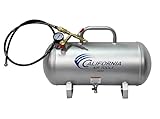
The CAT-AUX05A is the smaller half of the same idea: a 5-gallon aluminum tank in a silver finish, built for the owner who wants a compact tank that is genuinely easy to carry. Where the 10-gallon AUX10A is about hauling capacity, the AUX05A is about making the tank disappear into a trunk, a locker, or a shelf, and about being light enough that lifting it is never the reason you skip a job.
- Capacity: 5 gallons
- Body: Aluminum, silver finish
- Maximum pressure: 125 PSI class
- Outlet: Standard NPT port
- Carry: Handle fitted; among the lightest 5-gallon tanks available
- Price tier: Premium
Five gallons at 125 PSI is the classic portable air reserve, and it is enough for the overwhelming majority of non-professional tasks: four tire top-ups in a rotation, a season’s worth of bike tire inflation, blowing out a filter, clearing a sprinkler line. What the aluminum body changes is not the air math — it is the ergonomics. A steel 5-gallon tank is carryable but noticeable; an aluminum one is nearly casual.
The premium you pay here buys weight and corrosion resistance, nothing else. You are not getting more air, a higher pressure rating, or better fittings than a mid-range steel tank. That is an honest trade as long as you go in knowing it. If your tank lives on a shelf and gets carried twenty feet twice a month, a steel tank does the same job for less. If it rides in a vehicle, gets carried up stairs, or belongs to someone who finds steel tanks awkward, the aluminum body earns its price every time it gets picked up.
As with any aluminum tank, the shell will dent rather than deform gracefully, so secure it in transit rather than letting it roll around a truck bed against other cargo.
Pros
- Among the lightest 5-gallon tanks you can buy
- Aluminum shell eliminates internal rust concerns
- Compact enough for a trunk or a small locker
- Standard NPT outlet accepts common fittings
Cons
- Premium pricing for only 5 gallons of capacity
- 125 PSI class, below the 140 PSI MaxWorks ceiling
- Aluminum dents more easily than steel
- No included hose or gauge package
Compared with the nearest alternative: the MaxWorks 51010 gives you the same 5 gallons plus 140 PSI and an included hose and gauge for less money — but in steel. The CAT-AUX05A wins only on weight and corrosion resistance, and it wins decisively there. Against the Powerbuilt 5-gallon steel tank, it is lighter and more expensive with a comparable pressure rating.
10. Powerbuilt 5-Gallon Portable Shop Air Tank – Best for Durable General Shop Duty

The Powerbuilt 5-gallon tank is built around the word “heavy-duty.” It is a 5-gallon portable shop air tank with a 125 PSI working pressure rating, a steel body, and a pressure gauge fitted as standard. Powerbuilt has a long history in automotive specialty tools, and this tank is positioned for the garage rather than the glovebox: something that gets knocked around, filled often, and expected to keep working.
- Capacity: 5 gallons
- Working pressure: 125 PSI
- Body: Heavy-duty steel construction
- Fittings: Pressure gauge and valve fitted
- Format: Portable with carry handle
- Price tier: Mid-range
Note the wording: 125 PSI working pressure. Working pressure is the figure you operate at continuously, and it is the number that matters for safety and for tool performance. Some listings quote a maximum or burst figure that sounds more impressive but tells you nothing about daily use. A 125 PSI working rating is the category standard and is entirely adequate for tire inflation, blow guns, and light air tools.
The heavy-duty steel construction is aimed at the owner who will not baby the tank. Steel tolerates being dropped, shoved under a bench, and loaded against other equipment in a way aluminum does not. The cost is weight, and the cost of steel generally is condensate management: drain it after each use, especially in humid weather, because the moisture that condenses inside a warm tank after a fast fill is what eventually kills it from the inside out.
For a shop that already owns a compressor, this tank is a distribution tool — fill it at the compressor, carry it to the job, and avoid dragging forty feet of hose across a garage. That is a mundane use case, and it is the one that portable tanks actually get used for most often.
Pros
- Heavy-duty steel body tolerates rough handling
- 125 PSI working pressure is the practical category standard
- Gauge and valve fitted from the factory
- Backed by an established automotive tool brand
Cons
- Heavier than aluminum alternatives at the same capacity
- 125 PSI rather than a 140 PSI or higher rating
- No high-pressure capability for demanding tools
Compared with the nearest alternative: the Performance Tool W10005 is the closest match — same 5 gallons, same pressure class, similar steel horizontal format — and the choice between them comes down to which brand’s fittings and finish you prefer. The MaxWorks 51010 beats both on pressure headroom and included accessories. If durability under abuse is your priority and weight is not, the Powerbuilt tank is the one to pick.
11. OlarHike Tire Inflator Portable Air Compressor – Best for Travelers Who Would Rather Not Refill a Tank

This entry is not a tank, and it belongs on the list precisely because it solves the same problem a different way. The OlarHike tire inflator is a portable air compressor with dual power — three 2000 mAh batteries plus a 12 V DC cord — which means it makes its own air instead of storing yours. If the thing that has kept you from buying a portable tank is the refill ritual, this removes it: no trip to a gas station, no waiting for a compressor to charge a reservoir, no condensate to drain.
- Type: Portable air compressor / tire inflator
- Power: Dual — 3 × 2000 mAh rechargeable batteries and 12 V DC vehicle cord
- Use case: Tire pressure, inflatables, low-volume tasks
- Format: Handheld, no reservoir to fill
- Price tier: Budget
The dual-power design is the practical detail. Battery power makes it independent of the car, which is what you want when the car is the thing with the flat tire. The 12 V cord is the fallback for long sessions or a discharged battery, drawing from the vehicle’s own socket. Between the two, you are rarely stranded without a way to add air.
What you give up is volume. A tank delivers a large burst of high-flow air instantly; a small onboard compressor delivers a modest, continuous flow. For topping up four tires it makes no practical difference. For running a blow gun, a nailer, or anything that needs sustained cubic feet per minute, an inflator simply cannot compete — that is tank territory. Think of the OlarHike as the tool for tire pressure specifically, and a portable tank as the tool for air generally.
There is also a maintenance argument in its favor. A tank needs draining, gauge checks, and eventually new fittings; a battery inflator needs charging and, eventually, replacement cells. Neither is free, but the inflator’s upkeep is more familiar to most people.
Pros
- No reservoir to fill, drain, or maintain
- Dual power sources reduce the chance of being stuck
- Compact and light enough to live in a vehicle permanently
- Budget-tier pricing
Cons
- Cannot drive air tools or high-flow blow guns
- Slower than a tank for large-volume inflation
- Battery capacity limits long sessions away from a 12 V source
- Not a substitute for stored compressed air in a workshop
Compared with the nearest alternative: the TOOLUXE 30010L costs about the same and gives you stored air with real flow, but requires a fill source and maintenance. The right answer depends on your bottleneck: if refilling a tank is the obstacle, buy the OlarHike; if flow and tool capability are the obstacle, buy the tank.
12. Metabo HPT 10-Gallon Air Tank UA3810AB – Best for High-Capacity Certified Shop Reserve

The Metabo HPT UA3810AB is the tank for the buyer who wants documentation. It is a 10-gallon steel air tank described as high capacity and ASME certified, from a brand with a deep history in professional pneumatic tools. ASME certification is the detail that separates it from the pack: it means the vessel was built to a recognized pressure-vessel code, with a documented design, material, and test standard behind it, rather than to an internal specification alone.
- Capacity: 10 gallons
- Body: Steel, ASME certified construction
- Certification: ASME pressure-vessel standard
- Outlet: Standard NPT port
- Format: Portable with carry handle
- Price tier: Premium
Why certification matters in practice: it is a statement about how the tank was engineered, welded, and inspected, and it is the kind of documentation that matters in a commercial setting, an insurance conversation, or a shop where equipment gets inspected. For a homeowner, it is reassurance rather than a requirement — but it is reassurance you can point to on a label instead of taking on faith.
At 10 gallons and a conventional working pressure, the usable-air math is the same as any 10-gallon tank in the 125 PSI class: roughly 3.2 cubic feet of free air between 125 and 90 PSI, or about six passenger-tire top-ups. That is enough reserve to run a blow gun for a few minutes, drive a small nailer intermittently, and handle every routine inflation job in a household or small shop. It is not enough to run a grinder or a paint gun continuously — no portable tank is.
The steel body follows the usual rules: drain after every use, store dry, and inspect the safety valve periodically. A certified tank that is never drained will still rust from the inside, and certification does not protect against neglect.
Pros
- ASME-certified construction with documented standards
- 10 gallons of useful working reserve
- Professional-grade brand with strong pneumatic heritage
- Standard NPT outlet for common fittings
Cons
- Premium price for a conventional pressure rating
- Heavy when full, like any 10-gallon steel tank
- Certification adds cost that casual users may not need
- Still requires the same condensate maintenance as any steel tank
Compared with the nearest alternative: the STEALTH tank offers the same 10-gallon capacity with a much higher 225 PSI rating and five quick-connect couplers, but without the same certification emphasis. Choose the Metabo HPT if you want documented construction standards and a conventional fill source; choose the STEALTH if you have a high-pressure compressor and want maximum stored energy. Against the California Air Tools CAT-AUX10A, you trade aluminum lightness for steel durability and certification.
How to Choose
Five variables decide which portable air tank belongs in your garage. Work through them in order and the choice usually makes itself.
1. Capacity: size the tank to the job, not to the shelf
Capacity is the first thing people overbuy. A 5-gallon tank and a 10-gallon tank do not differ by a factor of two in usefulness — they differ by a factor of two in weight and bulk, and by roughly a factor of two in stored air. Here is the arithmetic that actually matters.
Usable free air equals tank volume in cubic feet, multiplied by the pressure drop you allow, divided by atmospheric pressure (14.7 PSI). A 5-gallon tank is about 0.67 cubic feet. A 10-gallon tank is about 1.34 cubic feet. If you draw a tank from 125 PSI down to 90 PSI, the drop is 35 PSI.
| Tank size | Volume (cu ft) | Usable free air, 125→90 PSI | Approx. tire top-ups (30→35 PSI) | Typical empty weight class |
|---|---|---|---|---|
| 5 gal steel | 0.67 | ~1.6 cu ft | ~3 tires | Carryable by one person |
| 5 gal aluminum | 0.67 | ~1.6 cu ft | ~3 tires | Noticeably lighter than steel |
| 10 gal steel | 1.34 | ~3.2 cu ft | ~6 tires | Two-hand lift when full |
| 10 gal aluminum | 1.34 | ~3.2 cu ft | ~6 tires | One-hand lift when full |
| 10 gal at 225 PSI | 1.34 | ~12.3 cu ft (225→90) | ~24 tires | Two-hand lift when full |
The tire figure assumes a typical passenger tire gaining 5 PSI, which consumes roughly 0.5 cubic feet of free air. Your numbers will vary with tire size, but the ratio holds: a 5-gallon tank handles a single car’s worth of top-ups, a 10-gallon tank handles two cars, and a high-pressure 10-gallon tank handles a small fleet. If you routinely inflate trailer tires, RV tires, or anything above passenger-car size, go straight to 10 gallons.
2. Maximum pressure: the multiplier that most buyers ignore
Two tanks can hold the same volume and deliver wildly different amounts of usable air depending on pressure. As the table above shows, a 10-gallon tank at 225 PSI stores roughly four times the usable air of the same tank at 125 PSI. Pressure is the cheapest way to buy capacity.
But pressure only helps if you can fill it. Home compressors typically cut out between 125 and 150 PSI. Gas-station air machines usually top out near 100 PSI. A 225 PSI tank fed by a 125 PSI compressor becomes a 125 PSI tank with an expensive label. Before paying for









