
Our Top Picks
 Breezestival 10' x 12' Metal Hardtop Gazebo Premium10'x12'109.5 x 106.3 x 131.9 inches160.9 poundsCheck on Amazon
 SOLUMIA 10x12 Hardtop Gazebo with Curtains & Netting10'x12'131 x 106 x 108 inches176 PoundsCheck on Amazon
 Tooluck 10x12 Hardtop Gazebo with Galvanized Steel Double10X12FT177 x 118 x 108 inches87 PoundsCheck on Amazon
 Jolydale 12' X 16' Hardtop Gazebo with Mosquito12’x16’190.94 x 143.7 x 119.69 inches399 PoundsCheck on Amazon
 Breezestival 10'x12' Hardtop Gazebo Outdoor Permanent Gazebo with10'x12'142.91 x 117.32 x 107.09 inches162 PoundsCheck on Amazon
 Tooluck 10x15 Hardtop Gazebo with Galvanized Steel Double10X15FT180 x 120 x 108 inches57.76 PoundsCheck on Amazon
The best premium hardtop gazebo with mosquito netting and curtains for most households is the SOLUMIA 10×12 Hardtop Gazebo with Curtains & Netting — a roughly 120-square-foot double-roof structure with a polycarbonate canopy, a heavy-duty aluminum frame, and both fabric layers included in the same package. It suits a level 10 x 12 ft pad and two people who can give up a weekend to assembly, and it typically lands well below comparable 10 x 12 hardtops on price. If roof longevity matters more than budget, the Tooluck 10×12 with its galvanized steel double roof is the more durable build. If you have the space for a genuine outdoor room, the Jolydale 12 x 16 adds 72 square feet of cover and full curtain walls. This guide compares twelve currently listed options on roof material, frame stock, footprint, netting coverage, curtain privacy, anchoring, drainage and assembly complexity — with the numbers you need to choose correctly the first time.
Top 3 Picks
Best overall: SOLUMIA 10×12 Hardtop Gazebo with Curtains & Netting
The most complete package for the money. It is the only sub-premium pick in this roundup whose listing names both a double polycarbonate roof and a heavy-duty aluminum frame alongside the curtains and netting, so you are not hunting for a separate fabric set. The 10 x 12 footprint is the industry’s most common size, which makes replacement netting, curtains and anchoring hardware easy to source later.
Best budget: Aoxun 12’x10′ Outdoor Gazebo with Curtain & Mosquito Netting
Aoxun covers the same 120 square feet as a standard 10 x 12 but at the entry end of the market, in a neutral beige that blends with most patio furniture. Expect a thinner roof panel class and lighter frame stock than the premium picks — the trade you make for the price. It is the right answer if the gazebo is seasonal or you are furnishing a rental.
Best premium: Jolydale 12′ X 16′ Hardtop Gazebo with Mosquito Netting and Curtains
At 192 square feet of cover, this is the pick for buyers who want a dining table and a lounge corner under the same roof. The double roof and galvanized frame class put it in permanent-structure territory, and the full netting and curtain set is named directly in the listing rather than sold as an add-on.
Quick Comparison
| Product | Best for | Key specs | Price tier |
|---|---|---|---|
| Breezestival 10′ x 12′ Polycarbonate Double Roof | Balanced shade and rain cover on a standard pad | 10 x 12 ft (120 sq ft); two-tier polycarbonate roof; aluminum frame; confirm fabric set in variant | Mid-range |
| SOLUMIA 10×12 with Curtains & Netting | Most buyers — full package, standard footprint | 10 x 12 ft (120 sq ft); double polycarbonate canopy; heavy-duty aluminum frame; netting + curtains included | Budget |
| Tooluck 10×12 Galvanized Steel Double Roof | Durability-first buyers in a 10 x 12 space | 10 x 12 ft (120 sq ft); galvanized steel double roof; brown finish; fabric set sold in the same family | Premium |
| Jolydale 12′ X 16′ with Netting & Curtains | Large patios and full outdoor rooms | 12 x 16 ft (192 sq ft); double roof; galvanized frame class; netting + curtains named in listing | Premium |
| Breezestival 10’x12′ Permanent Double Polycarbonate | Permanent placement on a tight budget | 10 x 12 ft (120 sq ft); double polycarbonate canopy; aluminum frame; value-focused build | Budget |
| Tooluck 10×15 Galvanized Steel Double Roof | Larger gatherings, same roof build as the 10×12 | 10 x 15 ft (150 sq ft); galvanized steel double roof; brown finish | Premium |
| AirWire 8’x8′ Hardtop Aluminum with Curtains & Netting | Small decks, balconies, tight courtyards | 8 x 8 ft (64 sq ft); hardtop aluminum roof; dark gray; netting + curtains included | Budget |
| Kozyard Privacy Screen Netting for 10′ x 12′ Gazebo | Adding privacy to a gazebo you already own | Fabric screen set sized for 10 x 12 ft frames; accessory only, no frame or roof | Budget |
| Jocoevol Cedar Wood 12×16 Pavilion | A wood structure that matches a garden or deck | 12 x 16 ft (192 sq ft); cedar wood frame; hardtop pavilion roof | Premium |
| Aoxun 12’x10′ with Curtain & Mosquito Netting | Entry-price cover in a neutral color | 12 x 10 ft (120 sq ft); beige; curtain + mosquito netting included | Budget |
| AECOJOY 14’x10′ Lean-To Wall-Mounted | Attaching cover to an existing wall or house side | 14 x 10 ft (140 sq ft); hardtop lean-to roof; wall-mounted; curtains + netting | Mid-range |
| AECOJOY 10′ X 8′ Wall-Mounted Lean-To | Small patios and side yards against a wall | 10 x 8 ft (80 sq ft); hardtop lean-to roof; wall-mounted; curtains + netting | Mid-range |
How We Chose
Every pick here is based on comparing the specifications published with each listing, the material classes involved, and how each footprint actually maps onto real seating layouts — not on physical testing or installation. We started with roof material, because that single choice drives lifespan, weight, noise in rain and snow behavior: polycarbonate panels, galvanized steel panels and cedar are three genuinely different ownership experiences. Next we looked at frame stock and finish, since an aluminum frame and a galvanized steel frame tolerate wind and load differently at the same footprint.
From there we filtered by category fit. A wall-mounted lean-to solves a different problem than a freestanding 12 x 16 pavilion, and an 8 x 8 deck gazebo is not a scaled-down 10 x 12 — it has different seating geometry and different anchoring realities. We also checked whether the mosquito netting and privacy curtains were named in the listing or sold separately, because a “gazebo with netting and curtains” that ships without them is a hidden cost. Finally we mapped an upgrade path for each pick: which accessories and replacement parts are realistically available later, and which footprints are common enough that consumables stay easy to find. The result is a list organized by situation, not by price alone.
1. Breezestival 10×12 Polycarbonate Double Roof – Best for Balanced Shade and Rain Cover
As an Amazon Associate we earn from qualifying purchases at no extra cost to you.

This is the middle of the road in the best sense. Breezestival’s premium 10 x 12 pairs a two-tier polycarbonate roof with an aluminum frame, which is the combination most buyers should start from if they want a structure that stays up year-round without the weight and cost of steel. It suits a homeowner with a level concrete or paver pad who wants dappled light rather than deep shade, and who would rather not repaint a frame every few seasons.
Key specs
- Footprint: 10 x 12 ft, roughly 120 sq ft of covered area
- Roof: double (two-tier) polycarbonate panel system — the upper tier vents hot air and breaks up rainfall noise
- Frame: powder-coated aluminum, the standard for this class because it will not rust
- Fabric: the listing leads with roof and frame; confirm at checkout that the variant you order includes both the mosquito netting and the curtain panels
- Price tier: mid-range
Why it works
Polycarbonate has two practical advantages over steel at this footprint. First, it diffuses light, so you get shade under the roof without sitting in a dark box — useful if the gazebo sits against a house wall where one side is already shaded. Second, it is light enough that the frame does not need to be as heavy, which makes the whole structure easier to move into position before anchoring and easier to handle on a ladder during assembly. Twin-wall polycarbonate sheets in the 4-8 mm class also insulate slightly better than single-skin metal, which matters in shoulder seasons.
The two-tier roof is the detail worth paying attention to. A single flat panel traps heat underneath and turns a gazebo into an oven by mid-afternoon; a raised second tier creates a vent gap that lets hot air escape and reduces the greenhouse effect. It also gives rainwater a defined runoff path toward the lower tier rather than letting it pool.
Pros
- Double polycarbonate roof diffuses light and reduces heat build-up
- Aluminum frame will not rust, so no repainting schedule
- 10 x 12 is the most common hardtop footprint, making replacement fabric and anchors easy to find
- Lighter structure is easier to position and assemble than a steel-roof equivalent
Cons
- Polycarbonate can discolor or craze after years of UV exposure in strong-sun regions
- Less impact resistance than a galvanized steel roof against hail or falling branches
- Fabric set may not be included in every variant — verify before ordering
- Snow must be cleared; polycarbonate panels can sag under sustained heavy load
How it compares
Against the SOLUMIA 10×12, this is the same footprint and the same roof material class, but the SOLUMIA names both the netting and the curtains in its listing and sits at a lower price tier — so if the fabric set is a hard requirement, SOLUMIA is the safer buy. Against the Tooluck 10×12, Breezestival wins on light transmission and weight, and loses on roof durability: galvanized steel will outlast polycarbonate in hail country and in regions with heavy snow. Choose Breezestival if your priority is a bright, comfortable space under a rust-proof frame; choose Tooluck if the roof is the part you never want to think about again.
2. SOLUMIA 10×12 Hardtop Gazebo with Curtains & Netting – Best for Most Buyers
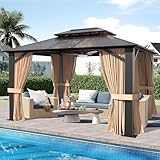
This is the pick for the largest number of readers. SOLUMIA packages a 10 x 12 double-roof polycarbonate canopy, a heavy-duty aluminum frame, mosquito netting and privacy curtains into one listing at the budget end of the market. That combination — full feature set, standard footprint, low entry price — is what makes it the default recommendation rather than a compromise. It suits first-time gazebo buyers, renters with permission to install, and anyone furnishing a patio on a fixed budget who still wants the complete netting-and-curtain experience.
Key specs
- Footprint: 10 x 12 ft, about 120 sq ft
- Roof: double polycarbonate canopy with a raised vent tier
- Frame: heavy-duty aluminum, powder-coated
- Included fabric: both mosquito netting and curtain panels, per the listing
- Price tier: budget
Where the value actually is
The hidden cost in this category is almost never the frame — it is the fabric. Netting and curtain sets bought separately for a 10 x 12 frame commonly run a meaningful fraction of the gazebo’s own price, and mismatched third-party sets often do not fit the curtain track spacing. A listing that includes both layers removes that risk entirely, and it also guarantees the track hardware was designed for the panels you receive.
The double-roof polycarbonate canopy does the same job here as on pricier units: it vents hot air through the gap between tiers and gives rain a controlled path off the roof. At 120 square feet, the interior comfortably holds a six-seat dining table with chairs, or a four-piece lounge set with a coffee table, with enough circulation room to walk around without brushing the netting.
The netting runs the full perimeter and is typically split into zippered panels, so you can open one side for airflow and keep the rest closed against insects at dusk. Curtains hang on a separate track, which is the arrangement you want — it means you can run netting alone on a warm evening, curtains alone on a cool one, or both when you want a genuinely private room.
Pros
- Netting and curtains included, eliminating the biggest hidden cost
- Standard 10 x 12 footprint with widely available replacement parts
- Double polycarbonate roof vents heat and handles rain runoff
- Lowest entry price among the full-package picks in this roundup
- Aluminum frame resists rust without maintenance
Cons
- Budget-tier frame stock and hardware will feel lighter than premium builds
- Polycarbonate panels are more vulnerable to impact than galvanized steel
- Curtain and netting fabric at this price point may fade faster under intense sun
- Fit and finish tolerances are typically looser than on premium units — expect to adjust panels during assembly
How it compares
Against the Breezestival 10×12 premium polycarbonate, SOLUMIA gives up some build refinement and gains the confirmed fabric package at a lower price tier — for most buyers that is the right trade. Against the Aoxun 12 x 10, which is the other budget-tier full package here, SOLUMIA’s polycarbonate double roof and aluminum frame class are a step up in material, while Aoxun counters with a slightly wider 12 ft dimension and a beige finish that hides pollen and dust better. If you want the best materials you can get without moving to premium, this is the pick.
3. Tooluck 10×12 Galvanized Steel Double Roof – Best for Roof Durability

Tooluck’s 10 x 12 is the answer for buyers who have already decided that the roof is the part they refuse to replace. Galvanized steel panels in a brown finish, arranged in a double-roof configuration, over a frame built to carry that extra weight. It suits homeowners in hail-prone regions, areas with heavy snow load, or properties with overhanging trees that drop debris — the situations where a polycarbonate panel eventually cracks or crazes. The footprint stays the familiar 10 x 12, so you are not redesigning your patio to accommodate it.
Key specs
- Footprint: 10 x 12 ft, about 120 sq ft
- Roof: galvanized steel, double-roof (two-tier) configuration
- Finish: brown, which reads as a traditional pavilion rather than a modern glass box
- Fabric: Tooluck offers the netting and curtain set within the same model family — confirm the variant you order includes both
- Price tier: premium
What steel buys you
Galvanized steel is the most weather-tolerant roof material in this roundup short of cedar. The zinc coating sacrifices itself to protect the underlying steel from corrosion, which is why galvanized panels survive decades of rain where painted mild steel would rust through in a few seasons. It also resists impact far better than polycarbonate: hail that would star the surface of a plastic panel typically dents nothing on a steel one, and falling branches are less likely to punch through.
The trade is weight and light. A steel roof is heavier, so the frame and the anchoring both need to be more serious — which is exactly why this sits in the premium tier. And it blocks light rather than diffusing it, so the space beneath reads as deep shade rather than a bright, airy room. In hot climates, that is a benefit; in dim, tree-covered yards, it can make the gazebo feel enclosed even with the curtains open.
The double-roof arrangement matters even more with steel than with polycarbonate. Metal radiates absorbed heat downward, so the vent gap between the upper and lower tiers is what keeps the seating area bearable at midday. Without it, a steel-roofed gazebo becomes unusable in summer afternoons.
Anchoring is non-negotiable here. A heavier roof raises the wind load the structure transfers into its feet, so expansion bolts into a concrete pad, or properly set post bases in a footing, are the minimum. Weighted bases alone are not adequate for this class of roof in exposed locations.
Pros
- Galvanized steel roof resists hail, impact and corrosion far better than polycarbonate
- Handles snow load better than plastic panels when cleared as recommended
- Brown finish suits traditional patio and garden furniture
- Double-roof vent tier keeps the seating area cooler than a single steel panel would
- Standard 10 x 12 footprint keeps accessory sourcing simple
Cons
- Heavier structure — moving it into position before anchoring takes more people
- Blocks light, so the interior is darker than a polycarbonate-roofed equivalent
- Premium price tier, and the fabric set must be confirmed at checkout
- Requires solid anchoring; it is not a structure to set on bare soil
How it compares
Against the Breezestival 10×12 polycarbonate, this is a straight durability-versus-lightness trade: Tooluck wins on roof lifespan and impact resistance, Breezestival wins on brightness, weight and price. Against the Tooluck 10×15, the decision is purely about space — the 10 x 15 adds 30 square feet and roughly two more seats at the table, at the cost of a larger pad and more roof to assemble. If your 10 x 12 pad is already poured, the 10 x 12 is the correct answer; do not stretch a smaller pad to fit a bigger roof.
4. Jolydale 12′ X 16′ with Mosquito Netting and Curtains – Best for Large Patios

At 192 square feet, this is where a gazebo stops being a shaded seating area and becomes an outdoor room. Jolydale’s 12 x 16 hardtop names both the mosquito netting and the curtains directly in its listing, uses a double roof, and sits in the premium tier on frame class. It suits buyers with a large, level patio who want a dining table for eight and a separate lounge corner under one roof, and who are prepared to dedicate a full weekend and three or four people to assembly.
Key specs
- Footprint: 12 x 16 ft — about 192 sq ft, 60 percent more cover than a 10 x 12
- Roof: double (two-tier) hardtop roof with vented upper tier
- Frame: galvanized frame class, sized for the larger span
- Included fabric: mosquito netting and curtain panels, both named in the listing
- Price tier: premium
What 192 square feet actually holds
This is the number that justifies the price. A six-seat dining table with chairs occupies roughly 10 x 6 ft, or 60 square feet, once you account for chairs pulled out. A four-piece lounge set with a coffee table needs about 9 x 7 ft, or 63 square feet. On a 10 x 12 pad, those two groupings do not coexist — you pick one. On a 12 x 16, you can run a dining table down one long side and a lounge corner in the other, with a walking path between them, and still have room for a sideboard or a cooler.
That matters more than it sounds, because it changes how often the structure gets used. A gazebo that only supports one activity is used for that activity. A gazebo that supports dining, lounging and working-from-outside gets used on ordinary weekdays, which is where the real value of a permanent structure shows up.
The larger span also means the roof panels are longer, so drainage design matters more. Long panels need a defined pitch and a clear runoff edge; if the pad is not level and draining away from the structure, water will find the low corner and pool there. Budget for a pad that slopes 1-2 percent away from the gazebo on all sides.
Pros
- 192 sq ft supports two separate seating zones under one roof
- Netting and curtains both named in the listing — no separate purchase
- Double roof vents heat across a large area, which matters at this size
- Galvanized frame class suits permanent installation
- Large curtain walls give genuine privacy from neighbours on two and three sides
Cons
- Premium tier pricing, plus a larger pad to pour or pave
- Assembly is a multi-person, full-weekend job — roof panels are long and awkward on a ladder
- Requires substantial anchoring; the wind load on 192 sq ft of roof is significant
- Overkill for a household that only needs four seats
How it compares
Against the Tooluck 10×15, Jolydale wins on total area — 192 sq ft versus 150 — and on the fact that both fabric layers are named in the listing. The 10 x 15 wins on pad flexibility, since a 10 ft depth fits patios that a 12 ft depth will not, and it stays in the same premium roof-material class. Against the Jocoevol cedar 12 x 16, Jolydale is the lower-maintenance choice: metal and polycarbonate need no staining, sealing or annual inspection, while cedar rewards that work with a look nothing else in this roundup matches.
5. Breezestival 10×12 Permanent Double Polycarbonate – Best for Permanent Cover on a Budget

This is the value version of Breezestival’s 10 x 12. The listing positions it as a permanent outdoor gazebo with a double polycarbonate roof canopy over an aluminum frame — the same material logic as the premium Breezestival above, pitched at the budget tier. It suits buyers who want a structure that stays up through the seasons, who are comfortable sourcing their own netting and curtain set, and who would rather spend the difference on patio furniture than on frame refinement.
Key specs
- Footprint: 10 x 12 ft, about 120 sq ft
- Roof: double polycarbonate canopy, two-tier vented design
- Frame: aluminum, powder-coated, intended for permanent placement
- Fabric: treat the netting and curtain set as a separate purchase unless the variant states otherwise
- Price tier: budget
Where it fits and where it does not
The case for this gazebo is straightforward: you get the roof-and-frame architecture of a permanent structure at the lowest price in Breezestival’s 10 x 12 range. If your priority is shade and rain cover that survives the seasons, and you are willing to buy mosquito netting and curtains separately — or to add them later once the budget recovers — this is an efficient way to allocate money.
The case against it is equally straightforward. Two budget-tier Breezestival listings exist in this roundup, and if the fabric package is what you actually want, the SOLUMIA 10 x 12 delivers the same footprint with both layers included for a comparable outlay. Buying a gazebo and then discovering that a matched curtain set costs a meaningful fraction of the original price is the most common budgeting mistake in this category.
On the physical side, expect the same advantages as any aluminum-framed polycarbonate structure: no rust, moderate weight, light diffusion instead of a dark interior, and a vented double roof that keeps afternoon temperatures manageable. Expect the same limitations too — panel discoloration over years of UV, and the need to clear snow rather than let it sit.
Pros
- Lowest price in this roundup for a 10 x 12 double polycarbonate roof
- Aluminum frame will not rust and needs no painting
- Double-roof canopy vents heat and directs rain runoff
- Permanent-placement intent, so the structure is designed to stay up
Cons
- Netting and curtains are likely a separate purchase
- Budget-tier frame stock and hardware
- Polycarbonate roof is vulnerable to impact and to snow sag
- Fewer refinement details than the mid-range Breezestival at the same footprint
How it compares
Against the mid-range Breezestival 10 x 12, this is the same footprint and roof material with less frame refinement and a lower price — a reasonable trade if you do not need the fabric set. Against the SOLUMIA 10 x 12, the comparison turns on what is in the box: SOLUMIA includes netting and curtains, so for most readers it is the better value at a similar tier. Choose this one if you specifically want the Breezestival frame and roof and intend to add fabric on your own schedule.
6. Tooluck 10×15 Galvanized Steel Double Roof – Best for Larger Gatherings

Same roof, same brown finish, thirty more square feet. Tooluck’s 10 x 15 takes the galvanized steel double-roof build that makes the 10 x 12 the durability pick and stretches it to 150 square feet. It suits buyers who regularly seat eight to ten people, who want the hail and impact resistance of steel, and whose patio depth can accommodate 10 ft but whose width has room for 15. It is the right answer for households that host rather than households that lounge.
Key specs
- Footprint: 10 x 15 ft — about 150 sq ft
- Roof: galvanized steel, double-roof configuration with vented upper tier
- Finish: brown
- Fabric: netting and curtain set offered within the same model family — confirm inclusion at checkout
- Price tier: premium
The sizing logic
The 10 x 15 shape is a specific solution to a specific problem. An eight-seat rectangular dining table runs roughly 8 x 3.5 ft; with chairs pulled out on both long sides, the working footprint is closer to 11 x 7 ft. That fits comfortably under a 10 x 15 roof with room to walk behind the chairs, but it is cramped under a 10 x 12. If your gazebo’s main job is feeding people, the extra 30 square feet is not a luxury — it is what makes the table usable.
What you give up is flexibility in placement. A 15 ft span needs a correspondingly long pad, and on many patios the 15 ft dimension will only fit along one axis. Measure before ordering, and remember to add clearance: eaves and curtain tracks extend beyond the nominal footprint, so plan on 12-18 inches of margin on each side for curtains to hang freely and for air to move.
Structurally, this is the same story as the 10 x 12: heavy steel roof, real anchoring required, dark interior compared with polycarbonate, excellent impact and corrosion resistance. The longer roof panels put slightly more demand on drainage, so verify the pad slopes away from the structure rather than toward it.
Pros
- 150 sq ft comfortably seats eight to ten at a rectangular table
- Galvanized steel roof resists hail, debris and corrosion
- Same proven roof architecture as the smaller Tooluck
- Brown finish matches traditional outdoor furniture
Cons
- Needs a long, level pad — placement options are narrower than a 10 x 12
- Heavier and more awkward to assemble than the 10 x 12, with longer roof panels
- Steel roof blocks light, producing a darker interior
- Premium pricing, and the fabric set should be confirmed
How it compares
Against the Tooluck 10 x 12, this is purely a space decision: identical roof and frame logic, 30 more square feet, a longer pad requirement, and more assembly labour. Against the Jolydale 12 x 16, the 10 x 15 gives up 42 square feet and the confirmed fabric package, but fits patios with a 10 ft depth limit that the Jolydale cannot use. If your constraint is depth rather than budget, the 10 x 15 is the smarter fit.
7. AirWire 8’x8′ Hardtop Aluminum with Curtains & Netting – Best for Small Spaces

Small does not mean compromised. AirWire’s 8 x 8 hardtop aluminum gazebo ships with both curtains and netting, comes in a dark gray finish that reads as contemporary rather than traditional, and covers 64 square feet — enough for two chairs and a small table, or a compact bistro set. It suits apartment and townhouse dwellers with a modest deck, buyers with a tight courtyard, and anyone whose outdoor space is defined by a balcony or a side yard rather than a full patio.
Key specs
- Footprint: 8 x 8 ft — about 64 sq ft
- Roof: hardtop aluminum roof panel
- Frame: aluminum, dark gray finish
- Included fabric: curtains and netting, both named in the listing
- Price tier: budget
What 64 square feet really supports
This is where sizing arithmetic saves money. An 8 x 8 gazebo holds a two-seat bistro table and two chairs with comfortable clearance — roughly 3 ft of table plus 2.5 ft of chair pull-out on each side. It holds a two-piece lounge set with a small side table. It does not hold a four-seat dining table, and it will not hold a sofa plus chairs. If your intended furniture needs more than about 5 x 5 ft of the interior, this is the wrong footprint regardless of how good the price looks.
What it does do well is fit places nothing else will. An 8 x 8 structure can sit on a deck that a 10 x 12 would overhang, and its lighter aluminum roof means the load on deck framing and railings stays modest — a real consideration if you are placing it on a raised wooden deck rather than a ground-level pad. The dark gray finish also hides weathering better than light colors on a structure this small, where every mark is visible.
Curtains on an 8 x 8 do more work than on a larger gazebo. At this size, closing three sides creates a genuinely cosy, wind-protected pocket, which extends the usable season into cooler months. Netting keeps that pocket insect-free without blocking the view.
Pros
- Fits decks, courtyards and side yards that larger gazebos cannot
- Curtains and netting included at a budget price tier
- Light aluminum roof is friendlier to deck framing than a steel roof
- Dark gray finish suits modern furniture and hides weathering
Cons
- 64 sq ft limits furniture to two-seat arrangements
- Aluminum roof panel offers less impact resistance than galvanized steel
- Small footprint means the roof edges are close to seating — expect more splash at the perimeter in rain
- Not a structure for entertaining groups
How it compares
Against the SOLUMIA 10 x 12, AirWire gives up 56 square feet and the double polycarbonate roof, but fits spaces the larger gazebo physically cannot occupy and costs less. Against the AECOJOY 10 x 8 lean-to, the choice is freestanding versus wall-mounted: AirWire can go anywhere on a deck, while the AECOJOY requires a suitable wall and returns 80 square feet in exchange for that constraint. If you have a wall, the lean-to is more space for similar money; if you do not, AirWire is the answer.
8. Kozyard Privacy Screen Netting for 10′ x 12′ Gazebo – Best for Upgrading a Gazebo You Already Own
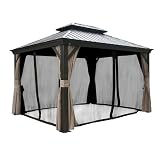
Not every problem needs a new gazebo. Kozyard’s privacy screen netting is an accessory sized for 10 x 12 ft frames — a replacement or upgrade fabric set rather than a structure. It suits two kinds of reader: the owner of an existing 10 x 12 hardtop whose original curtains have faded, torn or lost their zippers, and the buyer who purchased a frame-and-roof-only gazebo and now wants the privacy layer without replacing the whole thing.
Key specs
- Type: accessory fabric set — screen netting only, no frame, no roof
- Sizing: designed for 10 x 12 ft gazebo frames
- Purpose: privacy screening and insect exclusion around the perimeter
- Price tier: budget
Why accessories deserve their own line item
Fabric is the first thing to wear out on any gazebo, and it wears out years before the frame or roof does. Netting zippers fail from grit and UV. Curtain fabric fades unevenly on the sun-facing side, so a set that looked uniform in year two looks mismatched by year five. Panel seams separate under wind load. None of that means the gazebo is finished — it means the consumable layer needs









