Our Top Picks


The best press fitting tool for most buyers is the iCrimp IWS-1632CF Copper Pipe Press Tool Kit. It covers the three sizes that account for the overwhelming majority of residential copper work — 1/2-inch, 3/4-inch and 1-inch — in a single battery-driven kit, and it is built around Viega Propress compatibility, which is the fitting system most North American plumbers already carry on the van. A mainstream fitting system, a complete jaw set and cordless operation in one box is what makes it the default recommendation for working plumbers, remodelers and committed DIYers who expect to press more than a handful of joints a year. If you press fewer than twenty joints annually and want the lowest possible entry cost, a manual hydraulic tool in the budget tier does the identical job with more effort per joint. If your work runs to HVAC/R refrigerant lines, or to stainless press sleeves rather than potable-water copper, a specialist or dual-system tool is the better fit — those are covered further down, along with the budget and premium alternatives that beat the overall pick on price or on speed.
Top 3 Picks
Best overall: iCrimp IWS-1632CF Copper Pipe Press Tool Kit. It bundles 1/2-inch, 3/4-inch and 1-inch capability with Viega Propress compatibility and battery drive, so it handles the three sizes that make up the bulk of residential and light commercial copper work without a separate purchase. It is the tool to buy if you want one box that covers most jobs and you would rather not pump a handle fifty times per joint. It suits working plumbers, remodelers and serious DIYers doing a repipe.
Best budget: VEVOR Copper Pipe Crimping Tool. A hydraulic-driven press tool with 1/2-inch, 3/4-inch and 1-inch jaws for VUS-type copper pipe, it delivers the same three core sizes at the lowest cost of entry in this roundup. You trade cordless convenience and cycle speed for a much smaller outlay, which is the right trade for occasional repairs, rental property maintenance and a backup tool that lives in the truck. It suits homeowners and maintenance techs who press a few joints a year.
Best premium: ROGVOC Copper Press Tool, 18V with 3 VUS Jaws. An 18V cordless press tool with the three core jaws, built for speed, one-handed operation and repeatable press cycles rather than lowest cost. It suits full-time trades who measure a tool in jobs per week, not joints per year. If you also press stainless sleeves, the Growlush 18V cordless kit is the premium alternative with wider system coverage.
Best for HVAC/R: iCrimp Copper Tube Press Tool 1/4-inch to 7/8-inch. Refrigerant lines run in small-diameter ACR copper, not the 1/2-inch-to-1-inch potable sizes, so a dedicated small-die tool is the correct purchase for that work. It suits HVAC technicians and refrigeration contractors who press line sets rather than water pipe.
Quick Comparison
| Product | Best for | Jaw / die sizes named in the listing | Drive type | Notable specs | Price tier |
|---|---|---|---|---|---|
| iCrimp IWS-1632CF Copper Pipe Press Tool Kit | Viega Propress copper work; the all-round pick | 1/2″, 3/4″, 1″ | Battery-driven kit | Viega Propress compatibility; complete kit form factor | Mid-range |
| iCrimp Copper Pipe Press Tool, Dual-Drive Crimper | Working without a battery pack | 1/2″, 3/4″, 1″ | Dual-drive (lever/hydraulic class) | Same three core copper sizes; no battery dependency | Mid-range |
| VEVOR Copper Pipe Crimping Tool | Lowest-cost entry into hydraulic pressing | 1/2″, 3/4″, 1″ | Manual hydraulic | VUS-type copper pipe jaws; three core sizes | Budget |
| Growlush Pro Press Copper and PEX Crimper Kit | Budget buyers who also need PEX | 1/2″, 3/4″, 1″ copper plus ASTM F1807 PEX | Kit with 8 dies | 8-die set; dual-system coverage in one box | Budget |
| Growlush Copper Pipe Crimping Tool (Hydraulic) | Single-purpose copper pressing on a budget | 1/2″, 3/4″, 1″ | Manual hydraulic | Three core copper jaws; copper tube fittings | Budget |
| ROGVOC Copper Press Tool | Cordless speed and one-handed work | 3 VUS jaws (1/2″, 3/4″, 1″ class) | 18V cordless | 18V platform; three VUS jaw profiles | Premium |
| Growlush 18V Cordless Pro Press Tool | Mixed copper and F877 stainless PEX sleeve work | 1/2″, 3/4″, 1″ | 18V cordless | Copper plus F877 stainless PEX press sleeves | Premium |
| iCrimp Copper Tube Press Tool 1/4″–7/8″ | HVAC/R refrigerant lines | 1/4″, 3/8″, 1/2″, 5/8″, 3/4″, 7/8″ class | Press tool for small-diameter ACR copper | Small-die range for line sets, not water pipe | Premium |
| AMZCNC Pipe Press Tool | Widest combined die coverage in one tool | 1/2″, 3/4″, 1″ copper plus F877 stainless PEX sleeves; 3/8″, 1/2″, 5/8″, 3/4″, 1″ listed | Press tool with multi-die set | Copper and stainless sleeve coverage from 3/8″ to 1″ | Mid-range |
How We Chose
This roundup was assembled from published listing specifications, manufacturer documentation and established norms for the press-fitting category — not from physical trials. Every product here had to meet four tests. First, pipe-system compatibility: a press tool is only as useful as the fittings it can legally and reliably press, so tools were grouped by whether they serve copper press systems, ASTM F1807 PEX crimp rings, F877 stainless press sleeves, or small-diameter HVAC/R copper, and each entry is described against the system its listing names. Second, jaw and die coverage measured against real job sizes: 1/2-inch, 3/4-inch and 1-inch dominate residential work, so a three-jaw tool is a complete kit for most buyers, while multi-die sets were assessed on how much additional ground they cover. Third, drive type and the practical consequences that follow from it — manual hydraulic tools cost less and never run flat but take far longer per joint, while 18V cordless tools trade a battery and charger for cycle speed and one-handed use. Fourth, ownership realities: accessory completeness, jaw wear, hydraulic seal service, battery replacement cost and the upgrade path from a first tool to a professional one. Price tiers reflect the general market band each tool sits in rather than a fixed figure, because listing prices move constantly.
1. iCrimp IWS-1632CF Copper Pipe Press Tool Kit – Best for Viega Propress Copper Work
As an Amazon Associate we earn from qualifying purchases at no extra cost to you.

This is the tool to buy if you want one box that handles the three sizes you will actually press, on the fitting system you are most likely to find at the supply house. The kit is built around Viega Propress compatibility and battery drive, and it covers 1/2-inch, 3/4-inch and 1-inch fittings. That size trio is not a compromise — it is the working range. On a typical residential repipe, 1/2-inch covers fixture branches, 3/4-inch covers room-level distribution and 1-inch covers the main run from the meter or water heater. A tool that presses all three covers the job end to end, which is why this kit takes the overall pick rather than any of the cheaper hydraulic options.
Who it suits. Working plumbers and remodelers who press weekly, and homeowners or property managers tackling a full repipe where the labor saving on 60-plus joints is worth the tool cost. It also suits anyone who has standardized on Viega Propress fittings, because jaw profile and fitting system must match — a jaw made for one manufacturer’s press system is not interchangeable with another’s, and pressing across systems is the fastest way to a warranty argument and a leaking joint.
Key specifications as listed.
- Fitting compatibility: Viega Propress press fittings
- Jaw sizes included: 1/2-inch, 3/4-inch, 1-inch
- Drive: battery-driven press tool (cordless kit class)
- Form factor: complete kit, with the jaw set and tool supplied together rather than as separate purchases
- Typical press cycle in this class: a few seconds per joint once the jaw is seated, with the tool doing the force work rather than the operator
Strengths. The single biggest advantage is that the three jaws arrive together. Buying jaws individually is where first-time press tool buyers get surprised — a bare tool plus three jaws frequently costs more than a bundled kit, and you can end up mid-job with the wrong die. Battery drive removes the pump-handle fatigue that dominates manual hydraulic work; on a 60-joint repipe that is the difference between a job that finishes in an afternoon and one that finishes the next morning. Viega Propress compatibility also means consumables are easy to source, and press fittings from a major system carry published press profiles and tool compatibility documentation, which matters for inspection and for insurance.
Pros
- All three core copper sizes in one purchase — no mid-job die shopping
- Viega Propress compatibility aligns with the most widely stocked press system in North America
- Battery drive means fast, repeatable, one-person presses with no pump fatigue
- Kit form factor keeps jaws, tool and case together, which reduces lost-die downtime
- Scales from a homeowner’s repipe to light commercial service work
Cons
- Mid-range tier cost is meaningfully above the manual hydraulic budget options
- Battery platform ties you to the brand’s charger and packs — a second battery is an extra purchase
- Three jaws stop at 1 inch; commercial work in 1-1/4-inch and larger needs additional jaws or a different tool
- Like every press tool, it requires jaw care, periodic seal service and clean, correctly inserted fittings to press reliably
- Cordless tools need charge planning on large jobs; a spare pack is effectively part of the kit
How it compares with the nearest alternative. The closest rival in this list is the iCrimp dual-drive crimper, which covers the same 1/2-inch, 3/4-inch and 1-inch range at the same mid-range tier but does not depend on a battery. If you work in occupied buildings where charging is awkward, in remote locations, or you simply do not want a second battery platform in your van, the dual-drive tool is the smarter buy. If you press often and value cycle speed, the IWS-1632CF wins. Against the VEVOR and Growlush hydraulic tools, this kit costs more but removes the per-joint pumping that defines those tools — and against the premium 18V options, it gives up some refinement and system coverage for a lower tier price.
2. iCrimp Copper Pipe Press Tool, Dual-Drive Crimper – Best for Working Without a Battery

This is the same three core sizes as the kit above — 1/2-inch, 3/4-inch and 1-inch — packaged around a dual-drive design instead of a battery. That distinction is the whole reason to choose it. A dual-drive press tool pairs a lever-actuated hydraulic pump with a ram, so the operator supplies the energy through the handle rather than drawing it from a pack. In practice you get hydraulic press force without a charger, without a battery that ages, and without a second cordless platform in the truck. For a lot of buyers that is a feature, not a compromise.
Who it suits. Plumbers and maintenance technicians who work in buildings with no convenient power, on remote or rural sites, or in occupied homes where running an extension cord to a charger is more trouble than it is worth. It also suits buyers who already own one cordless platform and refuse to add another, and anyone who wants a tool that will still work after five years in a truck bed without a battery replacement. Finally, it suits the buyer who presses enough to want hydraulic force but not enough to justify the premium cordless tier.
Key specifications as listed.
- Fitting sizes: 1/2-inch, 3/4-inch, 1-inch
- Drive: dual-drive crimper — a lever and hydraulic arrangement rather than a battery pack
- Category: manual hydraulic press tool class
- Consumables: hydraulic seals and fluid are the wear items; no batteries to replace
- Portability: no charger, no spare pack, no mains dependency
Strengths. The absence of a battery is a genuine reliability advantage. Battery packs are the most common failure point on cordless tools: cells lose capacity, chargers get lost, and a pack left discharged in a cold van is useless when you need it. A lever-and-hydraulic tool has none of that. It also tends to be simpler to store and cheaper to keep running long-term, since a seal kit costs far less than a replacement battery over a decade of ownership. And because there is no motor or electronics, there is less to go wrong in dusty, wet or freezing conditions — crawl spaces, basements and exterior meter pits are exactly where cordless tools are least happy.
Pros
- No battery, no charger, no cordless platform lock-in
- Covers the three sizes that do the bulk of residential copper work
- Works anywhere, including unpowered sites and occupied buildings
- Lower long-term consumable cost than a cordless tool — seals instead of packs
- Simple, robust construction with few electronic failure points
Cons
- Slower per joint than an 18V cordless tool — the operator supplies the pumping effort
- Higher physical effort per press, which compounds over a long day of large-diameter work
- Hydraulic seals and fluid still need periodic service, and a neglected tool loses force
- Stops at 1 inch, like most three-jaw tools
- On a 100-joint day the time and fatigue gap against a cordless tool becomes significant
How it compares with the nearest alternative. Against the iCrimp IWS-1632CF kit, the choice is speed versus independence: identical size coverage and tier, different energy source. Against the VEVOR and Growlush hydraulic tools, this sits a tier higher and is worth it if you want a tool built for regular use rather than occasional repairs. Against the ROGVOC 18V, it loses on cycle time but wins on never needing a charge — and that single fact decides the purchase for a lot of service techs who have been stranded by a flat pack at 4pm.
3. VEVOR Copper Pipe Crimping Tool – Best Budget Hydraulic Press Tool

The VEVOR crimping tool is the cheapest sensible way into hydraulic pressing. It is a hydraulically driven press tool with 1/2-inch, 3/4-inch and 1-inch jaws for VUS-type copper pipe — the same three sizes the mid-range and premium tools cover, at the lowest tier in this roundup. That is the entire pitch, and for a large group of buyers it is the right one: you get hydraulic press force and the three core sizes without paying for a battery, a charger or a case.
Who it suits. Homeowners facing one repipe or one major repair, rental property owners and maintenance staff who press a handful of joints a year, and anyone who wants a spare press tool to keep in a truck or a shop as a backup. It is also a sensible first press tool for a DIYer who is not yet sure how often they will use one. If you press two joints a month, the per-joint time penalty of a manual hydraulic tool is irrelevant; if you press forty a week, it is not, and you should be reading the cordless sections instead.
Key specifications as listed.
- Jaw sizes: 1/2-inch, 3/4-inch, 1-inch
- Drive: hydraulic driven press tool (manual pump class)
- Fitting system: VUS-type copper pipe jaws
- Power requirement: none — no battery, no cord
- Price tier: budget
Strengths. Cost of entry is the headline. For the price of a premium tool’s spare battery, you get a complete hydraulic press capability in the three sizes that matter. Because it is manual, it never runs flat and never needs a charger — useful in basements, crawl spaces and exterior pits where power is a nuisance. It is also mechanically simple, which means fewer things to fail, and its low cost makes it a legitimate second tool to keep as insurance against a mid-job breakdown. For the occasional user, the force delivered is the same order of magnitude as the cordless tools; the difference is who supplies the energy.
Pros
- Lowest tier cost of any tool in this roundup
- Covers 1/2-inch, 3/4-inch and 1-inch — the residential working range
- No battery, no charger, no power source needed on site
- Simple hydraulic mechanism with few electronic failure points
- Good backup or second tool for a working van
Cons
- Manual pumping makes each press considerably slower and more tiring
- Budget-tier build and finish are not intended for daily professional use
- Jaws are specific to the listed VUS-type profile — verify your fitting system before buying
- No battery means no automatic cycle completion, so the operator must confirm full press pressure every time
- Accessories and case are typically minimal at this tier, so you may need to add storage
How it compares with the nearest alternative. The Growlush hydraulic copper tool is the closest match: same budget tier, same three copper sizes, same manual hydraulic drive. The difference comes down to jaw profile and what your local fittings require, plus whichever listing currently offers better accessory content. Against the Growlush 8-die kit, this tool loses on coverage — that kit adds ASTM F1807 PEX capability — but wins on simplicity if you only ever touch copper. And against the iCrimp dual-drive at the mid-range tier, it is the cheaper way to get hydraulic force, with the trade-off being build quality and service life.
4. Growlush Pro Press Copper and PEX Pipe Crimper Kit – Best Budget Kit with the Widest Die Coverage

This kit is the value play in the budget tier. It ships with an eight-die set covering 1/2-inch, 3/4-inch and 1-inch copper pipe plus ASTM F1807 PEX, which means one box can serve two different pipe systems that often appear in the same house. If you are renovating a property where copper feeds the water heater and PEX runs the branches — which is extremely common in homes built or remodeled over the last thirty years — a single kit that handles both saves you from buying two tools or hiring out half the job.
Who it suits. DIYers and remodelers working on their own property, landlords maintaining a mixed-system portfolio, and budget-conscious buyers who want maximum capability per dollar rather than maximum speed. It is also a reasonable starter kit for someone learning press and crimp work, because the die count lets you practice on both systems without additional purchases.
Key specifications as listed.
- Die count: 8 dies in the set
- Copper sizes: 1/2-inch, 3/4-inch, 1-inch
- PEX standard: ASTM F1807 PEX
- System coverage: copper press and PEX crimp in one kit
- Price tier: budget
Strengths. Die count is the differentiator. Buying eight dies separately at any tier is expensive, and coverage gaps are the most common reason a first press tool purchase turns into a second purchase within a month. Because the kit spans copper press and ASTM F1807 PEX, it also reflects how real plumbing work is done: press fittings on copper, crimp rings on PEX, often in the same wall cavity. One kit, one case, one learning curve. For a homeowner doing a full bathroom or kitchen rough-in, that breadth is worth more than the cycle-speed advantage of a cordless tool they will use twice a year.
Pros
- Eight dies in one purchase — the widest coverage at the budget tier
- Covers 1/2-inch, 3/4-inch and 1-inch copper, the residential working range
- Adds ASTM F1807 PEX capability, so mixed-system homes need only one tool
- Kit form factor keeps all dies together, which prevents mid-job gaps
- Budget tier cost makes it accessible for one-off renovation projects
Cons
- Note that PEX crimp rings and press jaws are different operations — the PEX side of this kit is a crimp interface per ASTM F1807, not a press jaw, and the two are not interchangeable
- Die changeovers add setup time between systems on a busy job
- Budget-tier construction is not aimed at daily professional volume
- More dies means more parts to lose or damage; a missing die stalls the job
- Verify jaw and die profiles against your specific fitting brands before committing to a whole-house job
How it compares with the nearest alternative. Against the VEVOR hydraulic tool, this kit is the better buy for anyone with PEX in the building — the VEVOR covers only the copper trio. Against the Growlush single-purpose hydraulic copper tool, the 8-die kit costs a little more but roughly doubles your system coverage. And against the AMZCNC mid-range multi-die tool, it gives up some tier-level build and the stainless PEX sleeve range but stays firmly in the budget band, which is the point of this section.
5. Growlush Copper Pipe Crimping Tool – Best Budget Single-Purpose Hydraulic for Copper Only

This is the focused version of the Growlush budget line: a hydraulically driven press tool with 1/2-inch, 3/4-inch and 1-inch jaws for copper tube fittings, and nothing else. No PEX dies, no stainless sleeves, no battery. If your work is copper and only copper, the simplicity is a virtue — there is less to learn, less to lose, and less to go wrong. It sits in the same budget tier as the VEVOR and the Growlush 8-die kit, which makes the choice between them a question of scope rather than quality.
Who it suits. Homeowners and maintenance techs with all-copper plumbing, older properties where PEX has never been introduced, and buyers who want a dedicated copper press tool without paying for capability they will never use. It also suits anyone building a small kit around one system, and buyers who prefer a lighter, simpler tool over a multi-die case they have to dig through.
Key specifications as listed.
- Jaw sizes: 1/2-inch, 3/4-inch, 1-inch
- Drive: hydraulic driven press tool (manual pump class)
- Application: copper tube fittings
- Power requirement: none
- Price tier: budget
Strengths. Focus. Three jaws and one job means fast setup and no die-selection mistakes — and die-selection mistakes are one of the leading causes of failed presses. Because it is hydraulic and manual, it works anywhere and never needs charging, and its simplicity means the maintenance schedule is short: keep the jaws clean, keep the hydraulic system sealed, and store it dry. For an all-copper house, this tool plus a supply of press fittings replaces a torch, flux, solder and the fire-watch that comes with sweating pipe in a finished wall cavity.
Pros
- Lowest tier cost with full 1/2-inch, 3/4-inch, 1-inch copper coverage
- No battery or power source required
- Simple, focused tool with a short learning curve
- No torch, flux or open flame — a real advantage inside finished walls and near framing
- Fewer parts to lose than a multi-die kit
Cons
- No PEX capability at all — mixed-system homes will need a second tool
- Manual pumping is slow and tiring compared with an 18V cordless tool
- Budget-tier construction and finish suit occasional use, not daily production
- Jaw profile must match your fitting system; confirm before purchase
- Stops at 1 inch, so larger commercial copper needs another tool entirely
How it compares with the nearest alternative. The VEVOR is the direct equivalent — same tier, same three copper jaws, same manual hydraulic drive — so the deciding factors are jaw profile compatibility and whichever listing includes better accessories. The Growlush 8-die kit is the more capable sibling for a modest step up in cost, and it is the better choice if there is any chance you will touch PEX within the next few years. Against the mid-range iCrimp dual-drive, this tool is the cheaper route to hydraulic force with a shorter expected service life under heavy use.
6. ROGVOC Copper Press Tool – Best Premium Cordless for Speed and One-Handed Work

The ROGVOC is the tool you buy when the press is no longer the interesting part of the job. It is an 18V cordless copper press tool supplied with three VUS jaws, covering the standard 1/2-inch, 3/4-inch and 1-inch range. Everything about it is oriented toward cycle speed and one-handed operation: you seat the jaw, pull the trigger, wait a few seconds for the press to complete, and move on. On a production job, that rhythm is the entire value proposition.
Who it suits. Full-time plumbers, service technicians and mechanical contractors who press daily and measure tool value in jobs completed rather than dollars saved. It also suits anyone working overhead or in confined spaces, where holding a tool steady with one hand while the other manages the fitting is not a convenience but a requirement. If you are pressing fewer than fifty joints a year, the premium tier is hard to justify — the budget hydraulic tools in this list will do the work, just more slowly.
Key specifications as listed.
- Battery platform: 18V cordless
- Jaws: 3 VUS jaw profiles (1/2-inch, 3/4-inch, 1-inch class)
- Cycle: powered press cycle measured in seconds, with the tool supplying force
- Operation: one-handed, suitable for overhead and confined-space work
- Price tier: premium
Strengths. Speed is the headline, but reliability of the cycle is the real benefit. A powered press runs to a set force and completes automatically, which removes the operator-judgment element that manual hydraulic tools require — you do not have to feel for full pressure. That consistency matters for inspection and for warranty purposes. One-handed operation changes what is possible in tight spaces: you can position a fitting, seat the jaw and press without needing a third hand or a helper. And on any job with more than about thirty joints, the time saving over manual pumping is substantial enough to change when you go home.
Pros
- 18V cordless power removes pump fatigue entirely
- Fast, repeatable press cycles with automatic completion
- Three VUS jaws cover the residential working range out of the box
- One-handed operation suits overhead and confined-space work
- Premium-tier build is intended for daily professional duty
Cons
- Premium tier cost is the highest in the copper-focused group
- Runtime depends on battery capacity and jaw size — large-diameter presses draw the most, so a spare pack is effectively mandatory on big jobs
- Battery and charger add ongoing cost and eventually need replacing
- Three jaws stop at 1 inch; larger commercial sizes need additional jaws
- Electronics and motor introduce failure points that a manual hydraulic tool does not have
How it compares with the nearest alternative. The Growlush 18V cordless tool is the closest rival and covers both copper and F877 stainless PEX press sleeves — so if your work includes stainless, that tool wins on scope at the same tier. If your work is copper only, the ROGVOC is the more focused purchase. Against the mid-range iCrimp IWS-1632CF kit, the ROGVOC costs more and buys cycle speed, one-handed operation and premium build; for a hobbyist that is a poor trade, and for a full-time plumber it is the whole point.
7. Growlush 18V Cordless Pro Press Tool – Best Premium for Mixed Copper and Stainless PEX Sleeve Work

This tool’s distinguishing feature is scope. It is an 18V cordless press tool with 1/2-inch, 3/4-inch and 1-inch dies, and it is listed for both copper pipe and F877 stainless PEX press sleeves. That combination puts it in a category of its own among the premium cordless tools here: most 18V press tools cover copper, and a few cover copper plus stainless sleeves, but buyers frequently end up owning two tools because they assumed one would not do both. If your work regularly crosses between copper distribution and stainless-sleeve PEX systems, this is the single-tool answer.
Who it suits. Service plumbers and mechanical contractors in buildings that mix systems — which describes most commercial and institutional service work. It also suits remodelers who do not want to carry two tools or two battery platforms, and anyone standardizing on one cordless kit for a van. If your work is exclusively copper, you are paying for coverage you will not use; the ROGVOC is the more focused premium choice.
Key specifications as listed.
- Battery platform: 18V cordless
- Dies: 1/2-inch, 3/4-inch, 1-inch
- System coverage: copper pipe plus F877 stainless PEX press sleeves
- Cycle: powered press, tool-supplied force
- Price tier: premium
Strengths. Dual-system coverage is the value. Press sleeves for PEX systems and press jaws for copper are different interfaces, and buying both capabilities separately pushes you into two tool purchases, two battery platforms and two cases. Consolidating into one 18V tool simplifies the van, the charger situation and the training. Cordless operation also delivers the usual premium benefits: fast cycles, automatic press completion, one-handed use, and no pump fatigue across a long service day. For a contractor whose jobs routinely cross systems, that consolidation is worth more than any single-spec advantage.
Pros
- Covers copper and F877 stainless PEX press sleeves in one tool
- 18V cordless speed with automatic, consistent press completion
- Three dies cover the 1/2-inch to 1-inch residential and light commercial range
- Reduces tool count and battery platforms for mixed-system contractors
- Premium build intended for daily professional use
Cons
- Premium tier cost — the highest band in this roundup
- Battery runtime still limits long days; a second pack is a practical necessity
- You pay for system coverage that copper-only users will never need
- Die range stops at 1 inch for copper work
- Cordless tools require charge planning and eventual battery replacement
How it compares with the nearest alternative. Against the ROGVOC 18V, the trade is straightforward: same tier, same cordless speed, but this tool adds F877 stainless PEX press sleeve capability while the ROGVOC is a copper-focused three-jaw tool. Against the AMZCNC mid-range tool — which also lists copper and F877 stainless PEX sleeve coverage, with sizes spanning 3/8-inch to 1-inch — this Growlush is the more expensive option, and the AMZCNC becomes the better value if you want maximum die breadth without paying premium-tier prices.
8. iCrimp Copper Tube Press Tool 1/4″–7/8″ – Best for HVAC/R Refrigerant Lines
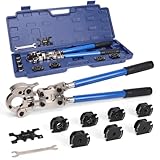
Refrigerant work is a different discipline from water pipe, and this tool exists because of it. It is a copper tube press tool for the 1/4-inch to 7/8-inch range, sized for HVAC/R line sets rather than 1/2-inch-to-1-inch potable water. If you are pressing refrigerant lines, the residential water-pipe tools in this list are simply the wrong diameter — a 1-inch jaw has no application on a 3/8-inch liquid line. Conversely, this tool cannot do a domestic water repipe. Buying the right diameter range is the first decision in this category, and it is the one buyers most often get wrong.
Who it suits. HVAC and refrigeration technicians, and contractors doing line-set installation or repair where brazing is impractical — inside finished walls, near combustible materials, or in occupied spaces where an open torch is unwelcome. It also suits mechanical contractors adding press capability for refrigerant work alongside their plumbing tools, and anyone working on equipment where a controlled, repeatable joint beats a torch joint for speed.
Key specifications as listed.
- Size range: 1/4-inch to 7/8-inch copper tube
- Application: HVAC/R refrigerant lines
- Category: small-diameter copper press tool
- Typical sizes in this range: 1/4-inch, 3/8-inch, 1/2-inch, 5/8-inch, 3/4-inch, 7/8-inch ACR copper
- Price tier: premium
Strengths. Small-diameter work is where press tools are at their most attractive. Line sets are short, joints are numerous, and many are in positions where brazing means shielding, a fire watch and a lot of time. A press tool turns those joints into a few seconds each with no flame, no nitrogen purge setup for the joint itself, and no heat damage risk to nearby components. The narrow die range also keeps the tool lighter and better balanced than a full-size water-pipe press tool, which matters when you are working overhead on a rooftop unit or inside a mechanical closet. And because refrigerant lines are small, press cycles are quick and battery runtime per charge is generous.
Pros
- Correct diameter range for HVAC/R line sets, where water-pipe tools do not apply
- No open flame — a major advantage inside walls and near combustibles
- Fast, repeatable joints on small-diameter ACR copper
- Lighter and more maneuverable than a full-size press tool
- Generous presses per charge because the dies are small
Cons
- Cannot press the 1/2-inch-to-1-inch sizes used for domestic water distribution at scale
- Premium tier pricing for a tool with a narrow application
- Refrigerant work has its own code, certification and system-specific fitting requirements — press fittings must be rated for the application
- Jaw profiles must match the fittings specified for the system; substituting is not acceptable on refrigerant circuits
- Not a substitute for proper evacuation, charging and leak-testing procedures
How it compares with the nearest alternative. There is no direct competitor in this list, which is exactly the point: every other tool here is built around the water-pipe sizes. The closest overlap is the AMZCNC mid-range tool, whose listed die range runs from 3/8-inch to 1-inch and therefore touches the small end of this tool’s range — but it is designed around copper and stainless sleeve systems rather than refrigerant line sets, so it is not a like-for-like substitute. If you work across both water pipe and refrigeration, you will own two tools; if you only press line sets, this is the one to buy.
9. AMZCNC Pipe Press Tool – Best Mid-Range for the Widest Combined Die Coverage

The AMZCNC tool is the coverage play at the mid-range tier. It is listed with dies for 1/2-inch, 3/4-inch and 1-inch copper pipe plus F877 stainless PEX press sleeves, with sizes spanning 3/8-inch, 1/2-inch, 5/8-inch, 3/4-inch and 1-inch. In practice that means one tool can handle copper distribution work and stainless sleeve systems, and it reaches down to 3/8-inch — a size most three-jaw copper tools do not touch. If you want the broadest die range without moving into the premium band, this is where to look.
Who it suits. Remodelers and service plumbers who cross between copper and stainless PEX sleeve systems, buyers who want one tool rather than two, and anyone whose work occasionally includes small-diameter runs that a 1/2-inch-minimum tool would leave uncovered. It also suits the buyer who has been burned by coverage gaps before and would rather over-buy dies once than shop mid-job.
Key specifications as listed.
- Copper dies: 1/2-inch, 3/4-inch, 1-inch
- Stainless PEX press sleeves: F877
- Listed size span: 3/8-inch, 1/2-inch, 5/8-inch, 3/4-inch, 1-inch
- System coverage: copper pipe plus F877 stainless PEX press sleeves
- Price tier: mid-range
Strengths. Die breadth at a mid-range price is the whole argument. Buying the equivalent coverage from a premium cordless brand usually means paying premium prices for each die group, and coverage gaps are expensive in a different way — a stalled job waiting on a die costs more than the die. Reaching down to 3/8-inch also covers small-bore runs that three-jaw copper tools miss. Mid-range construction is generally a step up from the budget hydraulic tools in durability and finish, without the cordless premium. And like the premium tools, it addresses both copper and stainless sleeve systems, which is the direction a lot of service work has moved.
Pros
- Widest listed die span in this roundup, from 3/8-inch to 1-inch
- Covers copper pipe and F877 stainless PEX press sleeves
- Mid-range tier cost rather than premium
- Reduces the need to own two separate tools for mixed-system work
- Small-diameter coverage that three-jaw copper tools do not offer
Cons
- More dies means more changeover time and more parts to keep track of
- Not a cordless premium tool — cycle speed and one-handed convenience will not match an 18V unit
- Verify every die profile against your specific fitting brands; breadth is only useful if the profiles match
- Stainless sleeve and copper press operations use different interfaces, so correct die selection is critical
- Large die sets benefit from organized storage to avoid losing the die you need
How it compares with the nearest alternative. The Growlush 18V cordless tool covers the same two systems at the premium tier, so the AMZCNC is the value route to dual-system capability — you give up cordless speed and one-handed operation, and you save the premium premium. Against the Growlush 8-die budget kit, the AMZCNC costs more but reaches down to 3/8-inch and is built at a higher tier. Against the iCrimp IWS-1632CF, it adds stainless sleeve and small-diameter coverage but gives up the Viega Propress alignment that matters if your fittings come from that system.