
Best Shoe Storage Cabinets for Small Spaces & Entryways
The best shoe storage cabinets are slim, ventilated, and sized to your actual shoe count: choose a 9–12 inch deep flip-drawer cabinet for narrow entryways, a 14–16 inch deep adjustable-shelf cabinet for larger shoes and boots, or a closed modular unit when capacity matters more than floor space.
Quick picks by entryway situation
| Situation | Best cabinet type | Useful capacity | Target dimensions | Why it fits |
|---|---|---|---|---|
| Narrow hallway, 1–2 people | Two-column flip drawer cabinet | 12–18 pairs | 24–32 in wide × 9–12 in deep × 40–48 in high | Uses vertical space without projecting far into the walkway |
| Family entryway, 3–4 people | Wide adjustable-shelf cabinet | 20–32 pairs | 30–40 in wide × 14–16 in deep × 36–48 in high | Handles different shoe sizes and gives better access to everyday footwear |
| Small apartment, frequent visitors | Stackable modular cabinet | 16–24 pairs per module | Each module about 24–32 in wide × 12–16 in deep | Can expand upward or sideways as storage needs change |
| Boots, trainers, and large footwear | Open-front or tall cabinet with adjustable shelves | 12–24 pairs | 30–36 in wide × 14–18 in deep × 36–72 in high | Allows shelf heights of 8–12 inches instead of forcing footwear into fixed slots |
| Lowest budget | Engineered-wood cubby cabinet | 12–24 pairs | 24–36 in wide × 12–16 in deep × 24–48 in high | Usually costs less than solid wood or metal while offering predictable capacity |
How much shoe storage do you actually need?
Cabinet capacity is often overstated because manufacturers count very small adult shoes or assume that every compartment holds one pair neatly. For a more realistic estimate, count the pairs that normally live near the entryway, then add 20% for seasonal changes, bulkier footwear, and household growth.
Our top picks
 VASAGLE Narrow Shoe Storage Cabinet Organizer with
- Versatile Farmhouse Charm: This shoe cabinet features barn‑door…
- Space‑Saving Design: This narrow shoe organizer features flip…
- Large Capacity: The shoe cupboard holds 14-16 pairs…
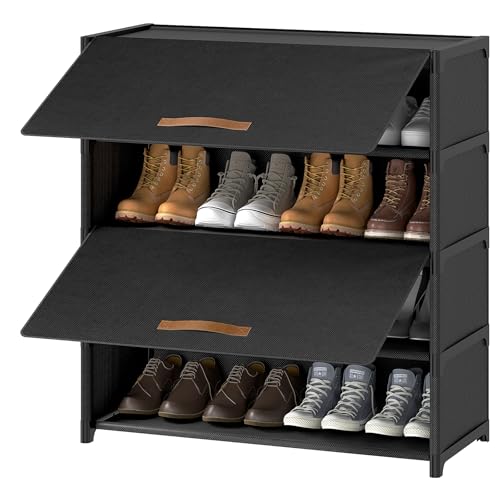
 GRUSIGN Shoe Cabinet
- 【Spacious Storage Capacity】 This hidden shoe cabinet features…
- 【Flip-Door Design for Easy Access】 Equipped with 2…
- 【Perfect for Small Spaces】 Designed to maximize space…
 UNITSTAGE 5 Tier Shoe Cabinet with Door
- 5 Tier Shoe Rack: UNITSTAGE 20 Pair shoe…
- Sturdy Shoe Shelf: The storage organizer is made…
- Dustproof & Prevent Pets from Chewing Shoes: All…
| Product | Key specs | |
|---|---|---|
| VASAGLE Narrow Shoe Storage Cabinet Organizer with | Versatile Farmhouse Charm: This shoe cabinet features barn‑door… Space‑Saving Design: This narrow shoe organizer features flip… Large Capacity: The shoe cupboard holds 14-16 pairs… | Check price |
| GRUSIGN Shoe Cabinet | 【Spacious Storage Capacity】 This hidden shoe cabinet features… 【Flip-Door Design for Easy Access】 Equipped with 2… 【Perfect for Small Spaces】 Designed to maximize space… | Check price |
| UNITSTAGE 5 Tier Shoe Cabinet with Door | 5 Tier Shoe Rack: UNITSTAGE 20 Pair shoe… Sturdy Shoe Shelf: The storage organizer is made… Dustproof & Prevent Pets from Chewing Shoes: All… | Check price |
 Fsbecl Shoe Cabinet Storage for Entryway with | Hidden Shoe Cabinet: This shoe cabinet is equipped… Large Capacity Shoe Cabinet: The shoe cabinet measures… More Considerate Design: The modern shoe cabinet adopts… | Check price |
As an Amazon Associate we earn from qualifying purchases at no extra cost to you.
For example, a household with two adults and two children might keep 18 pairs by the door. The calculation is:
18 pairs × 1.2 = 21.6 pairs
That household should shop for at least 22 practical pairs of capacity, not a cabinet advertised for exactly 18. Allow more space if anyone wears high-top trainers, wide shoes, ankle boots, or shoes with thick soles. A flip drawer designed for narrow dress shoes may hold only two-thirds of its stated capacity when filled with bulky footwear.
Capacity guidelines
- 8–12 pairs: suitable for one person or a guest-focused entryway.
- 12–20 pairs: practical for one or two people who rotate footwear seasonally.
- 20–32 pairs: a better target for a family or anyone who keeps work, casual, sports, and weather footwear together.
- 32 pairs or more: consider two units, a mudroom cabinet, or a separate seasonal storage area rather than one very tall, unstable cabinet.
Flip drawers versus shelves: which layout is better?
Flip-drawer cabinets
Flip drawers are usually the strongest choice for a shallow entryway. The angled compartments let a cabinet hold footwear in roughly 9–12 inches of depth, where a conventional horizontal shelf may need 13–16 inches. They also hide visual clutter and keep shoes off the floor.
The trade-off is flexibility. Compartments can be too short for boots, too narrow for wide shoes, and awkward for tall trainers. Hinges, drawer stops, and the lower edges of the fronts are the parts most likely to loosen or show wear. Check that the doors open without striking a nearby wall, bench, or radiator.
Adjustable-shelf cabinets
Shelves are the better all-purpose option when the entryway is at least 14 inches deep. Removable or adjustable shelves can be spaced for sandals, adult trainers, children’s shoes, and boots. A cabinet with 10-inch shelf spacing is more useful than one with many permanently fixed 6-inch compartments.
Shelves also make cleaning easier because you can remove them and vacuum the interior. Their disadvantage is that open doors or deep shelves require more clearance, and a crowded shelf can become untidy quickly.
Open cubbies
Open cubbies offer the fastest access and the best airflow. They work well for footwear used every day, especially damp trainers or rain shoes. However, they expose dust, odors, and visual clutter. Choose them when convenience and drying matter more than a concealed appearance.
Material durability and what wears first
| Material | Durability profile | Best use | Watch for |
|---|---|---|---|
| Powder-coated steel | Strong frame and good resistance to everyday knocks | Busy family entryways and narrow tall cabinets | Scratches can expose metal; thin panels may flex |
| Solid wood | Repairable and long-lasting when kept dry | Freestanding furniture-style storage | Higher weight, cost, and sensitivity to standing moisture |
| Veneered engineered wood | Stable, attractive, and generally more affordable than solid wood | Most indoor entryways | Swollen edges if wet shoes or puddles sit inside |
| Laminate-coated particleboard | Reasonable for light to moderate use if edges remain sealed | Budget storage in a dry apartment | Cam fasteners, screw holes, and unfinished edges can fail first |
| Plastic resin | Moisture-resistant and easy to wipe | Garages, porches, and damp climates | Can look less furniture-like; doors and hinges may be less rigid |
The most common failure is not the main panel. It is usually a hinge, drawer stop, cam connector, warped edge, or overloaded shelf. A cabinet rated for 20 pairs may still fail early if every compartment is packed with heavy boots. Metal brackets, thick shelf pins, reinforced backs, and included wall anchoring hardware are more valuable than decorative trim.
Ventilation matters more than a sealed door
Closed storage protects the room from visual clutter, but freshly worn shoes release moisture into the cabinet. Without airflow, that moisture can create persistent odor and encourage deterioration of leather, fabric, adhesives, and interior finishes.
Look for perforated doors, ventilation slots along the sides or back, raised feet, or a small gap behind the cabinet. These features do not replace drying: wet shoes should be left outside the cabinet until they are reasonably dry. Avoid placing a closed shoe cabinet directly beside a heat source, since excessive heat can damage adhesives and dry natural materials unevenly.
For an entryway exposed to rain or snow, an open lower shelf is useful. It gives damp footwear a temporary drying location while the upper closed compartments store dry shoes. Removable waterproof trays can protect the cabinet base, but they should be emptied and wiped regularly rather than left holding moisture.
Measure the space before choosing a cabinet
- Measure the clear width. Take the narrowest measurement between walls, trim, furniture, and doors.
- Measure usable depth. Include the cabinet’s doors and handles, not just the body. Keep a passage comfortable when the cabinet is closed.
- Check door swing and drawer projection. A shallow unit may still block a door when its flip drawers are open.
- Measure height to obstacles. Consider light switches, chair rails, wall shelves, and the underside of stairs.
- Reserve ventilation space. Leave the clearance specified by the manufacturer, or at least a small gap behind a ventilated unit when the room allows it.
- Plan for anchoring. Tall or narrow cabinets should be secured to a wall stud or suitable masonry anchor, particularly in homes with children or pets.
Features worth paying for
- Adjustable shelves: the simplest way to accommodate boots and wide footwear.
- Ventilation openings: especially important for closed cabinets used daily.
- Wall anchoring hardware: essential for tall, shallow designs.
- Raised feet or a sealed base: protects against wet floors and makes cleaning easier.
- Soft-close or restrained hinges: reduces slamming and stress on doors.
- Removable shelves: make it possible to vacuum dust and clean muddy marks.
- Sturdy back panel: adds rigidity and helps prevent the cabinet from racking sideways.
Maintenance and ownership realities
Vacuum grit from the bottom and shelf corners every few weeks. Wipe laminate, plastic, and powder-coated metal with a lightly damp cloth, then dry them. For wood-based cabinets, never leave wet footwear directly on an unprotected shelf. Use a washable tray and let it dry outside the cabinet.
Do not use strong solvents on laminate or powder coating, and avoid saturating engineered wood. Tighten loose hinge screws before the door begins to sag; repeated misalignment can enlarge the hole and make a later repair more difficult. If a shelf bows, reduce its load or add a center support rather than continuing to stack footwear above its intended capacity.
For most small entryways, a ventilated flip-drawer cabinet is the best space-saving choice. If your household owns boots, wide trainers, or frequently changing footwear, accept the extra depth and choose adjustable shelves. The right cabinet is not the one with the largest advertised pair count; it is the one that fits the wall, leaves a safe walkway, allows moisture to escape, and still has roughly 20% spare capacity after your real shoes are counted.









