
Key takeaways
- Household repairs and occasional DIY: Choose an auto-ranging True RMS meter rated CAT III 600 V, with a clear continuity buzzer and fused current inputs. It covers common outlet, battery, and appliance checks without making every measurement a manual range-selection exercise.
- Automotive troubleshooting: Look for dependable DC voltage and resistance measurement, fast continuity, a min/max function, and leads that reach comfortably around the vehicle. A CAT III meter can be useful in a workshop, but never assume its rating makes every vehicle or hybrid-system measurement safe.
- Professional electrical work: Choose a meter with CAT III 1000 V or CAT IV 600 V protection appropriate to the work location, specified accuracy, robust input protection, and replacement leads from the manufacturer. Verify the rating applies to the meter and the leads as a complete setup.
- Lowest-cost occasional use: A reputable basic meter can be enough for batteries and simple continuity checks. Avoid unknown, unrated meters for mains work, and do not pay extra for a large display count if you will not use the added resolution.
Best Digital Multimeters for Home, Auto & Pros
The best digital multimeters for most people are a compact auto-ranging True RMS meter with a CAT III 600 V rating for household and vehicle troubleshooting, while frequent professional work calls for a higher safety rating, stronger leads, and a documented accuracy specification. For cars, prioritize useful DC voltage, resistance, continuity, and diode functions; for home circuits, safety category and probe quality matter more than an unusually high display count.
Quick picks by situation
- Household repairs and occasional DIY: Choose an auto-ranging True RMS meter rated CAT III 600 V, with a clear continuity buzzer and fused current inputs. It covers common outlet, battery, and appliance checks without making every measurement a manual range-selection exercise.
- Automotive troubleshooting: Look for dependable DC voltage and resistance measurement, fast continuity, a min/max function, and leads that reach comfortably around the vehicle. A CAT III meter can be useful in a workshop, but never assume its rating makes every vehicle or hybrid-system measurement safe.
- Professional electrical work: Choose a meter with CAT III 1000 V or CAT IV 600 V protection appropriate to the work location, specified accuracy, robust input protection, and replacement leads from the manufacturer. Verify the rating applies to the meter and the leads as a complete setup.
- Lowest-cost occasional use: A reputable basic meter can be enough for batteries and simple continuity checks. Avoid unknown, unrated meters for mains work, and do not pay extra for a large display count if you will not use the added resolution.
What the specifications mean in practice
Counts and accuracy are different
Display counts describe how many values the meter can show before it changes range. A 6,000-count meter can display a finer number than a 2,000-count meter on a suitable range, but that alone does not mean the reading is more accurate. Accuracy is usually stated as a percentage of the reading plus a number of counts, and varies by function and range. Check the manufacturer’s accuracy specification for the measurement you actually need.
Our top picks
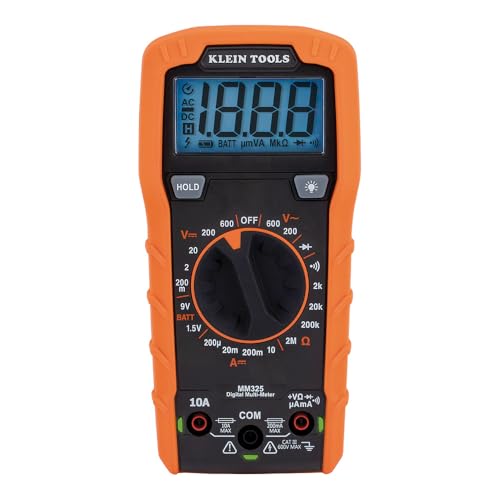 Klein Tools MM325 Digital Manual-Ranging Multimeter
- Measures AC/DC voltage up to 600V, 10A DC…
- LEDs on the meter illuminate to indicate proper…
- LCD shows clear readings in low-light conditions for…
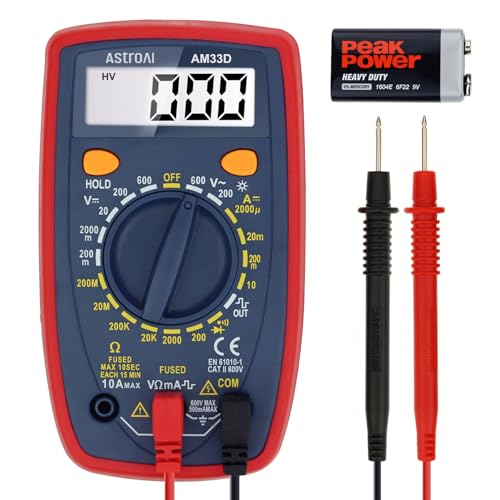 AstroAI Digital Multimeter Tester 2000 Counts with
- Additional Tips - The following incorrect operations may…
- Versatile Digital Multimeter - Accurately measures AC/DC Voltage,…
- Troubleshooting with Accuracy - This Multimeter has a…
 AstroAI Digital Multimeter
- Versatile Digital Multimeter - Accurately measures AC/DC Current,…
- Thoughtful Design - Support Data Hold, Large LCD…
- Suitable For Many Occasions - This Multimeter is…
| Product | Key specs | |
|---|---|---|
| Klein Tools MM325 Digital Manual-Ranging Multimeter | Measures AC/DC voltage up to 600V, 10A DC… LEDs on the meter illuminate to indicate proper… LCD shows clear readings in low-light conditions for… | Check price |
| AstroAI Digital Multimeter Tester 2000 Counts with | Additional Tips - The following incorrect operations may… Versatile Digital Multimeter - Accurately measures AC/DC Voltage,… Troubleshooting with Accuracy - This Multimeter has a… | Check price |
| AstroAI Digital Multimeter | Versatile Digital Multimeter - Accurately measures AC/DC Current,… Thoughtful Design - Support Data Hold, Large LCD… Suitable For Many Occasions - This Multimeter is… | Check price |
 Digital Multimeter Voltmeter Battery Voltage Multi Tester | Accurately Test Full Features: Accurately measures AC/DC voltage,… High Quality & Safety :Our multimeter is designed… 2.7"Large Backlit LCD Display, Data Hold, Easy to… | Check price |
As an Amazon Associate we earn from qualifying purchases at no extra cost to you.
For many household checks, a 2,000- or 4,000-count display is adequate. More counts can help when comparing small changes, but only if the meter’s accuracy and stability support the extra digits.
True RMS matters for some AC measurements
True RMS meters can measure the effective value of many non-sinusoidal AC waveforms more accurately than average-responding meters. This can matter around variable-speed drives, dimmers, and electronic equipment. It is less important for straightforward checks on clean, conventional AC supplies. True RMS does not automatically mean a meter is accurate at every frequency; check its specified frequency range.
CAT ratings are a safety choice, not a voltage shortcut
CAT ratings describe the electrical environment a meter is designed to withstand, including transient surges. CAT III generally relates to distribution wiring and fixed installations; CAT IV covers the origin of an installation, where transient hazards can be greater. A rating must be paired with the appropriate maximum voltage, intact probes, and correct use. Never use a meter or leads with damaged insulation, and do not work on energized circuits unless qualified and equipped to do so.
Comparison: established meter options
The models below illustrate different use cases. Specifications can vary by model revision and market, so confirm the current manufacturer datasheet before buying—especially the safety category, voltage limit, accuracy, and included leads.
| Model | Display / range style | True RMS | Safety rating commonly specified | Best fit |
|---|---|---|---|---|
| Fluke 101 | 6,000 counts; manual ranging | No | CAT III 600 V | Basic electrical checks and compact carry |
| Fluke 117 | 6,000 counts; auto-ranging | Yes | CAT III 600 V | Electricians and household troubleshooting |
| Fluke 87V | 20,000 counts; auto-ranging | Yes | CAT III 1000 V / CAT IV 600 V | Frequent professional and industrial diagnostics |
| AstroAI DM6000AR | 6,000 counts; auto-ranging | Yes | Check current model documentation | Budget-conscious home and hobby use |
These are not interchangeable solely because their displays show similar numbers. The Fluke 101 is a compact manual-ranging option, but it lacks True RMS and auto-ranging. The Fluke 117 adds True RMS and electrician-oriented features. The 87V is designed for more demanding work and costs accordingly. The AstroAI is a lower-cost option; verify its exact safety documentation and supplied accessories before considering mains measurements. Typical market positioning ranges from budget models at roughly $20–$50, mainstream meters around $100–$250, and professional instruments that can exceed $400.
Choose by work pattern, not by maximum specs
| Your situation | Recommended feature set | Why it fits |
|---|---|---|
| Occasional home use, limited budget | Auto-ranging; continuity buzzer; CAT III 600 V from a documented brand | Simple operation and a sensible safety baseline without paying for specialized functions |
| Car maintenance, novice to regular DIY | Strong DC voltage and resistance functions; min/max; replaceable leads; True RMS if also used on household AC | Most routine vehicle diagnostics center on 12 V systems, connections, and component resistance |
| Professional electrical service, frequent use | True RMS; CAT rating matched to site; suitable accuracy; robust construction and accessory support | Repeated use makes reliability, safe accessories, and fit-for-task protection more valuable |
| Panel or service-entrance work | Appropriately rated CAT IV instrument and matching leads; training and safe procedures | Potential transients are more severe; a general-purpose DIY meter is not a substitute |
Auto-ranging, leads, and ownership costs
Auto-ranging selects a measurement range for you, which is convenient for mixed household and automotive tasks. Manual ranging can be quicker when repeatedly checking a known signal and is often found on simpler meters. Neither feature replaces selecting the right function and input jack: putting a lead in the current jack and then measuring voltage can create a short circuit.
Leads often wear before the meter does. Inspect probe tips, strain reliefs, and insulation regularly; replace damaged leads with ones that meet the meter’s rating. Fuses are also consumables, and a meter with inaccessible or nonstandard replacement fuses can be frustrating to maintain. Keep the meter clean and dry, remove batteries before long storage if the manufacturer recommends it, and store probes so their tips cannot puncture the case or other gear.
Avoid measuring resistance or continuity on an energized circuit. Before measuring current, confirm the expected current is within the meter’s input and fuse limits, use the correct jack, and return the lead to the voltage jack afterward. For vehicle work, do not probe airbag circuits or high-voltage hybrid and electric-vehicle systems unless trained and equipped for them.
Bottom line
For a general-purpose household meter, prioritize documented CAT III 600 V protection, auto-ranging, and True RMS if you expect to measure electronic or distorted AC waveforms. For regular automotive work, make DC voltage, continuity, and robust leads the priority. For professional installation or service work, select the safety category and accuracy required by the actual environment—not simply the highest count number—and check the current datasheet for the exact model and accessories.









