
Key takeaways
- Spruce top
- Meranti back & sides
- Rosewood fingerboard & bridge
The best classical guitars are matched to your hand size, playing level, preferred tone, and budget—not simply chosen by brand—so a beginner may be happiest with a full-size Yamaha C40, a smaller player with a 3/4 or 7/8 model, and an advancing guitarist with a solid-top Córdoba C5 or Alhambra 3C.
Our top picks
 Yamaha C40II Classical Guitar
- Spruce top
- Meranti back & sides
- Rosewood fingerboard & bridge
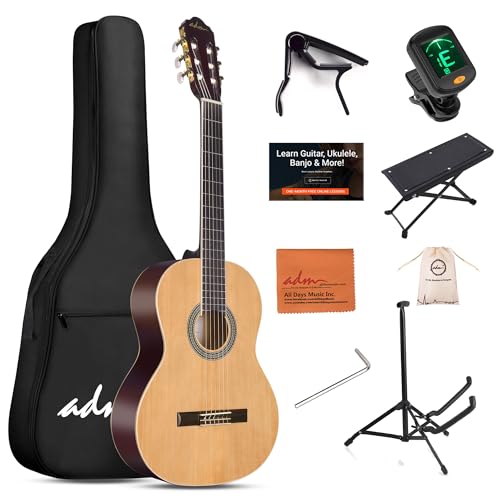 ADM Full Size Classical Nylon Strings Acoustic
- ♫【COMPREHENSIVE BEGINNERS SET WITH FREE LESSONS】This 39 inch…
- ♫【SELECTED MATERIAL】Featured with solid spruce for the top,…
- ♫【SPECIAL DESIGN】Solid spruce top guitar with scalloped X…
 Pyle 36-Inch Beginner Classical Acoustic Guitar Kit
- Start playing with a 36-inch 3/4-size classical guitar,…
- The junior-scale body is easier to hold than…
- Six nylon strings provide a softer playing feel…
| Product | Key specs | |
|---|---|---|
| Yamaha C40II Classical Guitar | Spruce top Meranti back & sides Rosewood fingerboard & bridge | Check price |
| ADM Full Size Classical Nylon Strings Acoustic | ♫【COMPREHENSIVE BEGINNERS SET WITH FREE LESSONS】This 39 inch… ♫【SELECTED MATERIAL】Featured with solid spruce for the top,… ♫【SPECIAL DESIGN】Solid spruce top guitar with scalloped X… | Check price |
| Pyle 36-Inch Beginner Classical Acoustic Guitar Kit | Start playing with a 36-inch 3/4-size classical guitar,… The junior-scale body is easier to hold than… Six nylon strings provide a softer playing feel… | Check price |
 Yamaha Student Series CGS103AII Classical Guitar | Spruce Top Meranti Back & Sides Rosewood Fingerboard & Bridge | Check price |
As an Amazon Associate we earn from qualifying purchases at no extra cost to you.
Quick picks by situation
| Player or situation | Best type or pick | Useful specifications | Typical 2026 market range |
|---|---|---|---|
| First full-size guitar on a tight budget | Yamaha C40 | 650 mm scale, spruce or meranti top depending on version, laminated body | $150–$220 |
| Small adult or older child | 3/4 classical guitar | 580–610 mm scale, narrower reach and reduced body depth | $150–$400 |
| Beginner wanting a warmer, more substantial instrument | Córdoba C5 | 650 mm scale, solid cedar top, laminated rosewood back and sides | $500–$700 |
| Fingerstyle player needing onboard electronics | Córdoba GK Studio | 650 mm scale, thinbody design, Fishman electronics on many versions | $600–$900 |
| Intermediate player prioritizing traditional construction | Alhambra 3C | 650 mm scale, solid cedar or spruce top, Spanish-style construction | $700–$1,100 |
| Advanced player seeking a concert instrument | Solid-wood luthier-built classical guitar | 650–660 mm scale, solid top, back, and sides; individually voiced | $2,000 and upward |
Prices vary by country, finish, included case, electronics, and whether the guitar is sold through a specialist dealer. Treat the ranges as budgeting guidance rather than fixed quotations.
What to choose at each budget
Under $250: a reliable first instrument
At this level, laminated woods are normal and often practical. They are less vulnerable to rapid humidity changes than a fully solid guitar, which matters when a beginner is still learning storage habits. The Yamaha C40 is a sensible reference point: it uses a conventional 650 mm scale and full-size body, has a familiar classical neck, and is widely available for lessons and replacement strings.
Expect a functional rather than highly refined instrument. The most important quality-control issue is setup: excessive action at the 12th fret can make notes difficult to fret, while badly dressed frets can cause buzzing. A modest professional setup may improve playability more than moving from one inexpensive laminated model to another.
$250–$700: the strongest value range
This is where a solid spruce or cedar top becomes accessible. A solid top can provide more complexity, projection, and dynamic response than a comparable laminate, although construction quality and setup still matter more than the label on the soundboard.
The Córdoba C5 is a useful choice for a player who has outgrown a basic student guitar but does not need a concert instrument. Its solid cedar top generally emphasizes a warm, rounded sound that suits lyrical pieces and fingerstyle playing. Choose a spruce-top alternative when you prefer a brighter initial attack and more separation between notes.
For a player who performs through an amplifier, the Córdoba GK Studio addresses a different problem. Its thinner body and electronics can be convenient on stage, but a thinbody design usually produces less unplugged air volume than a conventional-depth classical guitar. It is a performance tool, not automatically an acoustic upgrade.
$700–$1,500: refinement and consistency
An Alhambra 3C or a comparable Spanish-made solid-top guitar can offer more controlled response, cleaner fretwork, and a stronger sense of balance across the strings. At this price, compare individual instruments when possible. Two guitars with the same model name can differ in setup, top stiffness, and tonal response.
Players should also consider whether the instrument has a truss rod. Many traditional classical guitars do not, and their neck relief is managed through construction rather than easy adjustment. That is not a defect, but it makes correct humidity, string tension, and professional setup more important.
Above $1,500: buy the response, not the specification sheet
Higher-priced classical guitars may use solid spruce or cedar throughout, lighter internal bracing, elevated fingerboards, or carefully selected tonewoods. These details can improve projection and nuance, but they do not guarantee that the guitar suits your technique. A concert instrument with a very responsive top may expose uneven right-hand control instead of concealing it.
At this level, a specialist dealer or reputable luthier is more valuable than a longer feature list. Ask for a return period, inspect the instrument under normal lighting, and confirm that repairs and humidity damage are covered by the seller’s policy.
Body size and scale length: fit the guitar to your hands
Most adult classical guitars use a 650 mm scale. This is the distance from the nut to the saddle, not the total guitar length. A 660 mm scale adds only 10 mm overall, but the extra reach can be noticeable in first-position stretches and barre chords. A 630 mm or 640 mm short-scale guitar reduces left-hand extension while retaining a more adult-like body than many 3/4 models.
Use these guidelines as a starting point:
- Small adult hands or shoulder discomfort: try a 630–640 mm scale before automatically choosing a 3/4 instrument.
- Children roughly 8–11 years old: a 1/2 or 3/4 guitar may fit better, but arm length and seated posture are more useful than age alone.
- Average adult reach: a 650 mm full-size guitar is the normal baseline.
- Long reach and strong projection preference: a 660 mm scale can offer slightly more tension and headroom, provided the neck feels comfortable.
For a practical fit test, sit with the waist of the guitar resting against your leg, keep the neck angled slightly upward, and place the left thumb behind the neck without squeezing. If the first-position index finger cannot comfortably reach the first fret while the other fingers remain relaxed, try a shorter scale or narrower neck. A smaller body can help, but a narrow waist and reduced depth may matter just as much.
Cedar, spruce, and other tonewood choices
| Top wood or construction | Typical tonal impression | Best suited to | Ownership consideration |
|---|---|---|---|
| Solid cedar | Warm, immediate, rounded attack | Beginners, lyrical fingerstyle, softer touch | Can sound compressed if played very forcefully |
| Solid spruce | Clearer attack, separation, headroom | Players developing stronger dynamics and articulation | May sound somewhat bright when new |
| Laminated top | Consistent, often less complex, adequately bright or warm depending on design | Students, travel, variable climates, limited budgets | Usually more resistant to minor humidity swings |
| Rosewood back and sides | Fuller bass and reflective, sustained response | Players wanting richness and projection | Often adds weight and cost |
| Mahogany or similar hardwood back and sides | More focused mids and direct response | Rhythmic playing and clear accompaniment | Can be lighter and less expensive than rosewood |
The soundboard has more influence than the back and sides, so do not choose a guitar solely because it uses rosewood. Cedar is often forgiving for a new player, while spruce can reward a controlled attack as technique develops. Tonewood descriptions are tendencies, not guarantees: bracing, finish thickness, scale length, and setup can outweigh species.
Decision matrix: match the guitar to your use
- Practicing three or four times a week at home: prioritize comfortable action, stable tuning, and a conventional 650 mm student model over expensive exotic woods.
- Daily practice with a teacher: spend enough for a solid-top instrument if your budget allows; its clearer response can make dynamic and articulation work easier to hear.
- Frequent travel: choose a laminated or hybrid construction, a padded gig bag, and a model whose replacement parts and strings are easy to find.
- Small room or apartment: a conventional classical guitar is already quieter than many steel-string designs; thinbody electronics are useful mainly when amplification is required.
- Recording or ensemble playing: prioritize note separation and intonation. A spruce-top guitar or a well-balanced cedar model may sit more clearly in a mix than a bass-heavy instrument.
- Buying for a child who is still growing: do not buy an oversized 650 mm guitar solely to avoid replacing it. Poor fit can discourage practice; a correctly sized instrument can later be sold or handed down.
Setup, strings, and durability realities
Classical guitars use nylon or composite trebles and wound basses. They stretch during the first several days, so frequent tuning after a string change is normal. Replace the full set when the basses become dull, the trebles lose intonation, or tuning stability remains poor after stretching. For a regular player, a fresh set every two to four months is a reasonable starting schedule; heavy practice may shorten that interval.
Action is measured at the 12th fret. A common comfortable starting range is approximately 3.0–4.0 mm on the sixth string and 2.5–3.5 mm on the first string, though playing style and instrument design change the ideal figures. Do not sand the saddle immediately to lower action: first check neck relief, saddle seating, nut height, and whether the bridge is lifting. A repair technician should handle structural adjustments.
Solid wood is most vulnerable to rapid humidity changes. Keep a solid-top guitar away from radiators, sunny windows, car trunks, and air-conditioning vents. In very dry conditions, a case humidifier may help, but over-humidifying can also cause swelling and high action. Wipe fingerprints from the strings and finish with a soft dry cloth, and use only products labeled for guitar finishes.
Final buying checklist
- Confirm the scale length and body dimensions, not just “full size” or “student.”
- Check that every note rings clearly up the neck without persistent buzzing.
- Look along the bridge edges for lifting and inspect the top for cracks or unusual bulging.
- Compare cedar and spruce by playing softly and forcefully, not only by listening to open strings.
- Budget for a padded case, tuner, footstool or support, spare strings, and a possible setup.
- For a first purchase, prioritize comfortable fit and dependable construction over decorative appointments.
For most learners, the best classical guitar is a correctly fitted 650 mm or short-scale instrument with comfortable action and a solid reputation for quality control. Start with the Yamaha C40 when cost is the deciding factor, move to the Córdoba C5 or Alhambra 3C for a meaningful solid-top upgrade, and choose a thinbody electric-acoustic model only when amplification and stage ergonomics are central to the decision.









